
A Markush claim recites a closed group of alternatives inside a single limitation, conventionally written as a compound selected from the group consisting of A, B, and C. That one limitation covers a family of related compounds without a separate claim for each, which is why the construct has survived since the Patent Office sanctioned the format in Ex parte Markush, decided in 1924.
Markush claim limitations buy three things worth having:
- One limitation reaches many species at a single claim fee.
- The USPTO and the courts treat the group as one claim element rather than a list of independent alternatives.
- Genus-level protection attaches at the earliest filing date, before every commercially viable species has been made.
Five constraints come with them:
- The group is closed to unrecited alternatives under a very strong presumption, though how far that closure reaches beyond the element itself depends on the surrounding claim language.
- The doctrine of equivalents remains available in theory, though asserting it means arguing against the all-elements rule, a thin body of chemical equivalence law, and usually your own prosecution record.
- A single prior art species can anticipate the entire group.
- Enablement and written description each cap achievable breadth, and they fail in different ways.
- Structurally diverse groups draw improper Markush rejections and election-of-species requirements, which cascade into divisional cost.
The strength and the vulnerability are the same feature. Practitioners who do well here stop chasing one perfect genus claim and build claim ladders instead, with the Markush parent as one tier among several.
Key Takeaways
- A Markush limitation is one claim element, not many. An accused compound meets it by containing a recited member, not by resembling one.
- Closure comes from “consisting of,” which raises a very strong presumption that the element excludes unrecited alternatives, later called an exceptionally strong one. It does not by itself exclude additional components elsewhere in the composition.
- Two prongs decide propriety, not size. Members must share a single structural similarity and a common use, and outside a recognized art-accepted class they qualify by sharing a substantial structural feature and a common use that flows from it.
- One prior art species can end the whole limitation, because a species anticipates a genus. In In re Gosteli, twenty-one recited species turned on two disclosed in one reference.
- Enablement and written description fail differently. Amgen v. Sanofi requires enablement of the full claimed scope, and the USPTO reads it as addressing a functionally defined genus rather than an enumerated structural group. Possession is a separate question.
- Equivalents survive in theory only. The Federal Circuit has called the chemical equivalence case law sparse and confusing, and the all-elements rule usually finishes the argument.
- The durable answer is architecture: a ladder of parent, subgenus, species, and method-of-use claims rather than a broader parent.
Markush Structure at a Glance: What These Claims Protect and Where Protection Stops
A Markush structure trades certainty for reach. You get a boundary that competitors cannot argue past, and in exchange you get a boundary they can read, measure, and step around. Everything below follows from that exchange.
The Markush Trade-Off: Read this as a ledger. Each row pairs something the closed set buys with the specific cost attached to it and the section that addresses that cost.
| What the closed set gives you | What it costs you | Where addressed |
| One limitation covering an entire enumerated family at a single claim fee | Every member must clear the same structural-similarity and common-use test, or the whole grouping draws a rejection. | Section 1.3 |
| Genus-level protection at the earliest filing date | Enablement must reach the full claimed scope, and written description must show possession of the genus rather than of three examples. | Section 2.4 |
| Treatment as a single claim element, which simplifies infringement mapping | An accused compound must fall inside the recited group to meet that element; one substituent outside the list and the element is unmet. | Sections 1.1 and 4.1 |
| A closed boundary competitors cannot argue past | The same boundary is a published map of where to design around. | Section 4.2 |
| Broad early coverage before commercial candidates emerge | Twenty-one recited species were exposed by two disclosed in the art in In re Gosteli; a group is only as strong as its most anticipated member. | Section 2.3 |
| One application instead of many | Structural diversity draws election-of-species requirements and pushes non-elected subject matter into divisionals. | Section 2.1 |
By the end you should be able to:
- Audit a proposed group against the USPTO’s two-prong test before an examiner does.
- Choose transitional language deliberately, knowing what closure does and does not reach.
- Tell an enablement vulnerability from a written description vulnerability in a granted claim.
- Build a four-tier claim ladder in which no single invalidity ruling ends the family.
- Decide in an afternoon whether a competitor analog sits inside or outside a closed group.
None of that is actionable without the structural mechanics of Markush claim limitations, which is where the analysis has to start.
The Structural DNA of Markush Claim Limitations
What Makes a Markush Limitation Legally Distinct From Conventional Claim Language
One idea governs everything downstream: a Markush structure is a single claim element, not many. A conventional limitation recites a thing. A Markush limitation recites a closed set of things and asks whether the accused subject matter contains one of them. The set is a Markush group, alternatives enumerated because no true generic language describes them collectively.
The single-element point is where practitioners still reason incorrectly. A twelve-member group looks like twelve chances at infringement, and it is not. An accused product does not infringe by resembling a member; it infringes by containing one. Elements are met or unmet, and this one is met only by a compound on the list.
Two consequences follow. A group cannot be partially infringed, and it cannot be partially valid the way a claim set can. Both are arguments for the tiers below it.
| Same limitation, two formats | Claim fee consequence | Construction consequence |
| Markush group of twelve alternatives | One claim | One element, invalidated as a unit |
| Twelve separate dependent claims | Twelve claims, with fees escalating past the base allowance | Twelve elements, each survives the invalidation of its siblings |
The table shows why the Markush format is cheaper and more fragile than the alternative it replaces.
Why “Consisting Of” Acts as Both Shield and Sword
Closure is the feature practitioners most often misdescribe, and it answers two separate questions. In Multilayer Stretch Cling Film Holdings, Inc. v. Berry Plastics Corp. (Fed. Cir. 2016), the Federal Circuit held that setting off a claim element with “consisting of” creates a very strong presumption that the element excludes anything unrecited. Overcoming it requires the specification and prosecution history to manifest a different meaning unmistakably. The court later described that presumption as an exceptionally strong one.
That settles the first question: closed to unrecited alternatives. It does not settle the second. In Amgen Inc. v. Amneal Pharmaceuticals LLC (Fed. Cir. 2020), the court reversed a construction that read two Markush groups as excluding additional excipients from the formulation altogether. Where a composition claim recites “comprising” in the preamble and “at least one binder selected from the group consisting of” in the body, the claim requires a listed binder and tolerates unlisted ones elsewhere. Same phrase, different scope.
Transitional Phrases in Markush Context: Use this to choose phrasing deliberately: the second row is the one most often chosen by accident.
| Phrase | What it admits | What it excludes | Typical scope outcome | When to use it |
| “consisting of” (conventional form) | Only the recited alternatives | Unrecited alternatives, under a very strong presumption | Predictable, narrow, examiner-preferred | Default for any enumerated group |
| “consisting of” inside a “comprising” claim, with “at least one” | A recited alternative, plus unrecited components elsewhere in the composition | Compositions containing no recited alternative | Broader than most readers assume | Formulation claims where extra excipients are foreseeable |
| “consisting of … and mixtures thereof” | Blends of the recited members | Unrecited members | Preserves combination coverage without opening the list | Any group whose members will be used together |
| “consisting essentially of” | Recited alternatives plus material not affecting the basic and novel properties | Material that changes those properties | Ambiguous, invites attack on what those properties are | Rarely, and only with those properties expressly defined |
| “comprising” inside the group itself | Everything | Nothing | Open-ended alternatives and a likely indefiniteness rejection | Not inside a Markush group |
Two cases mark where closure stops. Shire Development, LLC v. Watson Pharmaceuticals, Inc. (Fed. Cir. 2017) found a closed outer-matrix limitation defeated by an unrecited excipient structurally and functionally related to the claimed formulation, even though the specification had disclosed that excipient. Norian Corp. v. Stryker Corp. (Fed. Cir. 2004) found a kit claim reciting “consisting of” still infringed by a kit containing a spatula, which had nothing to do with the invention. Relatedness to the invention is the line, against the backdrop of 35 U.S.C. § 112.
Structural Similarity and Common Utility: The Two Tests Every Markush Group Must Pass
Before any of the above matters, the Markush structure has to be one the USPTO will accept, and two prongs decide that. Under MPEP § 2117, a claim contains an improper Markush grouping if the members fail to share a single structural similarity or fail to share a common use. Where the alternatives do not belong to a recognized art-accepted class, they satisfy the standard by sharing a substantial structural feature together with a common use that flows from that feature.
The phrase that does the work is “flows from”. A shared scaffold plus a utility the members happen to have in common is not enough; the utility has to be attributable to the shared feature. Examiners assess this on the claimed subject matter as a whole rather than on the variable substituent alone. The MPEP, following In re Harnisch, directs that compounds be considered as wholes rather than broken down into elements or components, a practice that occasionally rescues a group that looks incoherent when only the R group is examined.
Run every proposed member through the following before filing.
- Does this member share the substantial structural feature recited in the core formula, or only a family resemblance to it?
- Does the shared utility flow from that feature, or do the members simply happen to work?
- Would an examiner recognize this class without expert testimony, or does the class exist only in our specification?
- Is this member enabled by a working example, a prophetic example, or nothing?
- Does the specification describe this member specifically enough to support possession of the genus, separately from enabling it?
- Does adding this member expand the prior art surface more than it expands commercial coverage?
- If this member alone were anticipated tomorrow, what survives?
A group that passes all seven still has to survive examination, which is a different problem with a different set of failure modes.
USPTO Prosecution Hurdles Specific to Markush Groups
How Markush Limitations Trigger Restriction Requirements and Election Demands
An office action addressing a broad Markush structure usually contains two separate actions, and confusing them costs rights. The first is an improper Markush grouping rejection under MPEP § 2117, which is a rejection on the merits and appealable to the PTAB. The second is an election-of-species requirement under MPEP § 803.02, grounded in 37 C.F.R. § 1.141 and § 1.146, which is reviewable by petition rather than appeal.
Two documents, two forums, two deadlines. The petition right survives only if the requirement was properly traversed, since a petition will not be considered where reconsideration was never requested, and it must be filed no later than the notice of appeal. That is where families are quietly damaged before anyone reaches a decision-maker.
Cost Cascade of a Broad Markush Group: Directional estimates drawn from prosecution experience rather than published figures. Compare the coverage column against the burden column; the two stop tracking each other well before the largest group.
| Group size | Likely examination outcome | Divisionals implied | Relative added burden | Coverage actually retained |
| ~10 closely related species | Election of species likely, grouping rejection unlikely | None to one | Baseline | Nearly all, if the elected species is chosen well |
| ~40 species across two substituent positions | Election plus a probable grouping rejection on the outlying members | One to three | Multiples of baseline in prosecution time and filing fees | Most, but only across several applications with staggered terms |
| ~120 species spanning structurally distinct classes | Grouping rejection near certain, election to a single species | Several, with some abandoned on cost | Substantially higher, with the increase concentrated in attorney time rather than fees | Considerably less than the claim recites, since non-elected matter survives only where it was actually filed |
How Examiners Build Indefiniteness Rejections Under 35 U.S.C. § 112(b)
Indefiniteness lives in § 112(b) and has nothing to do with enablement, which is a § 112(a) problem addressed later in this section. The question under Nautilus, Inc. v. Biosig Instruments, Inc. (2014) is whether the claim, read in light of the specification and prosecution history, informs a skilled artisan about the scope of the invention with reasonable certainty. Applied to a group, that becomes a question about who is in it.
Groups written as open fail on both fronts at once. A skilled artisan cannot envision the membership, so the metes and bounds are unascertainable, and the grouping is improper besides. Vague functional descriptors inside a group create the same vulnerability, which resurfaces years later at claim construction when the accused infringer argues the boundary was never fixed.
| Formulation that drew the rejection | Amended formulation | Scope surrendered and preserved |
| A substituent “such as methyl, ethyl, or the like” | A substituent selected from the group consisting of methyl, ethyl, and n-propyl, with broader alkyl coverage moved to a dependent claim | Surrendered: unnamed homologs in the independent claim. Preserved: the same homologs at the dependent tier. |
| A member defined as “a pharmaceutically acceptable stabilizer” | An enumerated list of the four stabilizers exemplified in the specification | Surrendered: unexemplified stabilizers. Preserved: everything the specification actually supported. |
| R² defined by reference to R¹ where R¹ is itself open | Both variables defined by closed enumeration | Surrendered: recursive breadth that was never enabled. Preserved: all combinations of the enumerated values. |
| Members distinguished by a property range with no stated method | The same range with the measurement method recited | Surrendered: nothing of substance. Preserved: the full range, now ascertainable. |
Each pair shows an amendment that resolved the rejection without conceding commercially meaningful scope.
How Prior Art Attacks a Markush Group Through a Single Species
One reference disclosing one member can take down the entire limitation. MPEP § 2131.02 states the rule: a generic claim cannot issue where the prior art discloses a species falling inside the claimed genus. In In re Gosteli (Fed. Cir. 1989), the applicant claimed twenty-one species of bicyclic thia-aza compounds in Markush form; one reference disclosed two of them, and the parties agreed those two would anticipate unless the applicant’s foreign priority date held. Twenty-one recited, two disclosed, everything riding on a priority claim.
The reference need not lay out the combination expressly. Under the standard the MPEP draws from Kennametal, Inc. v. Ingersoll Cutting Tool Co. (Fed. Cir. 2015), a disclosure anticipates where a skilled reader would at once envisage the claimed arrangement.
Obviousness works differently, and the difference is where practitioner writing usually goes wrong. Breadth is not itself evidence of obviousness; the size of a genus alone does not carry the rejection. Breadth increases exposure along three separate paths:
- More members means a higher probability that at least one falls inside a range or class some reference teaches.
- A group built by permuting substituents across a scaffold reads on the record like routine optimization rather than discovery.
- Unexpected results, the standard rebuttal, must be commensurate in scope with the claim, and data on three members rarely carries a group of forty.
In practice the third path is the one that most often decides the question, and it appears least often in practitioner discussion. Where the parent is under this kind of pressure, the subgenus and species tiers are what keep the family alive.
How Enablement Limits Markush Breadth After Amgen v. Sanofi
Enablement caps how much a Markush structure can actually claim, and the 2023 decision that reset expectations is narrower than its reputation. In Amgen Inc. v. Sanofi, the Supreme Court held unanimously that a specification must enable the full scope of what is claimed. Amgen had claimed a genus of antibodies defined by what they do rather than what they are, disclosed twenty-six by sequence, and offered a roadmap for finding the rest. The Court found the roadmap asked skilled artisans to repeat the inventors’ own trial and error.
The Wands factors still structure the analysis, and the USPTO has confirmed that its personnel continue to apply them after Amgen to decide whether the experimentation needed to reach the full claimed scope is reasonable. The question for a compound group is whether reaching every member would require undue experimentation. Here is the part that gets lost: Amgen concerned a functional genus, a class defined by binding and blocking behavior rather than by structure, and the agency’s own guidance reads the decision that way. An enumerated group of named analogs, each with data, occupies a different posture entirely. Post-Amgen pressure concentrates on variable substituents written as open categories. Practitioners who read the case as a blanket condemnation of Markush claiming end up surrendering scope they did not need to.
Written description is a separate requirement with a separate failure mode. Ariad Pharmaceuticals, Inc. v. Eli Lilly & Co. (Fed. Cir. 2010) (en banc) confirmed as much: § 112(a) imposes written description and enablement as separate requirements under different standards, and the disclosure must show that the inventor possessed the claimed genus as of the filing date. A group can be fully enabled and still fail it.
Enablement vs. Written Description: Two requirements under the same statute, asking different questions and demanding different things from the specification.
| Factor | Enablement | Written Description |
| The question | Can a skilled artisan make and use the full claimed scope without undue experimentation? | Did the inventor possess the full claimed genus at filing? |
| Failure mode | The specification supplies a trial-and-error roadmap rather than a route to the whole class. | The specification describes a few species without identifying what the genus shares. |
| What the specification must contain | Working and prophetic examples spanning the structural range, plus a rationale for consistent behavior across it. | Representative species across the group, or a structure-function correlation identifying the common feature. |
| Governing authority | 35 U.S.C. § 112(a); Amgen. | 35 U.S.C. § 112(a); Ariad. |
Clearing both requirements gets the claim granted, which is a different achievement from making the granted claim worth something.
Advanced Drafting Strategies That Fortify a Markush Group
Architecting Claim Ladders That Survive Examination and Litigation
Every threat described so far attacks a single tier, which is the argument for having more than one. A claim ladder distributes those failure modes so that no single ruling reaches the whole family.
| Tier | Recites | Survives what the tier above does not |
| Markush parent | The full enumerated group | Nothing, broadest and first to fall |
| Subgenus | A structurally coherent subset with its own shared feature | Anticipation of a member outside the subset, and a narrower enablement burden |
| Species | One compound, usually the commercial candidate | Improper-grouping and full-scope enablement attacks entirely |
| Method of use | The species or subgenus in a recited indication | Composition-of-matter invalidity, and it reaches a different infringer |
Negative limitations deserve more care than they usually get. Carving out a prior art species is cleaner than narrowing the positive recitation when the excluded compound is discrete and identifiable, because the carve-out leaves the rest of the group untouched. The carve-out becomes vulnerable under § 112 when the exclusion is framed functionally, or when the specification never described the excluded subject matter, leaving no written description support.
Managing Prosecution History to Protect Markush Scope
Every word added to a group during prosecution becomes an argument someone else makes later, so the operative question is when argument alone can carry the response. Amendments create estoppel that competitors and courts can use to confine infringement scope, and the estoppel outlives the examiner who prompted it.
Argument alone is realistic when the rejection rests on a reference read too broadly, when the group already recites the distinguishing feature, when the record can be clarified without amending the claim, or when the examiner’s concern is classification rather than patentability. Amendment is forced when a recited member is squarely disclosed, when the group fails the two-prong test on its face, or when an indefiniteness objection identifies a term with no ascertainable bounds.
When amendment is unavoidable, narrow by removing the specific member rather than by adding a qualifier to the group. A removal estops as to that member; a qualifier estops as to all of them. Reviewing an inherited prosecution record for this kind of exposure is standard scope in a patent portfolio analysis.
Drafting Subgenus Claims That Hold Value When the Parent Falls
A subgenus tier converts an invalidated parent from a catastrophe into a setback, provided it was drafted as its own invention rather than a smaller copy. A patentable subgenus needs a shared structural feature distinct from the parent’s and broader than any single species, plus a utility the specification ties to that feature. In our experience, pharmaceutical portfolios run these ladders across families and jurisdictions, staggering filing dates so the narrow tiers outlive the broad ones.
Overlapping tiers raise obviousness-type double patenting, which is the trap the format invites. A terminal disclaimer resolves it and costs two things. The first is term, since the disclaimed patent expires with its reference patent. The second is flexibility, because the rule requires the patent to remain commonly owned with the patent that formed the basis of the double patenting to remain enforceable, which constrains any later decision to divest or exclusively license one family member without the others.
That second cost is the one portfolio owners discover late, usually in the middle of a transaction. Judicial treatment of Markush claim limitations is where all of these drafting decisions get graded.
Litigation Realities and Portfolio-Level Implications of Markush Claims
How Courts Construe Markush Limitations in Infringement Analysis
Markush claim limitations reach litigation as construction questions first. If you are assessing a granted claim rather than drafting one, the cases below are where the analysis starts. Courts treat these groups as closed by default, and the arguments that shift that default come from the surrounding claim language and the specification rather than from the group itself.
Four decisions and what each one teaches: Read the last column as drafting instructions; each was available to the patentee before filing.
| Case | Claim language at issue | Holding | Drafting lesson |
| Multilayer Stretch Cling Film v. Berry Plastics (Fed. Cir. 2016) | Five inner layers, each selected from a group consisting of four resins | Closed to unrecited resins under a very strong presumption, but open to blends of the four, because the specification unmistakably supported blends | The specification decides the blends question, not the transitional phrase. Say what you mean about mixtures. |
| Amgen v. Amneal (Fed. Cir. 2020) | “Comprising … at least one binder selected from the group consisting of …” | Requires a listed binder but does not exclude additional unlisted binders elsewhere in the composition | “At least one” plus a “comprising” preamble widens a group most readers would call closed. |
| Shire Development v. Watson (Fed. Cir. 2017) | Outer matrix consisting of recited excipients | An unrecited excipient related structurally and functionally to the invention defeated the limitation, despite specification disclosure | Disclosure in the specification does not rescue a member left out of the group. Recite it or lose it. |
| Norian v. Stryker (Fed. Cir. 2004) | Kit consisting of recited chemicals | An additional spatula did not defeat infringement, being unrelated to the claimed invention | Closure reaches the invention, not everything in the box. |
Equivalents are available in theory and difficult in practice. No decision establishes a categorical bar, and vitiation is properly a conclusion reached after an insubstantial-differences analysis rather than a shortcut around one. What defeats most assertions is the accumulation: the all-elements rule of Warner-Jenkinson Co. v. Hilton Davis Chemical Co. (1997), under which every limitation must satisfy an equivalence test; chemical equivalence case law that the Federal Circuit in Mylan Institutional LLC v. Aurobindo Pharma Ltd. called sparse and confusing; and a record in which the group was narrowed to secure allowance. That court also found the function-way-result test poorly suited to chemical subject matter. Plan as though equivalents will not be available.
How Competitors Design Around a Markush Group
A competitor evaluating your claim reads it as a list of what to avoid, and the list is short enough to work through systematically. The whole exercise, hypothetically, runs like this:
A claim recites a scaffold in which R¹ is selected from the group consisting of methyl, ethyl, and n-propyl. A competitor synthesizes the isopropyl analog. Isopropyl is none of the three, so the element is unmet and the literal infringement analysis ends. It does not matter that the compound has the same activity, the same mechanism, and the same commercial application. The list was the boundary and isopropyl was not on it.
Continuations are usually the only inexpensive fix, and only while something in the family is pending, since the benefit of the earlier filing date attaches only where the later application is filed before the parent is patented or abandoned. Filing new limitations that reach predicted analogs costs a fraction of what the same coverage costs after issuance, when it is usually unavailable at any price. Where an analog has already appeared and exposure needs assessing rather than preventing, that is a patent defense question on a different timeline.
How to Audit and Coordinate a Markush Portfolio
If you inherited a family rather than drafted one, start here. The checklist below is built to be copied into a working document. Run it against the three broadest granted groups first, since those carry the most exposure and the least fallback.
- Does every member of the granted group share a substantial structural feature, and does the claimed use flow from that feature?
- Is each member supported by a working or prophetic example, or does the specification rely on a general synthetic route?
- Does the specification describe representative species across the structural range, or cluster around one region of it?
- Does the surrounding claim language, including the preamble transition and any “at least one” phrasing, make this group narrower or broader than the file summary assumes?
- What was amended into or out of this group during prosecution, and what does that record estop?
- Which single prior art species, if located, would take the whole group down?
- Does a subgenus or species claim exist that would survive that reference?
- Do the foreign counterparts recite the same group, and does anything argued in one office contradict a position taken in another?
Item eight deserves a caution rather than a treatment. Unity of invention under the PCT and at the EPO is a distinct doctrine from U.S. improper-Markush practice, though the regimes interact; the MPEP’s Markush guidance works through an example drawn from the PCT guidelines. Arguments made in one office can surface in another’s file or in later litigation. Take local advice on each jurisdiction rather than assuming the U.S. analysis transfers.
Those audits raise the same handful of questions in nearly every engagement.
Common Questions About Markush Claim Limitations
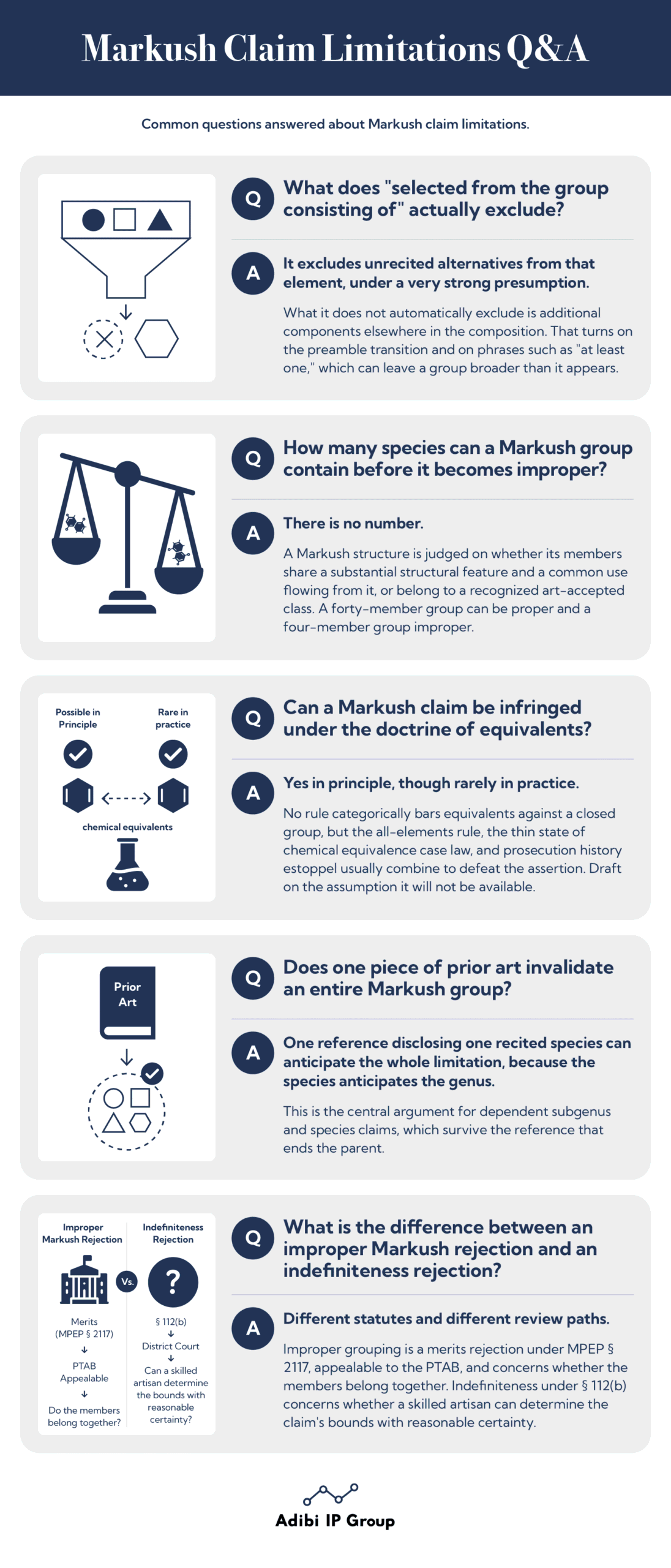
What does “selected from the group consisting of” actually exclude?
It excludes unrecited alternatives from that element, under a very strong presumption. What it does not automatically exclude is additional components elsewhere in the composition. That turns on the preamble transition and on phrases such as “at least one,” which can leave a group broader than it appears.
How many species can a Markush group contain before it becomes improper?
There is no number. A Markush structure is judged on whether its members share a substantial structural feature and a common use flowing from it, or belong to a recognized art-accepted class. A forty-member group can be proper and a four-member group improper.
Can a Markush claim be infringed under the doctrine of equivalents?
Yes in principle, though rarely in practice. No rule categorically bars equivalents against a closed group, but the all-elements rule, the thin state of chemical equivalence case law, and prosecution history estoppel usually combine to defeat the assertion. Draft on the assumption it will not be available.
Does one piece of prior art invalidate an entire Markush group?
One reference disclosing one recited species can anticipate the whole limitation, because the species anticipates the genus. This is the central argument for dependent subgenus and species claims, which survive the reference that ends the parent.
What is the difference between an improper Markush rejection and an indefiniteness rejection?
Different statutes and different review paths. Improper grouping is a merits rejection under MPEP § 2117, appealable to the PTAB, and concerns whether the members belong together. Indefiniteness under § 112(b) concerns whether a skilled artisan can determine the claim’s bounds with reasonable certainty.
Strengthening Your Markush Claims
The closed set is not a flaw to engineer around. It is the mechanism that makes a Markush structure work and the same mechanism that makes it a single point of failure. The response is architecture rather than breadth.
Three things are worth starting today:
- Run the seven-question membership audit against the group in whichever application is closest to filing.
- Pull the three broadest granted Markush limitations in the portfolio and test each against enablement vs written description exposure.
- For the single most commercially important group, identify which one prior art species would end it, then confirm whether a subgenus claim exists below it.
Where those questions surface problems, Adibi IP Group conducts Markush claim audits and portfolio gap analyses for chemical and pharmaceutical families, including inherited portfolios of uncertain provenance. Our chemical patent attorneys work from the granted claims and the prosecution record rather than from the docket summary. To discuss a specific family, contact us.
A century of practice has not made the closed group safer, only better understood. It rewards the drafter who writes the list knowing what sits outside it, and who has already built the tier that survives the day the list fails.
This article is general information about United States patent practice and is not legal advice. It does not create an attorney-client relationship. Patent matters turn on specific facts, and you should consult qualified counsel about your own applications and portfolio.