A U.S. utility patent’s enforceable life runs twenty years from its earliest effective non-provisional U.S. filing date. Five variables then move that date. Two add time, two subtract it, and one can end the patent regardless of the other four. Of the five, the terminal disclaimer effect on patent term is the largest single adjustment in most portfolios, and the only one that cannot be reversed after the patent issues.
Below is a table of the five variables that set a U.S. patent’s term and which of them can be reversed.
| Variable | Direction | Governing authority | Typical magnitude | Reversible? |
| Patent Term Adjustment (PTA) | Adds | 35 U.S.C. § 154(b) | Days to several years | Only within the challenge window after grant |
| Patent Term Extension (PTE) | Adds | 35 U.S.C. § 156 | Up to 5 years | No — the 60-day filing window has no cure |
| Applicant delay | Subtracts | 37 C.F.R. § 1.704 | 30 days per month of delay | Partially, and only before issuance |
| Terminal disclaimer | Caps | 35 U.S.C. §§ 253, 154(b)(2)(B) | All PTA beyond the disclaimed date | No, once the patent has issued |
| Maintenance fees | Terminates if unpaid | 35 U.S.C. § 41(b); 37 C.F.R. § 1.362 | Total loss — fees due by 3.5, 7.5, 11.5 years, plus a 6-month surcharge grace period | Limited, by petition |
Key Takeaways
- Among factors that impact patent term, only the terminal disclaimer cannot be undone. Withdrawable by petition before issuance; after issuance, it stands. It also ties enforceability to continued common ownership with the reference patent. Identify which patents in your portfolio carry terminal disclaimers, calculate what each one cost, and brief a business team on effective exclusivity using numbers you can defend.
- The challenge window is short and sequential. Two months from grant, extendable to seven — and the 180-day civil action runs from the decision on that request, so no request means no review at all. Audit a PTA determination before the challenge window closes.
- Adjustment dies at the disclaimed date. Extension survives it. Assume both are lost and you undervalue the asset; assume both survive and you overvalue it.
- Extension has one deadline and no cure: sixty days from approval, one patent per product, five years maximum, fourteen years post-approval.
- Most of this is decided at the desk, years early, by extensions of time, IDS timing, and the choice among continuation, divisional, and RCE practice. Recognize prosecution habits that leak patent term, and quantify the cost.
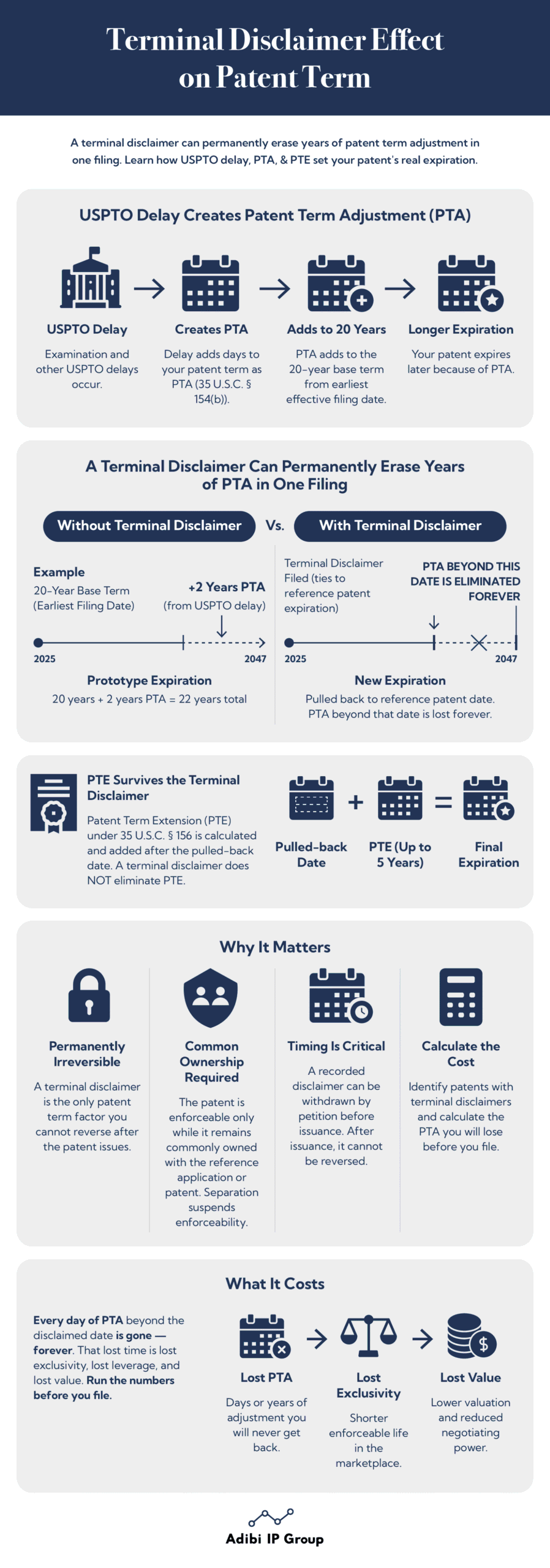
Terminal Disclaimer Effect on Patent Term: The One Adjustment You Cannot Reverse
What a Terminal Disclaimer Does to a Patent’s Expiration Date
A terminal disclaimer is a filing under 35 U.S.C. § 253 and 37 C.F.R. § 1.321 in which the patent owner surrenders the portion of term extending beyond a specified reference patent’s expiration date. The mechanical result is simple. The disclaimed patent now expires when the reference patent does, whatever the face of the patent would otherwise indicate.
There is a second condition, and it is the one that surprises people. Rule 1.321(c)(3) requires every such disclaimer to state that the patent is enforceable only for and during the period it remains commonly owned with the application or patent that formed the basis for the double patenting rejection. If ownership later separates — through a divestiture, a spin-out, a partial portfolio sale — enforceability of the disclaimed patent is suspended until common ownership is restored.
That condition does not appear on the face of the patent as a date. It appears in the recorded disclaimer, which means a term audit that only reads expiration dates will miss the condition entirely. A buyer acquiring part of a family may be acquiring a patent it cannot enforce. The seller frequently does not know.
Timing governs everything else here. A recorded disclaimer can be withdrawn by petition under 37 C.F.R. § 1.182 before the application issues. Once the patent issues, the Office will not nullify it. For background on the instrument itself, see what a terminal disclaimer is and when to file one.
Why a Terminal Disclaimer Erases PTA but Leaves PTE Intact
Section 154(b)(2)(B), headed “Disclaimed term,” provides that no patent the term of which has been disclaimed beyond a specified date may be adjusted beyond the date specified in the disclaimer. The forfeiture is automatic and total as to any adjustment past that date. Nobody has to decide it. It simply happens.
Patent term extension arises under a different statute, and Congress wrote no equivalent limitation into it. The Federal Circuit confirmed the consequence in Merck & Co. v. Hi-Tech Pharmacal Co., 482 F.3d 1317, 82 USPQ2d 1203 (Fed. Cir. 2007), holding that a Hatch-Waxman extension may be applied to a patent subject to a terminal disclaimer filed to overcome double patenting. Section 156 is unambiguous, the court reasoned, and serves a purpose that does not conflict with § 253. The Manual of Patent Examining Procedure adopts the point directly at § 2751, under the heading “Terminally Disclaimed Patents Are Eligible.”
The sequence matters as much as the rule, and it runs in this order:
- The terminal disclaimer pulls the expiration date back to the reference patent’s date.
- Every day of PTA beyond that date is extinguished.
- PTE is then calculated and added on top of the pulled-back date.
In Merck, the extension ran from the effective date of the terminal disclaimer. A related decision, Novartis AG v. Ezra Ventures LLC, 909 F.3d 1367, 1375 (Fed. Cir. 2018), held that a § 156 extension remains valid so long as the patent is otherwise valid without that extension — so double patenting cannot negate an extension where the reference could not have reached the unextended term.
For a regulated product, this asymmetry separates two very different valuations. The same filing that destroys two years of adjustment may leave a five-year extension untouched. Assume both are lost and you will undervalue the asset. Assume both survive and you will overvalue it. Both errors show up in diligence.
PTA vs. PTE Under a Terminal Disclaimer:
| Issue / Factor | Patent Term Adjustment | Patent Term Extension |
| Governing statute | 35 U.S.C. § 154(b) | 35 U.S.C. § 156 |
| What it compensates | USPTO examination delay | FDA regulatory review period |
| How it is calculated | Statutory delay categories, less applicant delay | Half the testing phase plus the full approval phase |
| Deadline | Reconsideration request after grant | 60 days from approval |
| Survives a terminal disclaimer? | No | Yes |
| Authority | § 154(b)(2)(B) | Merck v. Hi-Tech Pharmacal; MPEP § 2751 |
One statute caps at the disclaimed date. The other was never written to.
The decision this enables is concrete. Before filing, model the adjustment at risk against the extension that will survive regardless — and against the alternatives below.
Obviousness-Type Double Patenting: Why the USPTO Forces the Trade-Off
Obviousness-type double patenting (ODP) is a judicially created doctrine barring a second patent on claims that are not patentably distinct from an earlier, commonly owned patent. Its purpose is to prevent a patentee from extending exclusivity over the same subject matter by obtaining serial patents on obvious variants.
Life-science portfolios generate these rejections as a matter of routine. Large continuation families with deliberately overlapping claim scope are exactly the fact pattern the doctrine was built to catch.
The rejection presents a binary. Distinguish the claims on the merits, or file the terminal disclaimer USPTO examiners will accept to obviate the rejection. Most prosecution teams take the disclaimer. It is fast, it is cheap at the desk level, and the person filing it is rarely the person who will later be asked what the portfolio is worth.
One timing trap closes the option entirely: a terminal disclaimer filed after the reference patent has already expired is not effective to obviate a nonstatutory double patenting rejection. The window closes with the reference patent, and there is no substitute remedy.
The Cellect and Allergan Line: What Recent Decisions Changed
In re Cellect, LLC, 81 F.4th 1216 (Fed. Cir. 2023), held that when ODP is evaluated on a patent that has received PTA, the relevant expiration date is the date including that adjustment, whether or not a terminal disclaimer was ever required or filed. Earned term can therefore expose a patent to invalidation over an earlier-expiring family member.
The facts made it worse. Cellect’s reference patents had already expired, which precluded any late filing of terminal disclaimers. The asserted claims were lost outright — a forfeiture with no cure.
Allergan USA, Inc. v. MSN Laboratories Private Ltd., 111 F.4th 1358 (Fed. Cir. 2024), narrowed that exposure. A first-filed, first-issued, later-expiring claim cannot be invalidated by a later-filed, later-issued, earlier-expiring reference claim sharing a common priority date. The original patent in a family sets the maximum period of exclusivity, and its own children cannot be turned against it.
The strategic consequence is worth stating plainly. The first-filed, first-issued application is both the most likely to earn substantial adjustment and the least vulnerable to ODP challenge. The most commercially critical claims belong there.
Two qualifications, because this area is less settled than it looks. The rehearing petition in Allergan was withdrawn before the court ruled, so the holding has never been tested en banc. And Acadia Pharmaceuticals Inc. v. Aurobindo Pharma Ltd., No. 2024-1401 (Fed. Cir. June 9, 2025), applied Allergan but is nonprecedential; a rehearing petition raising the same question followed. Anyone building a filing strategy on this line should confirm its current status rather than assume it.
Rulemaking is not the live variable. The terminal disclaimer USPTO rulemaking proposed in May 2024 would have expanded the requirements for filing one; the Office withdrew it on 4 December 2024 after more than 300 comments, and no replacement rule is in effect. Case law is what moves here.
Avoiding the Terminal Disclaimer: Four Alternatives Worth Pricing
The terminal disclaimer effect on patent term is avoidable more often than prosecution practice suggests. Four techniques, roughly in descending order of how underused they are.
Use the § 121 safe harbor. A divisional filed as a result of a restriction requirement is shielded from ODP over its parent under 35 U.S.C. § 121. This is among the most underused disclaimer-avoidance tools available. Three conditions make it unforgiving: the shield reaches divisionals only, not continuations; the divisional must be filed before the other application issues; and consonance fails if the claims change in material respects from those the restriction addressed. All three are decided at the restriction stage, and a lapse cannot be repaired later.
Front-load the critical claims. Place the most commercially valuable subject matter in the first-filed, first-issued application. This follows from Allergan, and it is also the position least exposed if the court revisits the question.
Argue patentable distinctness on the merits. Where claim scope genuinely differs, traverse the rejection rather than defaulting to the disclaimer. Calculate the adjustment at stake first. That number justifies the additional prosecution cost, and it is usually the larger of the two.
Draft continuations for distinctness from the outset. Claim-scope planning at the family level, before anything is filed, is materially cheaper than remediation once the rejection arrives.
One standing rule follows from all four: never file a terminal disclaimer without first calculating the PTA it will destroy. For related considerations, learn more about terminal disclaimer patent strategy.
Auditing the Terminal Disclaimers Already in Your Portfolio
Most portfolios contain terminal disclaimers that nobody currently on the team decided to file. They were filed years ago, by outside counsel, to clear a rejection on a Tuesday.
Pull three things for every issued patent in the top tier: the file wrapper flagged for a recorded disclaimer, the reference patent identified in it, and the adjustment figure printed on the face of the patent. Read the disclaimer’s terms, not merely its existence — the common-ownership condition lives there.
Then calculate one number per asset: the difference, in days, between the printed expiration date and the date the patent would have carried without the disclaimer. That is the forfeited term.
The audit is for accurate valuation. Recorded disclaimers cannot be undone, and no audit will recover them. What it corrects is the term model that business development and finance are relying on right now, and the decisions the same team will make on the next rejection.
If it would help to review terminal disclaimer exposure across your portfolio, our patent team is available to discuss the scope of that review.
That disclaimer caps a term that other forces have already been shaping for years. Where does the term come from in the first place, and what erodes it before anyone contemplates a disclaimer?
The Twenty-Year Term: How It Is Set and Where It Erodes
Where the 20-Year Clock Starts and Why the Issue Date Is Irrelevant
The question of how long a patent lasts has a precise answer and a widely believed wrong one. Under § 154(a)(2) the grant begins at issuance and ends twenty years from the U.S. filing date — or, where benefit of an earlier application is claimed, from the earliest such filing date. Foreign priority does not move it.
Every day of prosecution therefore consumes commercial life. A patent that takes four years to issue has sixteen years remaining before any adjustment is applied. A priority claim to an earlier application pulls the start date backward and shortens the remaining term accordingly.
Pendency as the First Structural Threat to Effective Term
The filing-to-issuance gap is the first and largest structural erosion, and only part of it is within the applicant’s control.
For regulated products, a second layer compounds it. Between issuance and regulatory approval, the patent is in force and the product cannot be sold. Both erosion vectors have to be understood before either recovery mechanism makes sense.
Maintenance Fees: The Term Killer That Rarely Appears in the Model
Maintenance fees fall due by 3.5, 7.5, and 11.5 years after grant, each followed by a six-month grace period on payment of a surcharge. Miss both and the patent expires on its anniversary date in the fourth, eighth, or twelfth year, regardless of every other calculation.
Lapse risk concentrates in acquired portfolios, post-merger docket migrations, and assets transferred between counsel — precisely the situations in which term modeling is least reliable and least likely to be checked.
Nominal Term, Adjusted Term, and Effective Exclusivity: Three Numbers, One Asset
Three different numbers describe the same patent, and conversations go wrong when people substitute one for another.
Nominal term is the filing date plus twenty years. It is the number non-specialists cite. Adjusted term is nominal plus PTA and PTE, minus applicant delay, capped by any terminal disclaimer — the number on the face of the patent, which may still be wrong. Effective exclusivity is the commercially meaningful window: adjusted term measured from regulatory approval, net of any competitor entry pathway.
The discipline is knowing which one you are quoting. The nominal figure should never substitute for the effective one in a business conversation, and it routinely does.
| Terms | Nominal term | Adjusted term | Effective exclusivity |
| Definition | Filing date + 20 years | Nominal, ± adjustments, capped by disclaimer | Adjusted term from approval, net of entry pathways |
| Who cites it | Non-specialists, press | Prosecution counsel | Business development, finance |
| Where it is found | Calculated from the filing date | Face of the patent | Nowhere — it must be modeled |
| Variance from effective | Substantial, usually overstates | Moderate, may still be wrong | — |
Congress built two mechanisms to give some of that eroded term back. The first applies to every patent, not only regulated ones.
Patent Term Adjustment: Recovering Time Lost to USPTO Delay
The Statutory Basis for PTA and What § 154(b) Actually Guarantees
Patent term adjustment is governed by 35 U.S.C. § 154(b), enacted under the American Inventors Protection Act of 1999. It compensates applicants when USPTO examination delay exceeds defined statutory benchmarks.
The statute creates three delay categories, each with distinct triggers, calculation logic, and limits. Reading it precisely is not optional. Courts have resolved narrow interpretive questions in this statute in ways that have cost applicants substantial terms, or recovered it.
A-Delay, B-Delay, and C-Delay: The Three Pillars of the Calculation
A-Delay accrues when the USPTO misses specific examination deadlines: a first Office Action or notice of allowance within fourteen months of filing, a response to a reply or appeal within four months, issuance within four months of issue fee payment, among others.
B-Delay accrues when total pendency exceeds three years from filing to issuance — but it is not cause-agnostic. The statute expressly excludes time consumed by continued examination, a proceeding under § 135(a), secrecy orders, appellate review, and applicant-requested delay.
C-Delay is headed, post-AIA, “derivation proceedings, secrecy orders, and appeals,” and triggers on a proceeding under § 135(a) — which reaches interferences in pre-AIA matters. Less common, and significant where it applies.
Periods qualifying under more than one category are not double-counted. The USPTO applies a deduction formula whose output frequently understates recoverable term.
A/B/C Delay Under Patent Term Adjustment Rules:
| Delay Basis | A-Delay | B-Delay | C-Delay |
| Trigger | Missed examination deadlines | Pendency beyond 3 years | Derivation proceeding under § 135(a) (interference, pre-AIA), secrecy order, successful appeal |
| Statutory benchmark | 14 months to first action, 4 months to respond | 3 years, filing to issuance | Duration of the proceeding |
| What is excluded | Overlapping periods | RCE time, § 135(a) proceedings, secrecy orders, appellate review, applicant-requested delay | Overlapping periods |
| Frequency in practice | Common | Common | Uncommon |
How USPTO Backlogs Consume Term Before Issuance
Art unit and technology center backlogs vary materially, which produces unequal adjustment outcomes for otherwise similarly situated applicants. Examiner workload and internal docketing drive issuance timing, and therefore residual term.
Rather than cite a figure that will be stale within a quarter, pull it directly. The USPTO Patents Dashboard publishes first action pendency, traditional total pendency, and total application inventory, with first action pendency also broken out by technology center on its own page.
One distinction there maps directly onto the exclusions above: traditional total pendency excludes applications in which an RCE was filed, while the RCE-inclusive measure runs to ultimate disposal regardless. The gap between the two is, in effect, the B-delay you will not be credited for.
The practice that follows: track pendency benchmarks for the specific art units handling your filings, and model exposure at filing rather than discovering it at issuance.
Applicant-Caused Delay: The Deductions That Shrink Recoverable Term
Any period attributable to applicant delay is subtracted from gross adjustment under 37 C.F.R. § 1.704. The deductions frequently consume a substantial share of what was earned.
Extensions of time carry the largest and most predictable cost. Applicant delay runs from the day after the three-month anniversary of the Office Action mailing date to the date the reply is filed. A reply in month four costs roughly thirty days. A three-month extension costs roughly ninety. Across a portfolio filing hundreds of responses a year, the aggregate is measured in years.
Three distinctions that prosecution teams routinely get wrong, all three stated in the rule itself. The shortened statutory period set in the Office action has no effect on the three-month PTA clock. The reduction applies to the cumulative total of periods over three months across the whole prosecution, so replies filed at three months and one week add up. And the clock runs from the date of mailing, not from receipt or docketing.
Information Disclosure Statement (IDS) timing is the second category. Statements filed after an initial reply can trigger deductions under § 1.704(c)(6), (c)(8), and (c)(9), and a paper filed after a Notice of Allowance falls under § 1.704(c)(10), the most costly of all. Supplemental replies, late responses, and applicant-requested suspension of action under § 1.704(c)(1) round out the list.
One provision cuts the other way. Section 1.704(d) is a safe harbor: an IDS-only paper escapes those deductions entirely if it carries the required statement on Office form PTO/SB/133, and the thirty-day period that statement rests on is not extendable.
These deductions accumulate silently across a prosecution lasting years. The habits set in the first six months determine the final number.
What Applicant Delay Actually Costs:
| Action | Governing rule | Approximate PTA lost | Avoidable? |
| Reply filed at 3 months + 1 week | § 1.704(b) | ~7 days, each time, cumulatively | Yes — internal deadlines |
| Reply in month four | § 1.704(b) | ~30 days | Yes |
| Three-month extension | § 1.704(b) | ~90 days | Usually |
| IDS after an initial reply | § 1.704(c)(6), (c)(8), (c)(9) | Varies | Often — with prior art monitoring, or the § 1.704(d) safe harbor |
| IDS after Notice of Allowance | § 1.704(c)(10) | Highest category | Usually — or preserved via § 1.704(d) |
| Requested suspension of action | § 1.704(c)(1) | Full suspension period | Yes |
Challenging a PTA Determination Before the Window Closes
Three deadlines govern here, they run in sequence, and the sequence is where portfolios lose the ability to act.
First, the administrative request. Under 37 C.F.R. § 1.705(b), a request for reconsideration of the adjustment printed on the patent must be filed no later than two months from the grant date. That period is extendable under § 1.136(a) by up to five additional months, which puts the outside deadline at seven months from grant.
Second, the civil action. Under § 154(b)(4)(A), an applicant dissatisfied with the Director’s decision on that request has an exclusive remedy by civil action against the Director in the Eastern District of Virginia, filed within 180 days after the date of that decision.
Read those two together, because the relationship is the point. The 180 days do not run from grant. They run from a decision that only exists if the administrative request was filed. No request means no decision, no clock, and no judicial review at all. This is not two independent remedies. It is one gate, followed by one door.
Third, and easiest to miss: § 1.705(c) allows reinstatement of adjustment reduced for failing to reply within three months, on a showing that in spite of all due care the applicant could not. It must be filed before the patent issues, it is not extendable, and no more than three additional months per response may be reinstated. It is the only one of the three a post-issuance audit cannot reach.
Courts have also constrained how far the Office may go. In Supernus Pharmaceuticals, Inc. v. Iancu, 913 F.3d 1351, 1359 (Fed. Cir. 2019), the Federal Circuit held that a reduction must equal the period during which the applicant actually failed to engage in reasonable efforts to conclude prosecution. The USPTO implemented that holding by rulemaking, amending § 1.704(c)(2), (3), (6), (9), and (10) effective for applications allowed on or after 16 July 2020 to measure the reduction from the beginning to the end of that failure. It is one reason an independent recalculation sometimes differs from the Office’s.
The operational conclusion is narrow and worth acting on. Seven months from grant is the window that governs everything downstream, it does not pause for internal review cycles, and verification therefore belongs in the standard post-issuance workflow rather than an annual audit.
If any of your recently granted patents are still inside that window, our patent attorneys can review the adjustment determination with you.
Adjustment addresses delay inside the Patent Office. A second and larger mechanism addresses the years lost outside it.
Patent Term Extension: Restoring Time Lost to Regulatory Review
The Hatch-Waxman Framework and What § 156 Was Built to Fix
Patent term extension is authorized under 35 U.S.C. § 156, enacted as part of the Drug Price Competition and Patent Term Restoration Act of 1984 — the Hatch-Waxman Act.
Its purpose is to compensate innovators for the regulatory review period that consumes patent life before a product can lawfully be sold. Coverage extends to patents claiming FDA-approved drugs, biologics, medical devices, food additives, and veterinary products. Without restoration, post-approval exclusivity on many products would be too short to support the investment that produced them.
Calculating PTE: The Regulatory Review Period and the Half-Time Rule
The regulatory review period divides into two phases: the testing phase, running from the Investigational New Drug (IND) application to submission of a New Drug Application (NDA) or Biologics License Application (BLA), and the approval phase, running from submission to approval.
Only half the testing phase counts, under § 156(c)(2). The approval phase is credited in full.
Two ceilings then apply. The extension cannot exceed five years, and remaining term after approval plus the revised review period cannot exceed fourteen years. Two further reductions routinely decide the outcome: extension reaches only the part of the review period falling after the patent issued, and any period in which the applicant did not act with due diligence is subtracted.
The deadline is unforgiving. The application may be submitted only within the sixty-day period beginning on the date the product received permission to market. There is no petition to revive a missed filing — and permission transmitted after 4:30 p.m. Eastern, or on a non-business day, is deemed received the next business day.
PTE Calculation Example Using the Half-Time Rule:
| Step | Input | Days |
| IND effective date | 1 March 2016 | — |
| NDA submission | 1 March 2021 | — |
| Testing phase | 5 years | 1,826 |
| Testing phase, halved | Half-time rule | 913 |
| Approval date | 1 September 2022 | — |
| Approval phase | 18 months, credited in full | 549 |
| Subtotal | 913 + 549 | 1,462 |
| Less: review period before patent issued | Patent issued 1 March 2017 | −365 |
| Extension before caps | 1,097 (~3 years) | |
| Five-year cap | Not reached | — |
| 14-year post-approval ceiling | Check against adjusted expiration | Apply if exceeded |
Eligibility: Which Patent Qualifies and Why the Choice Cannot Be Revisited
Only one patent may be extended for the same regulatory review period for any product, under § 156(c)(4). That forces a selection among family members, and the selection cannot be revisited.
The application must identify each claim covering the approved product or a method of using or manufacturing it. The patent must never have been extended, and must not have expired before the application is submitted.
Beyond those gates, five criteria typically decide the choice: which patent has the longest remaining term after adjustment; which has the broadest claim coverage of the product as actually approved; which is most likely to withstand a validity challenge; which is least exposed to ODP; and — following Merck and Ezra Ventures — how that ODP exposure looks when assessed on the expiration date before the extension is added.
Name the trade-off, because it is the one that gets people. The longest-term patent is frequently not the strongest one. Selecting for term and then losing the patent to a validity challenge is the worst available outcome, and it is not rare.
Coordinating PTA and PTE Without Losing the Benefit of Either
Both may apply to the same patent. Section 156(a) says so in terms: extension runs from the original expiration date of the patent, “which shall include any patent term adjustment granted under section 154(b).” They are additive, not offsetting.
The real constraint is the ceiling. Where adjustment has already extended term substantially, the fourteen-year post-approval cap in § 156(c)(3) can render part or all of an available extension worthless. Modeled in isolation, each looks like a gain. Modeled together, one of them may be worth nothing.
That is why both have to be modeled at the same time, before the extension application is filed. Doing it in sequence produces the wrong patent selection. And where a terminal disclaimer is also in play, the disclaimer applies first, and the extension is added from the pulled-back date.
Prosecution timing decisions therefore reach forward into a calculation performed years later. Which raises the question of what determines how much term there is to restore in the first place.
Prosecution Decisions That Determine Final Term
Continuations, Divisionals, and RCEs: Choosing the Right Vehicle
Continuations restart pendency but do not reset the twenty-year term, which still runs from the parent’s earliest effective filing date. Each generation issues into a narrower remaining window than the one before it.
A request for continued examination (RCE) stops B-delay accrual. Time consumed by continued examination is excluded from the three-year calculation regardless of when the RCE was filed, which is precisely why RCE practice is corrosive to term. Time after a notice of allowance is not part of that excluded period unless examination actually resumes — a distinction the Federal Circuit had to resolve, and one the Office wrote into the rules in 2015.
Divisionals filed in response to a restriction requirement can preserve term for distinct inventions, and they carry the § 121 safe harbor benefit.
Each of these three is a term decision with a calculable cost. Each should be documented as one.
Continuation vs. Divisional vs. RCE:
| Effect on Patent Term | Continuation | Divisional | RCE |
| Effect on the 20-year clock | None — runs from parent | None — runs from parent | None |
| Effect on B-delay | New application, new clock | New application, new clock | Stops accrual |
| ODP exposure | High | Lower, if properly filed | N/A |
| § 121 safe harbor available? | No | Yes, if in response to a restriction | No |
| When it is the right call | Genuinely distinct claim scope worth pursuing | A restriction requirement was issued | Narrow issue, close to allowance |
Response Timing: Treating Extensions as Term Expenditures
Teams that default to extensions for workload management are converting client term into competitor opportunity, roughly thirty days at a time.
Internal response deadlines set in advance of statutory ones eliminate the structural reliance on extensions. Prosecution calendaring that surfaces the term cost at the point of decision is among the highest-return term-protection measures available, and it costs nothing to implement.
One belief has to go first: that a six-month shortened statutory period buys breathing room. It does not. The adjustment clock starts at three months regardless of what the Office Action says.
An extension of time is an expenditure. It is not an administrative convenience.
Prior Art and IDS Timing: Front-Loading to Protect Term
Proactive prior art monitoring allows references to be submitted early, before the deductions attach.
Post-allowance submissions are the most expensive category, and they are usually the most avoidable — they generally reflect a monitoring gap rather than a genuinely late discovery.
IDS practice should be audited across all outside counsel as routine portfolio hygiene, not investigated after a shortfall appears in a term model.
These are technical decisions, made quickly, at the desk level. What they look like on a balance sheet is a different matter.
What Inadequate Term Management Costs
The Commercial Reality of Expiry for Life-Science Portfolios
Expiration triggers generic or biosimilar entry, and the erosion that follows is a function of how many competitors arrive, not simply how much time passes.
FDA’s published analysis of generic competition and drug prices quantifies it. Measured against average manufacturer prices across a sample of 181 products with first generic entry between 2015 and 2017, generic prices run roughly 39% below the pre-entry brand price with a single generic producer, about 54% below with two, about 79% below with four, and more than 95% below with six or more.
Those are price figures. Revenue erosion is a related but distinct measure, since it also depends on substitution rates and volume retention. Conflating the two produces forecasts that are wrong in both directions.
The practical point for a term model: effective patent life after approval is routinely far shorter than the nominal term, and the number of entrants — not the calendar — is the variable that determines what expiry actually costs. A single miscalculation on a major asset carries consequences out of all proportion to the cost of getting it right.
Premature Expiration, and How Fast the Competitive Response Arrives
Early expiration invites Abbreviated New Drug Application (ANDA) and biosimilar filings ahead of the planned exclusivity window. Six months of lost exclusivity on a major asset can exceed the entire lifetime prosecution cost of the patent family protecting it.
There is an asymmetry here worth naming. Generic manufacturers invest heavily and systematically in expiration date analysis. Many innovators treat it as a back-office function. The side that models term more carefully wins the date.
Devaluation in Licensing, M&A, and Investor Analysis, Where Term Errors Surface Late
Term is a primary valuation input in licensing. A shorter effective window compresses royalty rates and upfront consideration directly.
Acquirers conduct term audits as standard IP due diligence. Undiscovered adjustment errors, unrecorded terminal disclaimer consequences, and missed extension applications surface as price adjustments — and they surface late, when there is no time to fix them.
Terminal disclaimers create a second exposure that goes beyond the date. Because a disclaimer filed to overcome double patenting makes enforceability conditional on continued common ownership, a transaction that separates ownership within a disclaimed family can suspend enforceability of the patent being sold. That is a constraint on deal structure, not merely an input to valuation.
Analysts increasingly assess the effective exclusivity window rather than patent count when evaluating pipeline value. Systematically underoptimized term signals broader IP management weakness, and buyers read it that way.
Regulatory Exclusivity as a Partial Backstop and Its Limits
Regulatory exclusivity provides a floor independent of patent term, and the two figures rest on different statutes: five years for a new chemical entity (NCE), and twelve years from first licensure for a biological product under 42 U.S.C. § 262(k)(7).
It does not substitute for patent term. Different competitive threats, narrower scope, different triggers. Overlapping patent and regulatory exclusivity produces the strongest protection available, and the gaps between them are exactly where entry occurs.
Both belong on the same timeline. Gaps that are visible three years out are manageable. Gaps discovered in the year they open are not.
Knowing what this costs is one thing. The system that prevents it is operational.
Building a Term Optimization Framework
PTA Monitoring That Catches Errors Before Issuance
Adjustment should be calculated independently throughout prosecution rather than accepted at face value from the USPTO at grant. Docketing systems can flag examination delays as they occur, which allows action before issuance rather than a petition afterward.
The deadlines make the case on their own. The administrative reconsideration window runs from grant — two months, extendable to seven — and the civil action window runs from the decision on that request, not from grant.
And one remedy expires the moment the patent issues. Reinstatement of adjustment reduced for a late reply must be requested before grant, and the period is not extendable. Some term can only be protected while the application is still pending, which is the whole argument for monitoring during prosecution rather than auditing after it.
Prosecution Conduct Standards, Written Into Outside Counsel Engagements
Internal response deadlines set ahead of statutory ones remove the default reliance on extensions. Training prosecution teams to recognize applicant-delay triggers produces results that are measurable and directly attributable to term preserved.
From the outset, claim-scope planning at the family level reduces double patenting exposure, and therefore terminal disclaimer USPTO exposure. It is also the cheapest point of intervention in the lifecycle.
Standards have to be written into outside counsel engagement terms. Left to convention, they will vary by firm, by office, and by associate.
Integrating Term Analysis Into Lifecycle and Business Development Planning
Term projections belong in new product planning as a standard input, not as a post-approval reconciliation.
Lifecycle management assets — formulation, method-of-use, and combination patents — each carry their own adjustment and extension profile, and their own ODP exposure to the primary family. In-licensing diligence should require a patent term audit as a condition, not a courtesy.
Aligning IP and commercial strategy in patent portfolio analysis requires knowing the effective exclusivity window years before the date matters.
Where to Start: A First-Pass Term Audit
- Rank the portfolio by commercial value and take the top tier.
- For each asset, pull the printed expiration date, the adjustment figure, and any recorded terminal disclaimer — including its reference patent and common-ownership condition.
- Recalculate the adjustment independently and flag any variance.
- Identify every asset still inside the reconsideration window — two months from grant, extendable to seven — and triage those first.
- Confirm extension status and eligibility for every approved product, and confirm the sixty-day deadline was met.
- Reconcile the corrected dates against the term model business development is currently using.
Term Is a Managed Asset, Not a Fixed Date
Twenty years is only where the calculation starts. Everything after it is a series of decisions — most delegated, several irreversible, and almost all of them made without anyone modeling what they cost.
Three of those decisions carry more weight than the rest. Calculate the adjustment at stake before any terminal disclaimer is filed, since the terminal disclaimer effect on patent term is permanent once the patent issues. Verify the adjustment within the challenge window after every grant, because that window is short and it is the gateway to every remedy that follows. And eliminate the default reliance on extensions of time, which is the largest avoidable leak in most portfolios.
None of this requires knowing the future. It requires knowing what you already hold — which is auditable, and from this point forward, controllable.
Start with the top tier of the portfolio and the six steps above. If you would like help scoping that work, our patent team is available. Contact Adibi IP Group ⟶