Patentable subject matter under 35 U.S.C. § 101 comes down to a single sentence: any new and useful process, machine, manufacture, or composition of matter is eligible — unless the claim is directed to a law of nature, a natural phenomenon, or an abstract idea without enough additional inventive concept to amount to “significantly more.” Every patent eligibility analysis, from an invention-disclosure review to a Federal Circuit appeal, is an argument about where a particular claim falls along that line.
Key Takeaways
- The controlling test is Alice/Mayo. Step One asks whether the claim is “directed to” a judicial exception. Step Two asks whether the claim recites “significantly more” than the exception — an inventive concept that transforms it into eligible subject matter.
- Sector exposure differs. Software and business-method claims live or die on whether they recite an improvement to computer functionality itself or merely implement an abstract idea on a generic computer. Diagnostic claims almost universally fail unless restructured as treatment steps or directed to non-naturally-occurring compositions. AI/ML claims map onto the “mathematical concepts” and “mental processes” groupings and are governed in current practice by the USPTO’s July 2024 AI guidance update.
- The USPTO playbook has leverage. The 2019 Revised Guidance introduced the Prong One / Prong Two analysis at Step 2A, and the Berkheimer memo forces examiners to support conventionality findings with specific evidence — both are load-bearing prosecution tools.
- Global filings have a different calculus. The EPO and CNIPA both apply predictable-if-demanding technical-character or technical-solution tests, which means claims that fail U.S. doctrine may still be allowable abroad.
- Unpredictability is real, but patterned. The same claim language can survive in one Federal Circuit panel and die in another. Outcomes correlate with drafting choices that are within the practitioner’s control, which is why specification strategy and prosecution tactics matter as much as they do.
What 35 U.S.C. § 101 Actually Says and Why It Is the Gateway to Every Patent
Patentable subject matter starts with the statute itself and the judge-made exceptions that have grown up around it over 170 years.
The Statutory Language and Its Four Patentable Categories
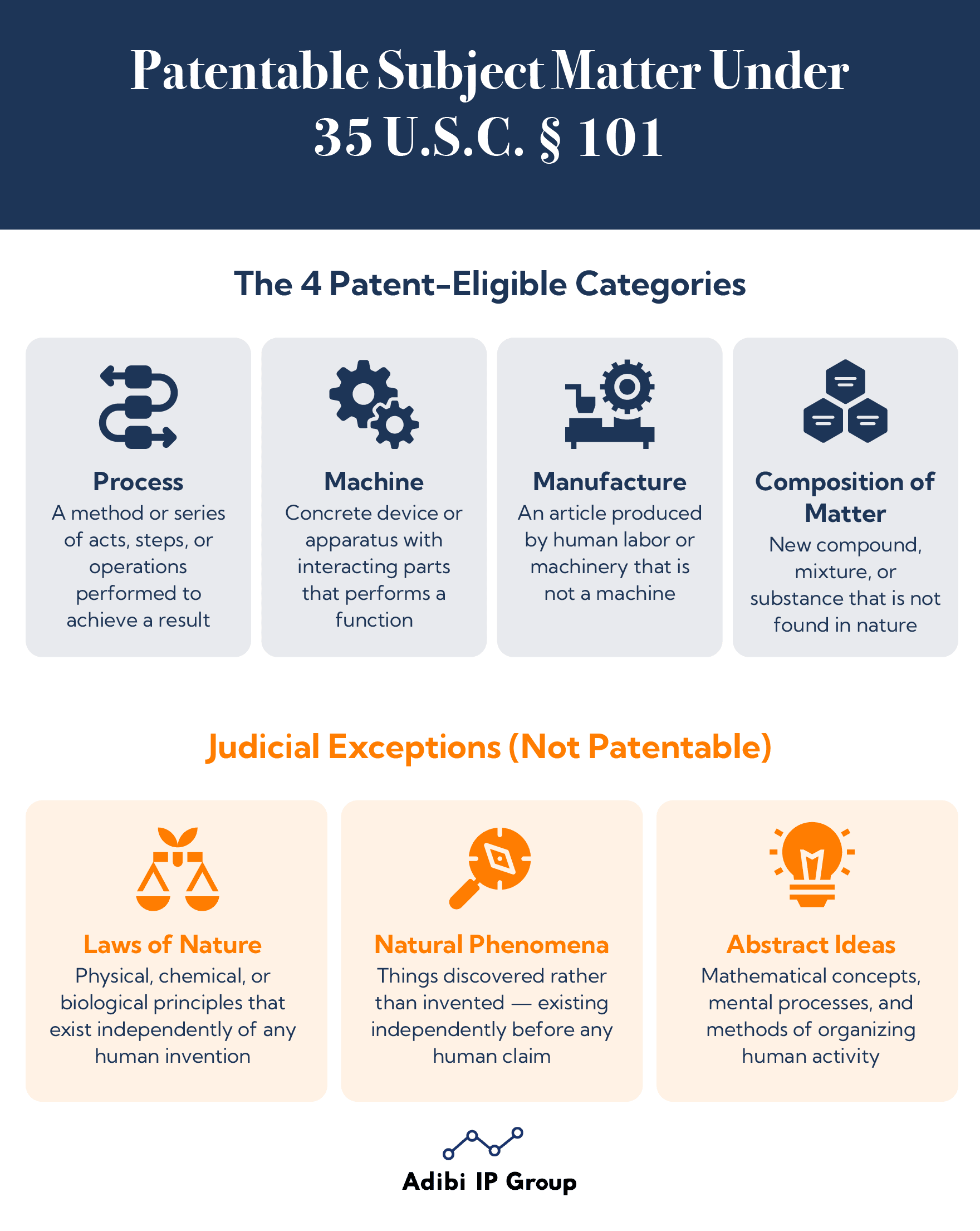
The core text has been remarkably stable since 1952. The statute declares eligible “any new and useful process, machine, manufacture, or composition of matter.” Four categories, deliberately broad. These categories are defined as follows: a process is a method or series of acts, steps, or operations performed to achieve a result; a machine is a concrete device or apparatus with interacting parts that performs a function; a manufacture is an article produced by human labor or machinery (that is not a machine); and a composition of matter is a new compound, mixture, or substance that is not found in nature. The 1952 Patent Act recodified language tracing back to the Patent Act of 1793, and Congress made clear in the 1952 legislative history that the categories were meant to reach “anything under the sun that is made by man” — a phrase the Supreme Court quoted with approval in Diamond v. Chakrabarty, 447 U.S. 303 (1980), when it held that a genetically modified bacterium was eligible. Chakrabarty is the textualist high-water mark and the case the judicial exceptions would later pull back from.
The gateway function is what makes the provision different from the rest of Title 35. A claim that fails § 102 can often be amended to recite a novel combination; a claim that fails § 103 can sometimes be saved with secondary considerations. A claim that fails at the eligibility threshold has no such recourse — the problem is conceptual, not evidentiary. That is why 35 USC 102(b) novelty requirements and 35 USC 103 non-obviousness are inquiries the examiner never reaches if eligibility fails first.
The Three Judicial Exceptions That Narrow Statutory Eligibility
The three judicial exceptions — laws of nature, natural phenomena, and abstract ideas — are not found anywhere in the statute. They are a judicial overlay nearly 170 years old, beginning with Le Roy v. Tatham, 55 U.S. 156 (1852), and formalized in O’Reilly v. Morse, 56 U.S. 62 (1854), which invalidated Samuel Morse’s eighth claim to electromagnetism “however developed” on the ground that no inventor can monopolize a principle of nature.
The three sort into different practical buckets. Laws of nature cover physical, chemical, and biological principles that exist independently of human invention — Newton’s second law, but also the correlation between a patient’s metabolite concentration and a safe drug dosage, as Mayo would later hold. Natural phenomena cover things discovered rather than invented: isolated DNA sequences, naturally occurring minerals, mathematical truths about the physical world. Abstract ideas are the most contested and most expansive category — covering economic practices, methods of organizing human activity, mental processes, and mathematical concepts, all of which the 2019 Revised Guidance later consolidated into defined groupings. It is where most software and business-method claims live or die.
The policy rationale the Supreme Court has repeatedly invoked is preemption — the concern that patenting a law of nature, a natural phenomenon, or an abstract idea would monopolize the “basic tools of scientific and technological work” and impede rather than promote innovation. Preemption is unpacked separately below; the key point here is that the judicial exceptions are judge-made law layered on top of a broadly written statute, creating the tension every eligibility analysis is navigating.
The Real-World Stakes When Eligibility Fails
A novelty rejection means the claim needs a narrower, more distinctive element. An obviousness rejection means the claim needs a non-obvious combination or secondary considerations. An eligibility rejection means the claim, as architected, has no path to patentability until its core framing is reconceived. That is why abandoned applications and invalidated patents cluster disproportionately at this stage.
The financial consequences compound. A startup that loses its foundational patent may lose its defensible position against larger competitors. A biotech company that loses a diagnostic patent after Mayo may lose the economic basis for a multi-year development program. A software firm that cannot patent its core algorithmic contribution may have to pivot to trade-secret protection, with its own risks. For R&D leaders, the chilling effect is quieter but real — budgets get allocated toward inventions that are filable, not always toward the ones with the greatest technical novelty.
The Alice/Mayo Framework: The Controlling Two-Step Test for Subject Matter Eligibility
The statute and its exceptions set the field. The Alice/Mayo framework is the instrument the courts and the USPTO actually use on the field. Any working understanding of subject matter eligibility has to start here.
Step One: Determining Whether a Claim Is Directed to an Exception
Step One asks whether the claim is “directed to” one of the three judicial exceptions. In practice, that determination turns on how a court or examiner characterizes the claim’s focus — and characterization is where most Step One battles are won or lost. A claim “directed to” a specific technical improvement will frequently survive; a claim “directed to” an algorithm or business practice with computer implementation frequently will not, even if both describe the same underlying technology.
Step One is frequently dispositive. The 2019 Revised Guidance narrowed its scope by categorizing abstract ideas into three enumerated groupings — mathematical concepts, mental processes, and certain methods of organizing human activity. Those groupings guide examiners and function as a sorting framework practitioners can use to anticipate rejections. They are not binding on the Federal Circuit, but they have materially reduced the range of claims an examiner will label abstract without additional justification.
Step Two: Identifying an Inventive Concept Beyond the Exception
Step Two asks whether the claim, even if directed to an exception, recites “significantly more” — an inventive concept that transforms the claim into eligible subject matter. The Supreme Court’s framing in Alice was that the additional elements must amount to more than well-understood, routine, and conventional activity previously known in the industry.
“Significantly more” is where the doctrine gets soft. Whether a claim element counts as conventional, whether a combination of conventional elements can itself be inventive, and whether the inventive concept must appear in a specific limitation or can be distributed across the claim — these are questions courts have answered differently in different cases. The Federal Circuit’s 2018 decision in Berkheimer v. HP Inc., 881 F.3d 1360 (Fed. Cir. 2018), clarified one piece by holding that whether a claim element is well-understood, routine, and conventional is a question of fact, not law — which means it cannot be resolved at the motion-to-dismiss stage if genuinely disputed.
The circular-reasoning criticism has been raised by Federal Circuit judges themselves — notably Judge Lourie in his concurrence to the denial of en banc rehearing in Athena Diagnostics v. Mayo Collaborative Services, 915 F.3d 743 (Fed. Cir. 2019), reh’g en banc denied, 927 F.3d 1333 (Fed. Cir. 2019). Step Two analysis, as applied, often mirrors the novelty and non-obviousness inquiries under §§ 102 and 103, but without the evidentiary rigor (prior art references, element mappings) those sections require. For practitioners, the pragmatic takeaway is that a Step Two argument invoking the Berkheimer fact question and pointing to the evidentiary basis for any conventionality finding is an argument the examiner or court has to engage with on its merits.
Why the Framework Generates Persistent Unpredictability
Alice/Mayo unpredictability is real, and worth naming honestly without tipping into cynicism. Different Federal Circuit panels have applied the framework to similar claims and reached opposite results. The Supreme Court has resisted every opportunity to define “abstract idea” with any precision, and the Federal Circuit has inherited that imprecision without the authority to resolve it.
Empirical evidence of the post-Alice shift is documented. The USPTO Office of the Chief Economist’s April 2020 “Adjusting to Alice” report found that, across 33 “Alice-affected” technology areas, the likelihood of receiving a first office action with a § 101 rejection rose by 31% in the 18 months following the decision, with examination uncertainty rising by 26% over the same period. One year after the 2019 Revised Guidance issued, the rejection likelihood for Alice-affected technologies had decreased by 25% and uncertainty had decreased by 44%. Tech Center 3600 (business methods and e-commerce) and Tech Center 2100 (computer architecture and software) absorbed the largest share of that volatility. Specific allowance-rate numbers vary by art unit, time window, and methodology; practitioners citing figures should link to the specific release they rely on.
Here is the part experienced practitioners recognize: the unpredictability is patterned, not random. Outcomes correlate with (a) Federal Circuit panel composition, which no one can control; (b) whether the specification articulated a specific technical problem and solution, which is entirely within the drafter’s control; and (c) whether the claim recites a tangible improvement to a specific technological environment as opposed to a functional result.
Patent Eligibility Across Key Technology Sectors: Software, AI, Biotech, and Business Methods
The Alice/Mayo framework reads cleanly in the abstract. Its real weight falls on four sectors where eligibility doctrine does the most work.
Software and Computer-Implemented Inventions
Software patent eligibility has moved through three doctrinal eras. The Federal Circuit’s 1998 decision in State Street Bank & Trust Co. v. Signature Financial Group, 149 F.3d 1368 (Fed. Cir. 1998), opened a wide door under a “useful, concrete, and tangible result” test that is no longer good law. Bilski v. Kappos, 561 U.S. 593 (2010), narrowed that door by rejecting the machine-or-transformation test as the sole eligibility standard. Alice reshaped the landscape by holding that implementing an abstract idea on a generic computer is not enough.
The machine-or-transformation test is not a gatekeeper — a point worth pinning down. Bilski described it as “a useful and important clue” for process eligibility, not a dispositive test. Post-Alice, the operative question is whether the claim recites an improvement to the functioning of a computer or a specific technological process (Enfish, LLC v. Microsoft Corp., 822 F.3d 1327 (Fed. Cir. 2016)) or whether it merely uses a generic computer as a tool to implement an abstract idea (Alice). Those two poles define the field.
Drafting for Alice resilience means choices at the specification stage. Functional language that describes what the software accomplishes without describing how tends to fall on the wrong side of Step One. Architectural language that anchors the claim to a specific data structure, a specific processing pipeline, or a specific interaction between software and hardware gives the drafter room to argue at Step One that the claim is directed to a technical improvement — and, if that fails, at Step Two that the specific implementation is not routine. The Federal Circuit’s pro-eligibility anchors — Enfish (self-referential database tables as an improvement to computer functionality), McRO, Inc. v. Bandai Namco Games America Inc., 837 F.3d 1299 (Fed. Cir. 2016) (specific rules-based automation of a previously manual process), and Berkheimer (conventionality as a fact question) — are the touchstones a well-drafted specification will map to.
Artificial Intelligence and Machine Learning Inventions
AI patent eligibility is where the doctrine is most visibly under strain. Neural networks, training methods, and algorithmic outputs map easily onto the “mathematical concepts” and “mental processes” groupings in the 2019 Revised Guidance, which makes AI and machine-learning claims particularly vulnerable to Step One rejections. The 2019 Revised Patent Subject Matter Eligibility Guidance helped by directing examiners to consider at Prong Two whether a judicial exception is “integrated into a practical application.”
In July 2024, the USPTO issued guidance specifically directed at AI inventions — the “2024 Guidance Update on Patent Subject Matter Eligibility, Including on Artificial Intelligence,” 89 Fed. Reg. 58128 (July 17, 2024). The update added three AI-specific hypothetical examples (Examples 47–49) to the Subject Matter Eligibility example set, clarifying how examiners should apply the Prong Two “practical application” analysis to claims involving neural network training, inference, and output generation. The July 2024 guidance is the current North Star for AI prosecution and required reading for practitioners drafting in this space.
The strategic pattern for AI claim drafting is the same one that works for software generally, with emphasis: identify a specific technical problem (latency, accuracy, resource consumption, model interpretability, training-data efficiency), describe the specific technical solution, and anchor the claim to the specific computational architecture in which the improvement is realized. A claim reciting “a method for predicting X using a trained neural network” is a Step One casualty. A claim reciting a specific architectural modification to a specific class of models, producing a measurable technical benefit, has something to argue at both steps.
Biotechnology, Diagnostics, and Life Sciences
Diagnostic patent eligibility has been the sector hardest hit. Mayo, 566 U.S. 66 (2012), held that a method claim reciting a correlation between a patient’s metabolite level and a therapeutic dosage was directed to a law of nature and lacked sufficient additional elements to confer eligibility. The claim recited administering a drug, determining the metabolite level, and adjusting dosage — and the Court held those steps, individually and in combination, were routine once the underlying correlation was known. Mayo‘s effect has been profound: correlation-based diagnostic claims almost universally fail Step One because the correlation itself is a law of nature, and the additional measuring-and-reporting steps are precisely what Mayo held cannot supply an inventive concept.
Association for Molecular Pathology v. Myriad Genetics, Inc., 569 U.S. 576 (2013), is the second foundational case. Myriad held that isolated human DNA is a product of nature and ineligible — but that complementary DNA (cDNA), because its sequence is not naturally occurring, is eligible. The cDNA distinction is among the most practically useful takeaways from Myriad for biotech drafters, and it is routinely missed in general-audience summaries. Molecular modifications producing sequences or structures that do not exist in nature remain patentable.
The field-tested pattern for salvaging diagnostic-adjacent eligibility is to claim treatment steps rather than the diagnostic correlation itself. Vanda Pharmaceuticals Inc. v. West-Ward Pharmaceuticals International Ltd., 887 F.3d 1117 (Fed. Cir. 2018), is the anchor — method-of-treatment claims that recited specific dosage adjustments tied to a CYP2D6 genotype survived where pure diagnostic claims of the Mayo variety had not. Vanda is the most actionable biotech case of the last decade, and it tells drafters to structure claims around the therapeutic application rather than the underlying biological correlation.
Business Methods and Financial Technology
Business method patent eligibility is where Alice did the most visible work. Bilski held that a method of hedging commodity risk was directed to an abstract idea, even though the claim did not recite any particular abstract economic principle by name. Alice four years later held that implementing an abstract idea on a generic computer does not transform the idea into an eligible application — the claim involved a computerized method for mitigating settlement risk through intermediated exchanges, and the Court found the computer implementation added nothing beyond what a person could have done with pen and paper.
Fintech eligibility after Alice is narrow but not nonexistent. Claims that survive tend to share a pattern: they recite a specific technical problem in financial systems — fraud detection at scale, low-latency settlement, secure multiparty computation, real-time risk scoring — and they anchor the claim to a specific technical solution rather than a financial result. A claim that recites improved detection accuracy through a specific data-processing architecture can clear Step One; a claim that recites an improved business outcome achieved through an unspecified algorithmic process cannot. The line the Federal Circuit has drawn is the “improvement to a technological process” line.
Sector-specific eligibility analysis often turns on fine distinctions that are hard to resolve in the abstract. If you are evaluating a specific invention in one of these areas, our patent team is available to discuss the claim architecture. Contact us to discuss a specific eligibility question.
USPTO Examination Guidelines and Prosecution Strategies
Doctrine shapes what the courts do. Most eligibility battles are fought at the USPTO years before any court sees the claim — which is why the prosecution playbook matters as much as the case law.
The USPTO’s Evolving Eligibility Guidance Framework
The 2019 Revised Patent Subject Matter Eligibility Guidance, published January 7, 2019 in the Federal Register (84 Fed. Reg. 50), restructured how examiners apply the Alice/Mayo framework. It introduced a two-prong analysis at Step 2A: Prong One asks whether the claim recites a judicial exception, and Prong Two asks whether the judicial exception is integrated into a practical application. An October 2019 update added clarifying examples from software and life-sciences contexts.
The Prong One / Prong Two vocabulary is now load-bearing for prosecution practice. A claim that fails Prong One (does not recite an exception) is eligible without further analysis. A claim that recites an exception but integrates it into a practical application passes Prong Two and is eligible. Only a claim that both recites an exception and fails to integrate it into a practical application moves to Step 2B, where the “significantly more” inquiry takes place. USPTO guidance binds examiners and the PTAB in examination practice; it does not bind the Federal Circuit or district courts. That gap means a claim that passes Prong Two during examination and issues can still be invalidated in litigation if a court applies a narrower reading.
Responding to a Section 101 Rejection During Prosecution
A Section 101 rejection during prosecution is frustrating but rarely fatal. The first strategic question is whether to argue, amend, or both. Arguing at Step One that the claim is not directed to a judicial exception is the strongest position when available — it avoids the evidentiary difficulty of proving non-conventionality. Amendment usually means adding specificity: anchoring the claim to a particular technical environment, reciting concrete implementation detail, or tying the claim to a measurable technical improvement.
The Berkheimer memo is the single highest-leverage tool available for responding to a Section 101 rejection. Issued April 19, 2018 by Robert W. Bahr, USPTO Deputy Commissioner for Patent Examination Policy, the memo requires examiners to support a finding that claim elements are well-understood, routine, and conventional with specific evidence — a court decision, a publication, a prior-art statement under 37 C.F.R. § 1.104(d)(2), or an official notice supported by citation. The memo operationalizes the Federal Circuit’s Berkheimer holding and shifts the evidentiary burden in a way that benefits patent owners. Practitioners routinely traverse eligibility rejections by invoking the memo and requiring the examiner to identify the specific evidentiary basis for any conventionality finding. Where the examiner cannot supply that basis, the rejection is vulnerable.
Declaration evidence plays a growing role. A well-constructed inventor or expert declaration describing the specific technical problem, the conventional approaches that existed at the time of invention, and the specific technical improvement the claim recites can frame Step Two analysis in the patent owner’s favor — particularly in art units where examiners have historically leaned toward conventionality findings without detailed evidentiary support.
Drafting Claims for Eligibility Resilience From the Start
The most important eligibility work happens before the rejection ever issues. Specification strategy begins with front-loading the technical problem and the specific technical solution. A specification that opens with a clear articulation of a technical problem — not a business problem, not a commercial problem, but a technical problem in a specific technological environment — and follows with a detailed explanation of the technical solution, gives the drafter the raw material needed for both Step One and Step Two arguments.
Claim architecture is the second discipline. A common pattern is to write independent claims that capture the specific technical improvement tightly, with dependent claims that add conventional elements (well-known hardware, standard data formats, routine processing steps). The conventional elements in the dependents are not the inventive concept; they are scope protection. Method, system, and computer-readable-medium (CRM) claim sets deployed strategically maximize eligibility across claim types — each presents different vulnerabilities and different arguments, and a full set provides layered protection.
Avoiding purely functional language is the third discipline. A concrete illustration, drawn from a sanitized generic example:
Before (abstract-idea vulnerable):
A method comprising: receiving user data; analyzing the user data to determine a risk score; and outputting the risk score.
After (technically anchored):
A method for reducing latency in a distributed fraud-detection system, comprising: receiving, at a first edge node, transaction data encoded in a specified binary format; applying a locally cached decision tree of depth N to produce an intermediate risk indicator within X milliseconds of receipt; and, when the intermediate indicator exceeds a threshold T, escalating the transaction to a central verification node over a dedicated low-latency channel, thereby reducing mean end-to-end decision time relative to centralized processing.
The “before” claim reads on any mental process involving looking at information and reaching a judgment — no specific technical environment, no specific implementation, no identifiable technical improvement. The “after” claim recites a specific technological context (distributed edge architecture), a specific technical problem (latency), concrete implementation parameters (tree depth N, threshold T, dedicated channel), and an identifiable technical improvement (measurable reduction in end-to-end decision time). The “after” version is not guaranteed to survive — no architecture is — but it gives the drafter something to argue at both steps.
Responding to a Section 101 rejection is one of the most technically demanding parts of patent prosecution. Adibi IP Group regularly handles eligibility rejections across software, life sciences, and electromechanical art units. Learn more about our patent consulting services.
Preemption: The Policy Engine Behind the Judicial Exceptions
The USPTO playbook above treats eligibility as an operational problem. Every eligibility analysis ultimately traces back to a single policy concern: preemption.
The Supreme Court has grounded the judicial exceptions in the concern that patenting a law of nature, a natural phenomenon, or an abstract idea would effectively monopolize the basic tools of scientific and technological work and impede rather than promote the progress of science and useful arts. That concern is explicit in Mayo, 566 U.S. at 85–86, where the Court described the rationale for the natural-law exception as preventing the preemption of future innovation. Alice, 573 U.S. at 216, reaffirmed the same concern in the context of abstract ideas.
Preemption is not a freestanding test, though — a point worth naming directly, because it is commonly misunderstood. The Federal Circuit has repeatedly held that the absence of complete preemption does not by itself establish eligibility. A claim that does not preempt all applications of an abstract idea can still fail if the specific application it recites does not supply an inventive concept. Ariosa Diagnostics, Inc. v. Sequenom, Inc., 788 F.3d 1371 (Fed. Cir. 2015), forecloses the argument that narrowing a claim sufficiently to avoid preempting the entire field is enough.
The practical significance is that preemption frames Step Two. Courts consider whether the additional elements in a claim represent a specific application of the underlying exception (eligible) or a generic placeholder that effectively claims the exception itself (ineligible). That framing is why specification detail about the specific technical problem and the specific technical solution matters so much — it is the raw material courts use to distinguish specific applications from generic implementations.
Landmark Supreme Court and Federal Circuit Decisions Shaping § 101
No eligibility reference is complete without a map of the cases that built the current framework.
Landmark § 101 Decisions at a Glance
| Case Name & Year | Court | One-Line Holding | Practical Takeaway |
| Gottschalk v. Benson (1972) | Supreme Court | A mathematical algorithm for converting binary-coded decimal to pure binary is not eligible because it would effectively preempt the formula itself. | Pure mathematical algorithms, standing alone, are not patent-eligible. |
| Parker v. Flook (1978) | Supreme Court | Adding post-solution activity to an otherwise ineligible algorithmic claim does not confer eligibility. | Tacking conventional steps onto an algorithm cannot save the claim. |
| Diamond v. Diehr (1981) | Supreme Court | A process using a mathematical formula to control rubber curing in a specific industrial application is eligible. | Algorithms integrated into a specific technical process can be eligible. |
| Bilski v. Kappos (2010) | Supreme Court | A method of hedging commodity risk is an abstract idea; machine-or-transformation is a useful clue, not the sole test. | Pure business methods without a specific technical application fail eligibility. |
| Mayo v. Prometheus, 566 U.S. 66 (2012) | Supreme Court | A diagnostic correlation between metabolite levels and drug dosage is a law of nature; routine administration and measurement steps do not supply an inventive concept. | Diagnostic claims reciting natural correlations plus routine steps are ineligible. |
| Ass’n for Molecular Pathology v. Myriad Genetics, 569 U.S. 576 (2013) | Supreme Court | Isolated naturally occurring DNA is a product of nature and ineligible; cDNA is eligible because it is not naturally occurring. | Engineered sequences are eligible; mere isolation is not. |
| Alice Corp. v. CLS Bank Int’l, 573 U.S. 208 (2014) | Supreme Court | Implementing an abstract idea on a generic computer does not confer eligibility; formalized the two-step framework. | The controlling test across all technology sectors. |
| Enfish, LLC v. Microsoft Corp., 822 F.3d 1327 (Fed. Cir. 2016) | Federal Circuit | Software claims directed to improvements in computer functionality itself are eligible at Step One. | Claims framed as improvements to computer operation can survive Step One. |
| McRO, Inc. v. Bandai Namco, 837 F.3d 1299 (Fed. Cir. 2016) | Federal Circuit | Specific rules-based automation of a previously manual process is eligible. | Rules-based automation with specific, unconventional rules survives Alice. |
| Berkheimer v. HP Inc., 881 F.3d 1360 (Fed. Cir. 2018) | Federal Circuit | Whether claim elements are well-understood, routine, and conventional is a question of fact. | Conventionality cannot be decided at motion-to-dismiss if genuinely disputed. |
| Athena Diagnostics v. Mayo Collaborative, 915 F.3d 743 (Fed. Cir. 2019), reh’g en banc denied, 927 F.3d 1333 (Fed. Cir. 2019) | Federal Circuit | Diagnostic claims remain ineligible under Mayo; en banc denial produced eight separate opinions calling for Supreme Court or legislative intervention. | Current doctrine forecloses most diagnostic patents absent reform. |
| Am. Axle v. Neapco Holdings, 967 F.3d 1285 (Fed. Cir. 2020) | Federal Circuit | Mayo applies to mechanical manufacturing claims; certiorari denied despite CVSG request (2022). | Eligibility doctrine reaches into the mechanical arts. |
The Supreme Court’s Foundational Jurisprudence
The Supreme Court’s eligibility line begins with the “algorithm trilogy” of the 1970s and early 1980s — Gottschalk v. Benson, 409 U.S. 63 (1972), Parker v. Flook, 437 U.S. 584 (1978), and Diamond v. Diehr, 450 U.S. 175 (1981). Benson invalidated a claim directed to an algorithm for converting binary-coded decimal numbers into pure binary, reasoning that the algorithm itself was effectively the claim. Flook followed with a claim reciting an algorithm plus post-solution activity (updating an alarm limit) and held that tacking conventional steps onto an ineligible algorithm could not supply eligibility.
Diehr is the crucial counterpoint. The Diehr claim recited the Arrhenius equation used to control curing time for rubber molding — and the Court held it eligible. The distinction from Flook was integration. Diehr‘s claim was not an algorithm with post-solution activity tacked on; it was a specific industrial process in which the algorithm was integrated with specific physical steps and a specific technical outcome. The Diehr/Flook contrast is the earliest version of this drafting lesson: how a claim is architected — whether it integrates an otherwise-ineligible concept into a specific technological process — often matters more than what the claim is nominally “about.”
The modern framework crystallized in Mayo (2012), where the Court articulated the two-step analysis in the context of a diagnostic claim. Two years later, Alice (2014) applied that framework to a computer-implemented method for mitigating settlement risk and reshaped software and business-method prosecution overnight.
Federal Circuit Decisions That Define the Boundaries
The Federal Circuit’s post-Alice decisions have done the work of applying the framework to specific technologies. Enfish established that software claims directed to improvements in computer functionality itself can survive Step One — the claim recited a self-referential database table that improved data-retrieval performance. McRO added a second pro-eligibility anchor: specific rules for automating facial animation that had previously been performed manually survived Alice because the rules themselves were specific and unconventional. Berkheimer‘s fact-question holding gives the USPTO’s Berkheimer memo its evidentiary teeth and limits courts’ ability to resolve eligibility on the pleadings when conventionality is genuinely disputed.
Athena Diagnostics (2019) is the most doctrinally important diagnostic case after Mayo itself. The claim involved a method for diagnosing a neurological disorder by detecting autoantibodies to a specific protein, and the court held it ineligible. The significance is less the holding and more the court’s own expressions of doctrinal discomfort — the denial of en banc rehearing produced eight separate opinions, with multiple judges stating that the court was bound to reach a result it believed was wrong as a matter of policy. Certiorari was denied in early 2020.
American Axle (2020) extended eligibility doctrine into an unexpected domain — mechanical manufacturing. The claim recited a method for tuning a vehicle driveshaft to reduce vibration, and the court held it directed to a natural law (Hooke’s law of harmonic oscillation) with insufficient inventive concept. The Federal Circuit split 6-6 on rehearing en banc, and certiorari was denied in 2022 despite a CVSG request from the Solicitor General. American Axle remains the most controversial recent eligibility decision and a regular touchstone for arguments that current doctrine has extended beyond its original domains.
The Ongoing Circuit Split and Calls for Legislative Reform
The Federal Circuit’s eligibility jurisprudence is visibly fractured. Judges Plager, Newman, Lourie, Chen, and others have written concurrences and dissents calling for Supreme Court reconsideration or Congressional action, sometimes in unusually direct terms. The 6-6 en banc split in American Axle and the eight separate opinions in the Athena en banc denial are the most visible signals.
Legislative reform efforts have moved in parallel. Senators Thom Tillis (R-NC) and Chris Coons (D-DE) circulated a bipartisan draft in May 2019 that would have replaced the judicial exceptions with a statutory test. That draft never received a formal bill number and was ultimately shelved after industry opposition — pharma and biotech wary, the tech industry split.
The Patent Eligibility Restoration Act (PERA) took the next step. PERA was first introduced as S. 4734 in the 117th Congress (August 2022) by Senator Tillis, and reintroduced in the 118th Congress as S. 2140 (June 2023). PERA would expressly eliminate all judicially created exceptions and replace them with a short statutory list of specific exclusions — unmodified human genes, mathematical formulas standing alone, mental processes performed entirely in the human mind. The bill has received committee hearings but has not moved to the floor.
The reform debate has two sides worth presenting fairly. Supporters argue that U.S. doctrine has become an international outlier, that unpredictability imposes real costs on innovation, and that the diagnostic gap created by Mayo is actively harmful to personalized medicine. Opponents argue that loosening the doctrine would revive overbroad software and diagnostic patents that previously chilled downstream research, that the judicial exceptions serve important preemption-related functions, and that statutory reform could introduce its own unpredictability during the years it would take courts to interpret new language. Both sets of arguments have substantive support. What can be said is that reform has stalled repeatedly and that practitioners should plan on practicing under the current framework for the foreseeable future.
§ 101 in Patent Litigation and Post-Grant Proceedings
Doctrine and prosecution shape what patents issue. Litigation and post-grant proceedings determine which of those patents survive contact with a motivated challenger.
§ 101 as a Litigation Weapon: Motions to Dismiss and Summary Judgment
Defendants facing patent infringement suits have made eligibility a first-line defensive tactic. A Rule 12(b)(6) motion to dismiss based on ineligibility can resolve a case before claim construction, before discovery, and before substantial expense. A successful early motion disposes of the case at a fraction of the cost of a full infringement trial.
The Berkheimer fact question is the primary shield against early dismissal. Because conventionality under Step Two is a question of fact, courts should not resolve it at the pleadings stage when the patent owner has plausibly alleged — often through the specification itself — that claim elements are not well-understood, routine, and conventional. Patent owners who front-load specific technical detail in their specifications, and who plead non-conventionality with specificity in their complaints, can survive motions to dismiss that would have succeeded before Berkheimer.
Litigation analytics providers including Docket Navigator and Lex Machina publish periodic reports on eligibility outcome rates in district court. Those reports have consistently shown that early-stage challenges succeed in a meaningful share of cases, particularly where claim construction is not in dispute and the specification does not provide detailed technical support for non-conventionality arguments. Specific outcome rates vary by jurisdiction, art unit, and time window; practitioners citing figures should link to the underlying study. The qualitative pattern is clear regardless: early-stage eligibility motions have become a standard defense tactic because of their comparatively low cost and their demonstrated ability to resolve cases before claim construction.
Inter Partes Review and the Role of § 101 in Post-Grant Challenges
Inter partes review (IPR) is not available for eligibility challenges. The America Invents Act limits IPR to §§ 102 and 103 grounds under 35 U.S.C. § 311(b), which means post-grant eligibility challenges cannot proceed through the most commonly used PTAB vehicle. That limitation pushes eligibility challenges into district court litigation, where they face different procedural rules and a different decisionmaker than the technical specialists at the PTAB.
Covered business method (CBM) review was a narrower AIA vehicle that permitted eligibility challenges against certain business-method patents. CBM review sunset on September 16, 2020, and no successor vehicle has been created. The effective result is that eligibility is now primarily a litigation-only challenge mechanism. Patent owners can sometimes use IPR strategically to strengthen positions that might otherwise face eligibility challenges — surviving IPR on §§ 102/103 grounds does not resolve eligibility, but it can narrow and clarify claim scope in ways that support later arguments.
Building a Defense Strategy for Patent Owners
Patent owners with portfolios exposed to eligibility risk benefit from proactive audits. A practical audit asks, for each asset, whether the claim reads on an abstract idea or natural law at Step One, whether the specification contains enough technical detail to support a Berkheimer-style non-conventionality argument, and whether the claim architecture includes dependent claims that provide fallback positions. Claim differentiation strategies across a patent family can preserve at least some eligible claims even when others are vulnerable — independent claims at different levels of specificity create a layered defense. Licensing and enforcement decisions should account for eligibility exposure: an asset with marginal eligibility may be better suited to a licensing strategy than to litigation.
Comparative Perspectives: § 101 in the Global Context
U.S. eligibility doctrine does not operate in isolation. Global filing strategy depends on understanding how other major jurisdictions treat the same claims.
Subject Matter Eligibility: U.S. vs. EPO vs. China
| Jurisdiction | Governing Authority | Treatment of Software | Treatment of Business Methods | Treatment of Diagnostics / Life Sciences |
| United States | 35 U.S.C. § 101; Supreme Court and Federal Circuit case law; USPTO guidance including 2019 Revised Guidance and July 2024 AI update | Eligible if directed to improvement in computer functionality; vulnerable if abstract idea on generic computer | Frequently ineligible under Alice; survives only with specific technical improvement | Diagnostic correlations ineligible after Mayo; cDNA and treatment steps eligible |
| European Patent Office | European Patent Convention Article 52; Boards of Appeal case law including T 641/00 (COMVIK) | Eligible if claim has technical character and features contribute to technical solution; “computer programs as such” excluded | Generally ineligible unless implemented in a technical way producing a technical effect | Therapeutic and diagnostic methods practiced on human body excluded under Art. 53(c); diagnostic products and devices eligible |
| China (CNIPA) | Chinese Patent Law; Patent Examination Guidelines (updated 2019, 2021) | Eligible if claim includes technical features solving a technical problem with a technical effect | Eligible if they provide a technical solution; pure business rules excluded | Diagnostic methods practiced on living humans/animals excluded; therapeutic compositions and devices eligible |
How U.S. Doctrine Compares to International Eligibility Standards
The structural comparison is instructive. European Patent Convention Article 52(2) lists specific excluded subject matter — mathematical methods, business methods, computer programs “as such,” presentations of information. The EPO’s Boards of Appeal developed the operative doctrine through the technical-character requirement and the COMVIK approach (T 641/00). Under COMVIK, when a claim contains a mix of technical and non-technical features, only the technical features contribute to the inventive step analysis. The practical effect is that software and business-method claims in Europe turn on whether the claim produces a technical effect beyond the normal operation of a computer.
The Chinese framework, reflected in the Patent Examination Guidelines updated in 2019 and again in 2021, asks whether the claimed subject matter includes technical features that solve a technical problem and produce a technical effect. That tripartite test is structurally closer to the EPO approach than to the U.S. Alice/Mayo framework, and the CNIPA updates have specifically clarified eligibility standards for AI-related and business-method-related inventions.
The practitioner takeaway is that the United States is doctrinally an outlier among major patent jurisdictions in its use of judge-made exceptions and its Alice/Mayo two-step structure. The EPO and CNIPA both apply predictable-if-demanding technical-character or technical-solution tests. That divergence matters for global filing strategy: claims that survive in the U.S. will usually clear EPO and CNIPA eligibility hurdles, but claims that fail under U.S. doctrine may still be allowable in Europe or China.
Strategic Considerations for Global Patent Portfolios
Portfolio strategy in light of these differences tends to follow a few patterns. Claims are often drafted with U.S. doctrine as the most stringent forum in mind, on the theory that an architecture that survives Alice will generally survive European and Chinese examination. Specifications are written to support multiple framings — U.S. Step Two arguments about non-conventionality, EPO technical-character arguments, Chinese technical-effect arguments — which means investing in implementation detail and technical-problem articulation that serves all three systems. PCT filing strategy becomes more consequential when U.S. eligibility is uncertain: an invention whose U.S. posture is weak may still be worth filing internationally if the EPO and CNIPA offer a more predictable path to allowance.
The Innovation Policy Debate
The policy debate over U.S. eligibility doctrine has been active for a decade. Empirical studies on the decline in software and biotech patent grants after Alice have fed arguments that the doctrine is imposing measurable economic costs on R&D investment. One side argues that strong eligibility standards prevent patent thickets, preserve the public domain for fundamental research, and protect downstream innovators from overbroad upstream claims — with particular force in diagnostics and software. The other side argues that eligibility uncertainty drives investment offshore, weakens U.S. technology leadership in fields like AI and personalized medicine, and imposes costs that exceed any benefits from preemption-based exclusions. The USPTO, Congress, and the courts are each responding in different ways, and those responses are not yet aligned.
The Working Rule: Eligibility as a Drafting Discipline
With the doctrine, sector application, USPTO practice, case law, litigation posture, and global context in hand, the remaining question is operational: what does a disciplined workflow look like at the disclosure-review and drafting stage?
A Decision Framework for Assessing Eligibility Before Filing
The following eight questions function as a pre-filing checklist that can be applied during invention-disclosure review, before substantial drafting resources are committed.
- Does the claim as drafted recite steps that could be performed entirely in the human mind or with pen and paper? (If yes: significant risk — the claim likely reads on a mental process.)
- Is the claim anchored to a specific technological environment, or does it read on any general-purpose computer, network, or device? (If the latter: significant risk — generic computer implementation is the Alice failure mode.)
- Does the specification identify a specific technical problem and describe a specific technical solution? (If no: weak Step Two / Prong Two posture.)
- If the claim involves an algorithm, rule, or mathematical operation, does it recite a concrete improvement to the functioning of a machine, a transformation of an article to a different state, or a measurable technical benefit? (If no: high risk — Benson/Flook territory.)
- For diagnostic or biotech claims: does the claim recite a treatment step, structural modification, or non-naturally-occurring composition, or does it stop at a correlation? (If the latter: near-certain Mayo exposure.)
- For software and AI claims: is the inventive contribution in the improvement to the computer or system itself, or in the information output the system produces? (The former is defensible; the latter is vulnerable under Alice.)
- Has the specification documented enough implementation detail to support a Step Two argument that the claim elements are not well-understood, routine, and conventional? (If no: Berkheimer traversal will be unavailable.)
- If a rejection issues, is there a USPTO SME example, a recent Federal Circuit decision, or a post-2019 Guidance hypothetical that the claim can be mapped to? (If yes: the rejection is amendable; if no: consider whether the claim architecture needs to be reworked rather than argued.)
Any invention yielding red-flag answers to any of these questions should receive serious architecture-level reconsideration before filing. Eligibility is a drafting problem before it is a litigation problem — to be solved at the front end with specification strategy, claim architecture, and prosecution discipline, rather than scrambled over at the back end in response to a rejection or a motion to dismiss.
If you are facing a Section 101 question on a specific claim set — whether at the drafting stage, in prosecution, or in litigation — Adibi IP Group’s patent team is available to discuss it. Contact us here.