The doctrine of equivalents means a court will treat the competitor’s product as infringing if it performs substantially the same function, in substantially the same way, to achieve substantially the same result as your claim – even if the words don’t match. In effect, it blocks copycats who make trivial changes to your patent. With hundreds of thousands of U.S. patents filed each year and thousands of infringement cases annually, you need to know how this doctrine protects you. Below we trace its origins, explain how courts apply it element-by-element, and show the strategies and limits you must consider to keep your patent fully enforced.
Key Takeaways
- The doctrine of equivalents protects patent holders from subtle infringers who perform essentially identical functions using minor modifications.
- Courts follow structured analytical tests for equivalency, yet several legal barriers may thwart successful equivalents claims.
- Thoughtful claim drafting and a keen awareness of judicial trends are vital to securing broad patent protection without running into enforcement hurdles.
Historical Development And Legal Basis Of The Doctrine Of Equivalents
This doctrine of equivalents grew out of early patent cases that recognized inventors needed protection beyond the exact wording of their claims. In 1853, the Supreme Court’s decision in Winans v. Denmead first held that a mere change in shape or design didn’t excuse infringement if the accused device “structure, mode of operation, and result” were the same. In Winans, a coal car shaped as a cone was found equivalent to one in a different shape, because it worked on the same mechanical principles. This principle set the stage: small design tweaks alone should not let copycats off the hook.
A century later, Graver Tank & Mfg. Co. v. Linde Air Prods (1950) gave us the classic rule. The Supreme Court said infringement occurs when the accused product performs substantially the same function, in substantially the same way, to achieve substantially the same result. In other words, look beyond the literal claim language to the invention’s essence.
That “triple identity” or function-way-result test is still cited today. After Graver Tank, Congress created the U.S. Court of Appeals for the Federal Circuit in 1982, which has since applied DOE uniformly across patent cases. Later Supreme Court decisions – Warner-Jenkinson Co. v. Hilton Davis (1997) and Festo Corp. v. Shoketsu (2002) – refined these ideas.
Warner-Jenkinson confirmed that DOE is evaluated on an element-by-element basis (no skipping parts of the claim) and highlighted the role of prosecution history in limiting DOE. Festo went further, holding that if you narrowed a claim during prosecution for patentability, you ordinarily give up the equivalent scope for that element, an important concern in any patent infringement strategy.
Key Historical Milestones:
- 1853: Winans v. Denmead first recognized that trivial mechanical changes won’t avoid liability.
- 1950: Graver Tank v. Linde established the modern “function-way-result” equivalence test.
- 1997: Warner-Jenkinson v. Hilton Davis reaffirmed element-by-element DOE and emphasized prosecution history estoppel.
- 2002: Festo v. Shoketsu imposed strict estoppel for claim amendments, limiting DOE scope.
Elements Of Equivalency Analysis
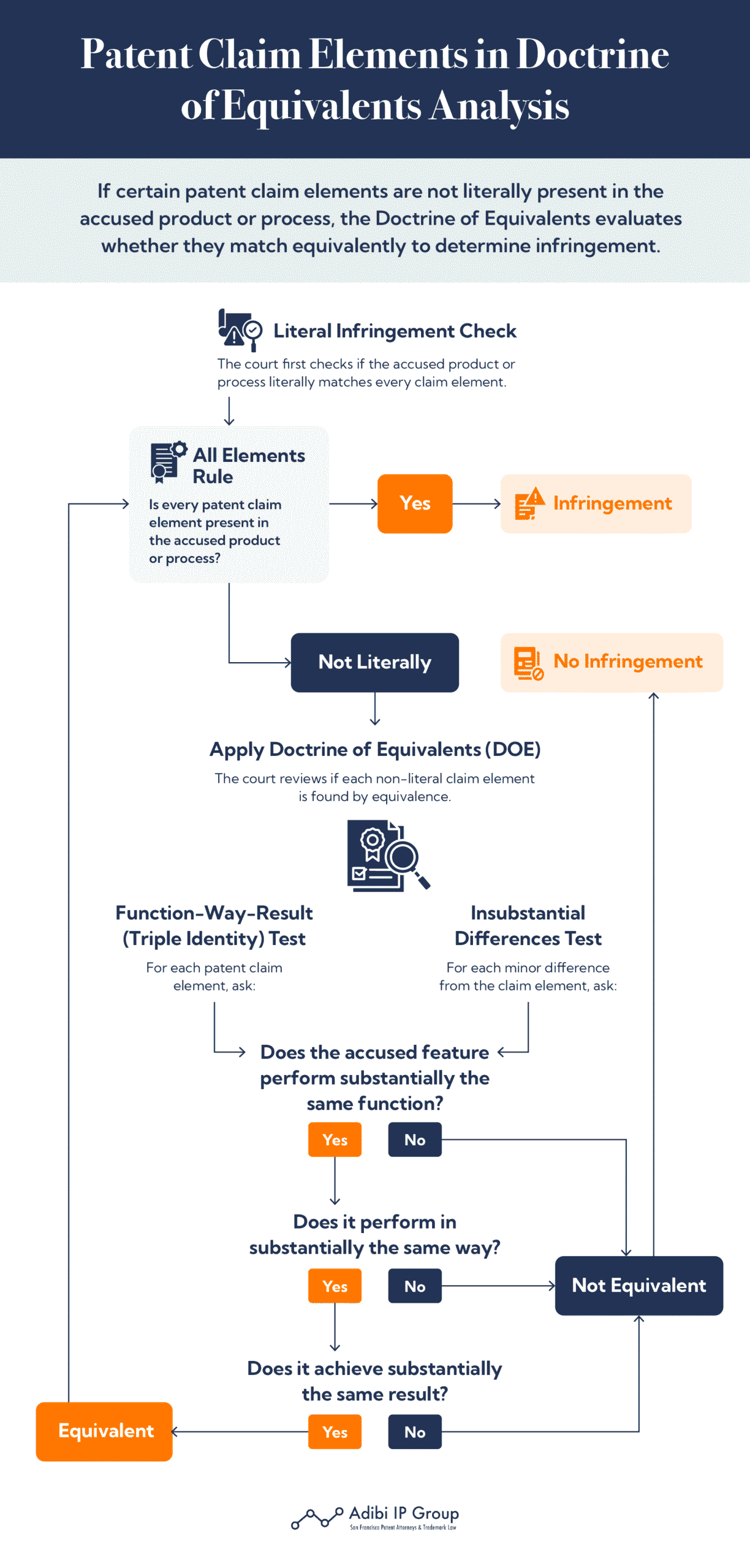
When you assert DOE infringement, the court compares your patent’s claims with the accused product on an element-by-element basis. Every limitation in your claim must appear either literally or by equivalent in the rival device. You can’t skip this detailed comparison and say “the products are similar overall.” For each claim element, ask: Does the accused feature perform substantially the same function, in substantially the same way, to dramatically get the same result? That is the classic test. If the answer is yes, that element is considered an equivalent.
Alternatively, courts use the insubstantial differences test: if the only differences between your claim element and the accused feature are truly trivial, then they’re still equivalent. These tests are essential to any patent infringement strategy, especially when competitors rely on surface-level tweaks. For example, if the only change is a minor material substitution that doesn’t affect how something works or what it accomplishes, a court may call that insubstantial. Both tests primarily focus on examining the actual operation of each element.
Before even reaching DOE, courts always check for literal infringement first. If the accused product already reads on every word of your claim, you win outright. DOE comes into play only if literal infringement fails for one or more elements, yet the differences are insubstantial. In practice, DOE analysis slots neatly into the normal infringement inquiry: once you exhaust literal infringement, you proceed to this equivalence test for the remaining elements.
Strategic Application And Limitations In Modern Patent Practice
Applying DOE in today’s patents involves both art and science. You must navigate prosecution history estoppel, adapt to how judges analyze your technology, and marshal strong evidence. The following points highlight what you need to consider.
Prosecution History Estoppel And Its Impact
Every change you made to the claims during prosecution can come back to limit DOE. If you narrowed a claim element to get allowance (for example, to overcome a prior-art rejection), you can’t later use DOE to cover what you gave up. In Warner-Jenkinson, the Court made clear that if you explicitly surrendered claim scope during prosecution, DOE can’t reclaim it. This makes it harder to protect against patent infringement post-grant, especially if your prosecution record isn’t crystal clear.
Festo then held that even minor claim amendments for patentability purposes create a rebuttable presumption of estoppel. In short, any amendment made for patentability reasons is assumed to surrender the original scope for that element. That’s why careful claim drafting and prosecution strategy are essential, not only to secure a grant but also to protect against patent infringement in future enforcement.
For you, this means being extremely careful during patent prosecution. If an examiner says “too broad” and you narrow a claim, you should be ready to lose DOE rights on that element later, unless you can prove your amendment was tangential (unrelated) to the accused equivalent. Always document why you made each change. Sometimes, you can argue that an amendment was made to target a different issue (a “tangential” amendment) to preserve DOE on the specific element of interest. But the burden is on you to prove that. The bottom line: think ahead during prosecution and keep a clear record of amendment reasoning, because every concession can permanently shrink your DOE coverage.
Specialized Applications Across Technical Fields
The doctrine of equivalents works across all industries, but how it applies can vary by field. For example, biotechnology patents often involve sequences (DNA, proteins) or biological processes. Suppose your claim covers a protein with a certain amino-acid sequence. A competitor might use a modified sequence or a different expression system. You would argue that if the competitor’s protein has the same biological function at the same stage of the process, it’s equivalent.
A solid patent infringement strategy means anticipating how your industry affects your equivalents argument. Misjudging this could mean forfeiting protection.
In pharmaceutical patents, claims often hinge on precise chemical structures, salt forms, or dosage ranges. A rival might tweak the dose slightly or use an alternative delivery method. Courts will scrutinize such tweaks carefully. For instance, if your claim specifies a dosage range of X–Y mg, a competitor using X–Y+ε mg might try to argue literal non-infringement. Under DOE, you’d need to show that difference ε is insubstantial for achieving the therapeutic effect.
Software patents face their own hurdle: for example, the Supreme Court’s Alice Corp. v. CLS Bank International decision requires that software claims not cover abstract ideas. When arguing DOE in software, focus on technical details. You must demonstrate that the accused code/module performs a genuine technological function equivalent to the claimed code/module. If the rival simply restructures the code or uses a known design pattern, courts will ask if this produces any new technical effect. Emphasize improvements in performance, security, or data processing as part of your equivalence argument.
Medical device patents often deal with mechanical or electrical components. Small design improvements (like a different gear or sensor) are common. Here, DOE can help – for example, if your claim has a spring of a certain stiffness and the defendant uses a slightly different material spring, you would argue that it operates in the same way. However, each substituted part is analyzed individually. Courts will want engineering evidence on how that new part performs. In short, for any technology domain, be prepared with evidence on how each feature in the accused product works and why it’s equivalent to the claimed feature in your patent.
Evidentiary Standards And Litigation Strategies
Proving DOE infringement is mostly a battle of evidence. Expert testimony is essential. You should have a technical expert walk through each claim element, comparing the accused feature to the claim and explaining why they are equivalent. These experts (often engineers or scientists) explain the function-way-result test and insubstantial differences in lay terms for the jury or judge. Without persuasive expert evidence on these points, your DOE claim can collapse. In fact, courts will grant summary judgment against you if you don’t provide sufficient proof of equivalence.
Your claim construction can make or break your DOE argument. If your claim terms are interpreted narrowly, many equivalences fall away. Work closely with your litigation team to align your preferred claim meaning with your equivalence case. Sometimes you may argue for a broader interpretation that includes the accused feature, then also fall back on DOE. Whatever you do, the interpretation you propose must support the DOE argument you plan to make.
Aligning your claim construction strategy with your DOE argument helps protect against patent infringement, especially when literal infringement can’t be proven.
Limitations And Boundaries
Even with strong evidence, DOE isn’t limitless. First, remember the All-Elements Rule: you must cover each claim limitation individually. You can’t use DOE to sweep away a claim element altogether. For example, if your claim requires a “non-magnetic material” and the accused device uses a magnetic one, DOE cannot justify ignoring that limitation if the magnetism was essential to the claim. If treating something as an equivalent essentially erases a claim element, that runs afoul of the vitiation doctrine. Courts often say you can’t “vitiate” a claim term by DOE. (In practice, judges apply vitiation inconsistently, but it’s a warning that DOE shouldn’t swallow the patent text whole.)
Prosecution history and prior art also set boundaries. As noted, if you narrowed a claim in prosecution, you gave up DOE scope for that element. Similarly, if the accused feature was already known in the prior art, you generally can’t use DOE to re-patent that old idea. Courts sometimes do a thought experiment: imagine a claim that literally included the accused feature. If that hypothetical claim would cover prior art and be invalid, they won’t allow the equivalent under DOE. So always check: if you explicitly claimed that equivalent feature, would prior art block it? If yes, DOE will likely be barred.
Finally, consider timing. DOE is judged based on the knowledge at the time of the invention, not years later. Your arguments should be anchored to the state of the art as of your patent’s priority date. Technology evolves, and a feature that seemed equivalent at the time of invention might later become a separate innovation. Be clear that your equivalence theory relies on how things looked at that earlier time.
Need Help with a Claim?
Don’t let clever competitors sneak by with minor tweaks. The doctrine of equivalents may be your best defense against lookalikes who avoid literal copying. If you’re navigating potential equivalents, consider consulting experienced patent counsel. Adibi IP Group has decades of expertise helping innovators protect their inventions. We work with founders, engineering teams, and companies to make sure “the benefit of the invention” stays with the patent owner. Our experts can review your claims and prosecution history to spot where DOE is available and advise on how to strengthen your patent strategy.
Get a consultation today to learn how to make every part of your patent count – and to ensure you capture every true equivalent of your innovation.