Somewhere in your portfolio there is a Patent Cooperation Treaty (PCT) family that matters more than the others. It has a 30-month date on the docket, a U.S. market behind it, and an investor who assumes the U.S. patent will simply arrive. In most international portfolios, the U.S. entry produces more administrative defaults than any other, and almost none of them involve the invention.
Here is the direct answer on PCT national phase deadlines for the United States. No later than 30 months from your earliest priority date, you must do two things: pay the basic national fee, and make sure the U.S. Patent and Trademark Office (USPTO) has a copy of your international application, which the International Bureau (IB) normally sends on its own. Miss either and the national stage application is abandoned as to the United States under 35 U.S.C. §371(d) and 37 C.F.R. §1.495(h). The only way back is a petition to revive for unintentional delay under 37 C.F.R. §1.137. Everything else on the list — the English translation, the inventor’s oath or declaration, the search and examination fees, translations of any Article 19 or Article 34 amendments, the power of attorney, and the Information Disclosure Statement (IDS) — can technically follow in response to a Notice of Missing Requirements. But every late item costs a surcharge, delays examination, or adds enforceability risk.
The two fatal items are rarely what goes wrong; docketing software catches them. The defaults that end in a petition are almost always a translation or declaration formality that slipped past the notice period, an IDS nobody built from the international-phase file, or an Article 34 amendment that entered the U.S. because no one decided whether it should.
Key Takeaways
- Two items are fatal at 30 months: the basic national fee and a copy of the international application at the USPTO (37 C.F.R. §1.495(b)).
- The 30-month period cannot be extended (37 C.F.R. §1.495(a)); the only route after the date is a §1.137 petition for unintentional delay, which requires additional explanation once two years have passed.
- A bypass continuation under §111(a) is an option only while the PCT is still pending. It is not a cure for a lapsed application.
- Late curable items cost money and time: the §1.492(h) surcharge for a late search fee, examination fee, or declaration; a §1.492(i) processing fee for a late translation; and a delayed first action.
- No RCE is available until every inventor declaration or substitute statement is on file (37 C.F.R. §1.114(e)(3)) — a trap that surfaces after final rejection.
- English-language Article 19 and 34 amendments enter by default unless you check the PTO-1390 box declining entry; untranslated annexes are treated as canceled.
- The IDS is a day-one deliverable. The duty of candor under §1.56 applies from entry, and the fee-free window closes three months after entry or at the first Office action.
- Appoint a registered U.S. practitioner and set a U.S. correspondence address before 30 months, so notices do not sit in an overseas mailbox while the cure period runs.
- Only the USPTO imposes an IDS-backed duty of candor; the U.S. is not the earliest deadline in the family, but it is the heaviest package so start it first.
U.S. National Phase Entry Requirements Checklist
| Requirement | Rule | Due | Consequence if late |
| Basic national fee | 37 C.F.R. §1.495(b)(2) | 30 months from earliest priority | Abandonment as to the U.S. (§371(d), §1.495(h)) |
| Copy of international application (if not sent by the IB) | §1.495(b)(1) | 30 months | Abandonment as to the U.S. |
| English translation | §1.495(c)(1) | Per Notice of Missing Requirements | Processing fee (§1.492(i)), delayed examination, abandonment if notice period lapses |
| Inventor oath or declaration | §§1.495(c)(3), 1.497 | Per notice, or postponed with an ADS | Surcharge under §1.492(h), blocks RCE until filed |
| Search fee, examination fee, size fee | §1.495(c)(1) | Per notice | Surcharge (§1.492(h)) on search and examination fees, delayed examination |
| Article 19/34 amendment translations | §371(c)(3), (5) & §1.495(d), (e) | 30 months (Art. 19), per notice with processing fee (Art. 34) | Untranslated amendments treated as canceled |
| Information Disclosure Statement | §§1.56, 1.97, 1.98 | Within 3 months of entry (fee-free window) | Fees, statements, inequitable-conduct exposure |
| Power of attorney / correspondence address | §1.32, Form PTO / AIA / 82 | Day one (best practice) | Notices sent overseas, improperly signed amendments not entered |
| Claim alignment and entity status | §112, §§1.27, 1.29 | Day one (best practice) | Excess-claim fees, improper-status risk |
Only the first two rows are fatal at 30 months; everything below is curable at a price.
Not sure which tier your pending entry is in? Adibi IP Group can review your file before the 30-month date.
Before working through the checklist, it helps to understand what the statute requires and when the clock starts.
Understanding the Legal Foundation of U.S. National Stage Entry Under 35 U.S.C. §371
What 35 U.S.C. §371 Actually Demands: The Statutory Triggers That Initiate National Phase Entry
A national stage application does not begin with a single filing. It begins when a list of statutory conditions is satisfied, and each item on the list carries a different consequence.
Under §371(b), the U.S. national stage commences at the end of the 30-month period set by PCT Article 22(1) or Article 39(1)(a). In plain terms: the clock runs from your earliest priority date, and nothing in the international phase moves it. Under §371(c), the applicant must furnish five things: the national fee; a copy of the international application with an English translation if needed; any Article 19 amendments with translation; the inventor’s oath or declaration; and translations of any annexes to the international preliminary examination report — the Article 34 amendments. Section 371(d) then splits the list. Failing the fee or the copy by 30 months means abandonment. Failing the other three means abandonment only if the applicant does not cure within the period the Office sets.
Two distinctions trip up foreign teams. The first is timing. The national stage normally commences at 30 months under §371(b), but an applicant can request early commencement under §371(f) by filing a complete package and expressly asking for it. Examination starts sooner, and so does the patent term adjustment clock — useful for a product with a short commercial window.
The second is the bypass continuation: a regular U.S. application under §111(a) claiming benefit of the PCT under §365(c) and §120, filed while the PCT is still pending, and not subject to §371 at all. Choose a bypass when you need to add new matter as a continuation-in-part, sidestep §371 translation timing, or file well before 30 months to accelerate examination. What a bypass is not, however, is a rescue. Benefit under §120 and §365(c) requires the international application to be pending on the day the §111(a) application is filed (MPEP §1895). Once the PCT has lapsed, there is nothing left to bypass from.
A §371 application does not fully comply with §371 until every inventor’s oath, declaration, or substitute statement is on file, and the USPTO will not accept a Request for Continued Examination (RCE) until that happens (37 C.F.R. §1.114(e)(3); MPEP §706.07(h)). Teams that postpone declarations “until allowance” learn this after a final rejection, with a response period running.
For the Office’s own walk-through of these mechanics, see MPEP §1893.
Bottom line: §371 is a set of enumerated conditions, not a single filing act. Know which ones are fatal and which are curable.
PCT National Phase Deadlines: Calculating and Protecting the 30-Month Priority Clock
Take a real sequence. A German application is filed on 3 March 2024. The PCT application claiming that priority is filed on 3 March 2025. The U.S. 30-month date is 3 September 2026. The PCT filing date plays no part; only the earliest priority date counts under PCT Articles 22 and 39. If no priority is claimed, the international filing date is the starting point.
That calculation is simple until the priority chain is not. Families with several priority documents run from the earliest one, even if it covers only part of the claims. A withdrawn priority claim resets the clock, but only for time limits that have not already expired, and only if the withdrawal was made in time under PCT Rule 90bis.3. A PCT filed as a continuation-in-part of an earlier PCT still runs from the earliest priority it claims. And a Chapter II demand, whatever it does elsewhere, does not change the U.S. date.
If the 30-month date lands on a Saturday, Sunday, or federal holiday in the District of Columbia, the deadline rolls to the next business day under 37 C.F.R. §1.7. Docket the calendar date anyway. The rolled date is a cushion, not a target.
The 30-month deadline cannot be extended. Section 1.495(a) says so in as many words, and the extension provisions of §1.136 do not reach it. Entry after the date is possible only by petition under §1.137, discussed next.
Keep the consequence in proportion. A missed U.S. date does not touch your European, Japanese, or Chinese entries; each office runs its own clock. What makes the U.S. miss disproportionately expensive is that the U.S. is usually the highest-value market in the family. One default, one market — but often the market that carried the valuation.
The miscalculation seen most often is not arithmetic. It is which priority date someone used. Docket the 30-month date twice, from two sources: the PCT Request (Form PCT/RO/101) and the published front page. If they disagree, a priority claim was added, corrected, or withdrawn after filing, and someone needs to learn why before the date is trusted.
The time limits for every office, including the U.S. chapter, are set out in the WIPO PCT Applicant’s Guide.
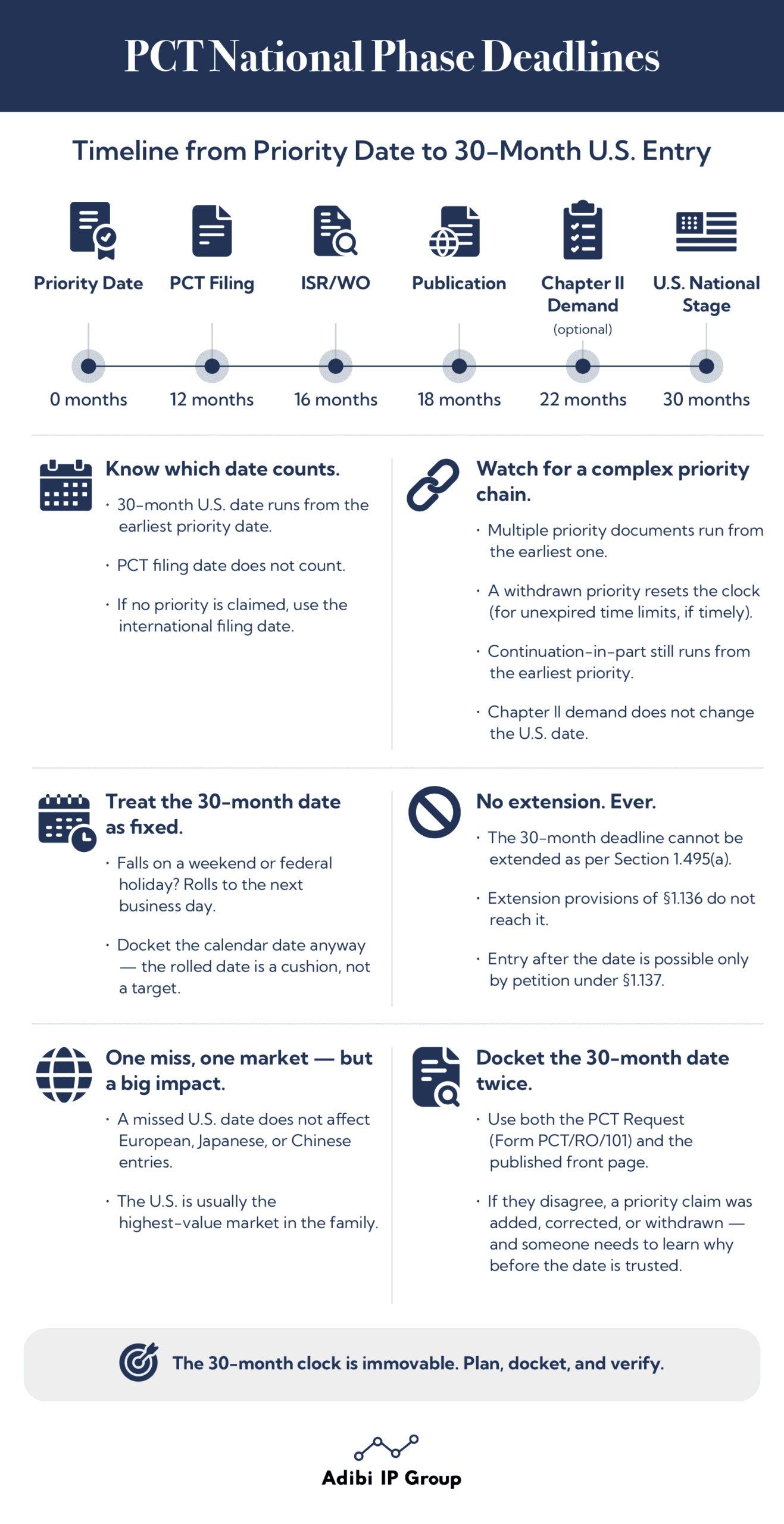
0 months: Priority date → 12 months: PCT filing → 16 months: International Search Report (ISR) & Written Opinion (WO) → 18 months: Publication → 22 months: Chapter II demand (optional) → 30 months: U.S. national stage.
Bottom line: Calculate from the earliest priority date, docket it twice, and treat 30 months as immovable.
Petitions to Revive and Late Entry: The Narrow Procedural Lifeline Under 37 C.F.R. §1.137
The date passes. The basic national fee was never paid. What now?
The only route is a petition to revive under 37 C.F.R. §1.137(a). The standard is that the entire delay — from the missed date until a grantable petition is filed — was unintentional. The package has four parts: the petition itself (the USPTO publishes Form PTO/SB/64PCT specifically for abandoned PCT applications designating the U.S.); the petition fee under §1.17(m); a statement that the entire delay was unintentional; and the missing items themselves.
Where the petition is filed more than two years after abandonment, the USPTO requires an additional explanation of the circumstances, not just the statement (85 Fed. Reg. 12222; MPEP §711.03(c)). The practitioner who signs is under a duty to have inquired into the facts. A statement that turns out to be wrong is its own candor problem.
“Unintentional” is judged on the whole period. A deliberate decision not to enter the U.S., regretted eighteen months later because a competitor launched, is not unintentional. Revival is a lifeline for the missed reminder, the mis-docketed date, the associate who left. It is not a strategy.
The two-year line is a practical cliff. A missed date caught at a 33-month portfolio audit is a routine petition. The same miss discovered during financing diligence three years later is a hard one, with an explanation the acquirer’s counsel will read closely.
Two alternatives exist, both narrow. If the PCT is still pending, a bypass continuation under §111(a) may be filed instead. And if there has been an intervening disclosure or a third party has begun practicing the invention, the honest advice may be to abandon rather than revive a right that litigation will scrutinize.
If you have already missed a deadline, contact us today for an assessment of revival options.
Bottom line: Revival is a lifeline, not a plan — budget and docket so you never need it.
With the statute and the deadline clear, the next question is practical: exactly what goes in the filing package, and in what order.
Mandatory Filing Requirements and Formalities for USPTO National Stage Compliance
The U.S. national phase entry requirements are set out in 37 C.F.R. §1.495, and the rule’s own structure is the checklist. Subsection (b) lists what is fatal at 30 months. Subsection (c) lists what the Office will notice and let you cure. The sections below take each item in the order a well-run entry handles them.
The Core Document Package: What Must Be Filed on Day One of National Phase Entry
A complete national stage submission is one transmittal letter and a short stack of enclosures. The transmittal, Form PTO-1390, tells the Office which application is entering, whether Article 19 or 34 amendments are to be kept out, whether a preliminary amendment or an IDS is enclosed, and who the applicant is. A wrong box on that form is among the most common reasons a Notice of Missing Requirements issues on an otherwise complete file.
Behind the transmittal, §1.495(b) requires two items by 30 months: the basic national fee, and a copy of the international application unless the IB has already communicated it or it was originally filed at the USPTO. Usually the IB has; under PCT Rule 93bis, the IB’s publication of the application at about 18 months is treated as that communication (MPEP §1893.01(a)(1)). Verify that in ePCT before relying on it; a communication that never happened is a fatal defect no one catches until the notice arrives.
Section 1.495(c) lists the curable items: the English translation, the inventor’s oath or declaration, the search fee, the examination fee, any application size fee, and translations of Article 19 and 34 amendments. Curable is not free. Late search or examination fees and a late declaration each trigger the §1.492(h) surcharge, and a late translation carries the §1.492(i) processing fee. The Notice of Missing Requirements usually sets a period of two months from the notice or 32 months from the priority date, whichever is later, extendable under §1.136(a) — but every month spent there is a month examination has not started.
There is a second reason to file everything on day one. Under 35 U.S.C. §154(b) and 37 C.F.R. §1.703(a)(1), the 14-month clock for the Office’s first action runs from the date the national stage commenced under §371(b) or (f). A package that sits in a notice cycle is not being examined.
When you file a patent from a PCT application, the package below is the day-one standard.
Day-One Filing Checklist for U.S. National Phase Entry (ordered by severity)
- Basic national fee paid and receipted.
- IB communication confirmed in ePCT, or a copy of the international application supplied.
- Form PTO-1390 completed with the correct amendment, IDS, and applicant boxes.
- English translation of the description, claims, abstract, and drawing text, as filed.
- Search fee paid.
- Examination fee paid.
- Inventor declarations, or an Application Data Sheet (ADS) naming every inventor with mailing address and residence.
- Article 19/34 election made on the transmittal, with annex translations.
- Power of attorney (Form PTO/AIA/82) and a U.S. correspondence address.
- IDS built from the international-phase file.
Ten items, one filing, no surcharge.
The rule text is at 37 C.F.R. §1.495 on eCFR.
Bottom line: Only two items are fatal at 30 months, but filing everything on day one is the cheapest path.
Translation Requirements: Navigating the English-Language Mandate Without Costly Errors
The translation you file becomes the U.S. specification. Every later amendment, claim construction argument, and written-description challenge will be measured against it, not against the German, Japanese, or Chinese original.
The USPTO requires an English translation of a non-English international application as filed. No accuracy statement, notarization, or sworn translator is required; the Office may require verification under §1.495(f) only where it considers it necessary. Translate the description, claims, abstract, any text in the drawings, and any Article 19 or 34 amendments you intend to enter. A translation of less than the whole application — one that omits drawing text, or translates the amended claims but not the originals — is unacceptable (MPEP §1893.01(d)). For applications filed on or after 1 July 2022, language-dependent free text in an XML sequence listing must be translated too.
Errors cut both ways. A translation that narrows a claim term gives away scope. One that broadens it invites a written-description rejection under §112(a) and a new-matter fight, because corrections are limited to what the original PCT text supports.
Yes, the translation may be filed after 30 months in response to a Notice of Missing Requirements — with the §1.492(i) processing fee and a later start to examination. Families with priority documents in several languages need one coordinating translator and one glossary, so the same technical term does not arrive in the U.S. under three names.
Literal translations of European and Japanese claim language routinely produce sentences a U.S. examiner reads as indefinite under §112(b). Having U.S. counsel read the translated claims before entry costs a preliminary amendment. Discovering the problem after the first Office action costs a full response cycle.
| Component | Translation required? | Common error |
| Description | Yes | Inconsistent technical terms across sections |
| Claims | Yes | Literal syntax that reads as indefinite |
| Abstract | Yes | Omitted entirely |
| Text in drawings | Yes | Untranslated flowchart labels |
| Article 19/34 amendments | Yes, if entered | Annexes left untranslated and treated as canceled |
| Sequence listing free text | Yes (post-July 2022 filings) | Assumed exempt |
Bottom line: The translation becomes the U.S. specification — review it as carefully as the original.
The Oath or Declaration Requirement: Satisfying 37 C.F.R. §1.497 Without Triggering Deficiency Notices
An inventor in Osaka has retired. Another in Munich has moved to a competitor and stopped answering email. The U.S. entry is due in six weeks. This is when the declaration requirement becomes real.
Section 1.497 largely incorporates the standard §1.63 declaration. The differences are timing and one useful shortcut: a declaration made under PCT Rule 4.17(iv) during the international phase can serve as the U.S. declaration if it complies with §1.63 and was submitted within the PCT Rule 26ter.1 time limits. Where an inventor is deceased, legally incapacitated, cannot be found or reached after diligent effort, or refuses to sign, the applicant may file a substitute statement under §1.64 instead.
Under the America Invents Act (AIA), an assignee may be the applicant. That does not eliminate the inventor’s declaration. A frequent misconfiguration in inbound files is a PCT naming the company as applicant and a U.S. entry with no declaration and no substitute statement, on the theory that the company already “owns” the filing.
Timing has real flexibility. If the entry includes an ADS listing each inventor’s legal name, mailing address, and residence, the declaration may be postponed until the application is otherwise in condition for allowance, and must be filed no later than payment of the issue fee. Two cautions: postponement does not avoid the §1.492(h) surcharge for a declaration filed after commencement, and no RCE is available until every declaration is in.
Declaration Pre-Flight Checklist
- Names and residences match the ADS exactly.
- Declaration identifies the PCT application number and title.
- Each inventor has signed and dated, or a §1.64 substitute statement is ready.
- Any PCT Rule 4.17(iv) declaration from the international phase has been checked for U.S. compliance.
- Declarations were collected before the 24-month checkpoint, not the week of entry.
Bottom line: Collect signed declarations during the international phase so the U.S. entry never waits on an inventor.
Power of Attorney and Agent Representation: USPTO-Specific Rules That Differ From Other Jurisdictions
Every Notice of Missing Requirements and every Office action goes to one address: the correspondence address of record. If the PCT named a foreign agent and no U.S. power or address was filed at entry, the notice goes overseas, sits in a mailbox, and the cure period runs. Of all the single points of failure in a U.S. entry, this is one of the most often left to chance.
The USPTO permits only registered patent practitioners to represent others before the Office in patent matters (37 C.F.R. §11.10). A European or Japanese attorney may assemble the file, advise the client, and instruct U.S. counsel, but may not sign a response or amendment; an amendment signed by someone without authority to prosecute is not entered (MPEP §714.01(a)). Appoint U.S. counsel with Form PTO/AIA/82 or a customer-number-based power, and set the correspondence address at the same time. A power of attorney is a written document under §1.32(a)(2); a customer number association alone is not a power of attorney, and conflating the two is a common docketing failure.
The division of labor that produces the fewest round-trips:
| Foreign associate sends | U.S. registered practitioner handles |
| Certified priority documents (or DAS codes) | Form PTO-1390 transmittal and fee payment |
| Complete PCT file: request, ISR, Written Opinion, IPRP | ADS, power of attorney, correspondence address |
| Every reference cited in any office, with English abstracts | IDS preparation and filing under §1.97 |
| Signed declarations or facts supporting substitute statements | Entity status verification and certification |
| Assignment and applicant details | Claim review, preliminary amendment, prosecution |
Bottom line: Appoint U.S. counsel and set the correspondence address before 30 months, not after the first Office action.
National Stage Fees: Government Fee Structures, Surcharges, and Strategic Payment Timing
The U.S. national stage carries five fee categories, each with its own timing rule. The basic national fee is due at 30 months without exception. The search fee and examination fee are curable but each attracts the §1.492(h) surcharge if paid after commencement; the application size fee is curable per the notice without that surcharge. Excess-claim fees apply to each independent claim beyond three, each claim beyond twenty, and to the presence of any multiple dependent claim (§1.492(d)–(f)) — best avoided by trimming the claim set before entry.
Two variables move the numbers. The search fee is reduced where the USPTO acted as International Searching Authority, or where an International Search Report from another authority is provided to the Office; it is reduced further where a USPTO written opinion or International Preliminary Examining Authority report found every claim novel, inventive, and industrially applicable (§1.492(b)). Entity status — micro, small, or large — reduces most fees, but each status claim is a certification, and an improper claim can be treated as fraud on the Office.
Small-entity status is a group test, not a company test. Status is lost if the applicant has licensed, or is under an obligation under contract or law to license, rights in the invention to a large entity (§1.27). A start-up with a distribution or joint-development agreement with a large partner often certifies a status it is not entitled to. Check the licensing chain before ticking the box.
| Fee | When due | Surcharge if late? | Entity discount? |
| Basic national fee | 30 months — fatal | No cure | Yes |
| Search fee | Day one (curable) | Yes, §1.492(h) | Yes, reduced by ISA |
| Examination fee | Day one (curable) | Yes, §1.492(h) | Yes |
| Application size fee | Day one (curable) | Per notice | Yes |
| Excess-claim fees | With the claim set | Assessed as due | Yes |
| Late declaration surcharge | On filing after commencement | n/a | Yes |
Current amounts are on the USPTO fee schedule; they change, so do not budget from a memo.
Bottom line: Pay the basic national fee by 30 months without exception; plan the rest to avoid surcharges.
Formalities get the application in the door; what keeps it enforceable is what happens next — disclosure obligations and claim strategy.
Information Disclosure Statement Obligations and Claim Strategy in the U.S. National Stage
IDS Requirements in the National Stage: The Disclosure Obligation That Sets the USPTO Apart From Other Major Patent Offices
The International Search Report cited six references. The EPO examiner added two more. The Japanese office action cited a utility model no one in the U.S. has read. Under 37 C.F.R. §1.56, every one of those belongs in front of the U.S. examiner.
The duty of candor applies from the moment of national stage entry and binds inventors, applicants, attorneys, and anyone substantively involved in prosecution. In plain terms: if you know of a reference a reasonable examiner would consider material, you must disclose it. The mechanism is the IDS, filed on Form SB/08. Do not assume the examiner will consider international-phase citations on their own; submit them.
The timing windows under §1.97 reward speed. Within three months of entry (§1.97(b)(2)), or before the first Office action on the merits (§1.97(b)(3)), an IDS needs no fee and no statement. After the first action but before final rejection or allowance, it needs one of two things: a statement that the reference was first cited abroad within the past three months, or the §1.17(p) fee. After final rejection or allowance, it needs both. After the issue fee is paid, nothing can be added without an RCE. Non-English references need an English abstract or a concise explanation of relevance under §1.98(a)(3), plus a copy of any English translation already in the applicant’s possession. Non-patent literature and references cited in related U.S. applications fall within the duty too.
Now, the consequence. A missed IDS creates inequitable-conduct exposure and invites an expensive defense. It does not, by itself, render the patent unenforceable. Since Therasense, Inc. v. Becton, Dickinson & Co., 649 F.3d 1276 (Fed. Cir. 2011) (en banc), a challenger must prove both specific intent to deceive and but-for materiality, each by clear and convincing evidence. That is a high bar, but the cost of defending the allegation in litigation or diligence is the real price of a missed IDS.
The duty is continuing, so the workflow must be too. Each new foreign office action in the family opens a fresh three-month window under §1.97(e)(1) to file the new citations without a fee. The teams that never have an IDS problem are not the ones with perfect memories. They are the ones whose docketing system opens a U.S. IDS task every time a foreign action arrives.
| Window | What’s required | Fee? | Statement? |
| Within 3 months of entry or before first action | IDS on SB/08 | No | No |
| After first action, before final or allowance | IDS | Either the §1.17(p) fee | or a §1.97(e) statement |
| After final or allowance, before issue fee | IDS | Yes | Yes |
| After issue fee paid | RCE required | — | — |
See 37 C.F.R. §1.97 on eCFR for the rule text.
We build the IDS from your international-phase file as part of every §371 entry. Talk to Adibi IP Group.
Bottom line: Treat the IDS as a day-one deliverable built from the international phase file.
Strategic Claim Alignment: Translating PCT Claims Into USPTO-Compliant Claim Architecture
A claim that sailed through the EPO can arrive in the U.S. carrying three problems at once: a “means for” clause with no structure in the specification, a chain of multiple dependencies, and twenty-six claims where twenty would do.
U.S. law treats functional language without structural support as means-plus-function under 35 U.S.C. §112(f), limiting the claim to the structures actually described; the test is whether the claim words carry a sufficiently definite meaning as the name for structure to a person of ordinary skill (MPEP §2181). Indefiniteness under §112(b) catches relative terms and literal translations. Multiple dependent claims carry a separate fee and, for fee purposes, count as the number of claims they directly reference (37 C.F.R. §1.75(c)). The fee schedule prices the set at three independent and twenty total before surcharges begin.
The strategic choice at entry is which claim set the examiner sees first: the original PCT claims, the Article 19 or 34 amended claims, or a preliminary amendment filed with the §371 submission. Reading the International Search Report and Written Opinion before choosing lets you anticipate the first rejection and avoid amendments that narrow scope unnecessarily, which also limits prosecution history estoppel later.
Three conventions foreign drafters most often miss: “characterized in that” two-part form is permitted but unfamiliar to U.S. examiners and rarely helps; reference numerals in claims are allowed but must not be read as limiting; and “comprising” is open, “consisting of” is closed, and “consisting essentially of” sits between — choose deliberately.
One preliminary amendment with the §371 submission is often cleaner than letting Article 19 or 34 amendments enter. It sets a single, U.S.-drafted claim set, avoids translating annexes, and fixes multiple dependencies and §112(f) triggers in one document. A preliminary amendment filed with the initial submission that cancels claims or eliminates multiple dependencies also reduces the excess-claim fees due (MPEP §1893.01(c)). The examiner reads one claim set, not a stack of amendments. That review is the core of the patent consulting done before every entry.
Bottom line: Enter with claims drafted for a U.S. examiner, not merely translated for one.
Amendments Entering the National Stage: Managing PCT Article 19 and Article 34 Amendments at the USPTO
The default runs the opposite way from what many foreign teams expect. Article 19 amendments, made after the International Search Report, and Article 34 amendments, annexed to the International Preliminary Report on Patentability (IPRP) during Chapter II, are entered into the U.S. application by default when they are in English — unless the applicant checks the box on Form PTO-1390 instructing the Office not to enter them (MPEP §1893.01(a)(2)–(3)). Amendments in another language enter only with an English translation. Article 19 amendments and their translation must reach the Office by 30 months or they are considered canceled (§1.495(d)); translations of Article 34 annexes may follow within the notice period with the §1.492(f) processing fee, and annexes still untranslated at the end of that period are treated as canceled (§1.495(e)).
That default is where files go wrong. An associate who worked hard on Article 34 amendments to overcome the Written Opinion may assume they were kept out, or never think about them at all. Or the opposite: amendments drafted for an EPO examiner enter automatically and narrow the U.S. claims for no U.S. reason. Either way, no one decided.
The second risk is support. Any amendment must be supported by the international application as filed; one that introduced new language will draw a new-matter objection under §132 and a written-description rejection under §112(a). Entry of an international-phase amendment does not mean it is proper — the examiner applies the same new-matter analysis as in any §111(a) application. Reconcile every pre-entry amendment against the PCT as filed before submitting the package, and consider whether a fresh preliminary amendment is cleaner than entering the international-phase history.
Bottom line: Decide deliberately which amendments enter the U.S.; do not leave it to default handling.
A compliant U.S. entry rarely happens in isolation — it is one of several national phase entries running on overlapping clocks.
Jurisdiction-Specific Considerations and Strategic Planning for Multi-Country National Phase Entry
Comparing USPTO Requirements Against Other Major Patent Offices: Where the U.S. National Stage Stands Apart
Lay the five major offices side by side and the U.S. is not the earliest deadline. It is the heaviest package.
The European Patent Office (EPO) and the Korean Intellectual Property Office (KIPO) allow 31 months. The Japan Patent Office (JPO) and the China National Intellectual Property Administration (CNIPA) allow 30, and CNIPA permits late entry to 32 months with a surcharge. The JPO allows the Japanese translation to follow within two months of the national-phase request, provided that request is filed in the final two months of the 30-month period. The USPTO allows 30 months, no extension, and a late translation only in response to a notice, with a processing fee.
Three features make the U.S. package heavier. Most offices require a local representative; the USPTO requires a registered practitioner to prosecute. Most offices accept an assignee filing with no inventor signature; the USPTO requires a declaration or substitute statement from each inventor. And no other major office imposes a §1.56-style duty of candor backed by an IDS filing obligation. That last difference is structural, and it is the one foreign teams most often underestimate.
The sequencing consequence is simple: start the U.S. package first, not because its date is earliest, but because it has the most moving parts and the least forgiveness. (Verify every foreign-office rule at the time of filing; these change.)
Comparison of PCT National Phase Rules
| Office | Deadline from priority | Extension? | Translation due | Local representative? | Disclosure duty? |
| USPTO | 30 months | No — revival only | Per notice, with processing fee | Registered practitioner to prosecute | Yes — §1.56 / IDS |
| EPO | 31 months | Limited further processing | At entry | Yes, for non-EPC applicants | No equivalent |
| JPO | 30 months | No | Within 2 months of the national-phase request, if that request is filed in months 29–30 | Yes | No equivalent |
| CNIPA | 30 months | To 32 months with surcharge | At entry | Yes | Limited |
| KIPO | 31 months | No | By 31 months, one-month extension on request (fee) | Yes | No equivalent |
Bottom line: The U.S. deadline is not the latest, but the U.S. package is the heaviest — start it first.
Timeline Planning and Docketing Architecture for Reliable National Phase Compliance
A docketing system that tracks only the 30-month date will let you miss the surcharge window, the IDS window, and the response period after a Notice of Missing Requirements. Track all four in one place, with one owner per jurisdiction.
The architecture that works has three internal checkpoints. At 18 months, when the application publishes, make the go/no-go decision on jurisdictions and set the budget. At 24 months, commission translations, circulate declarations, engage U.S. counsel, and sign the power of attorney. At 28 months, assemble and review the complete package, draft the IDS, and confirm entity status. Nothing here is new work; the checkpoints simply move it away from the deadline.
Use the IB’s notifications and WIPO’s ePCT platform to confirm that the international application has been communicated to the USPTO and to track entry status across every designated office. Between the foreign associate, the in-house team, and U.S. counsel, the question at every checkpoint is the same: who owns this item, and has it been done?
| Month | Decision | Documents collected | Owner |
| 18 | Jurisdictions and budget approved | ISR, Written Opinion, publication | In-house IP manager |
| 24 | Translations commissioned, U.S. counsel engaged | Draft translation, signed declarations, POA | Foreign associate |
| 28 | Package reviewed, IDS drafted, entity status confirmed | Complete §371 package, SB/08, PTO-1390 | U.S. registered practitioner |
Bottom line: Three checkpoints and one owner per jurisdiction prevent most last-minute failures.
Avoiding the Domino Effect: Risk Mitigation Strategies That Protect the Value of the Global Patent Portfolio
In a diligence data room, the question is never “is the invention good?” It is “is the U.S. patent clean?” A defective declaration, an unfiled IDS, or a mis-certified entity status will not usually kill the patent, but each becomes a line item in a diligence memo, a discount in a valuation, or a defense in litigation. For a venture-backed company, the U.S. entry is where those line items are created or avoided.
The failure points repeat: priority-date miscalculation, unverified IB communication, missing or defective declarations, untranslated amendments, missed IDS windows, wrong entity status, and a correspondence address left overseas. Each has a cheap verification step, cheapest before examination begins. A patent portfolio analysis run before the first Office action catches most of them.
National Phase Compliance Audit — ten checks with the rule beside each:
- 30-month date recomputed from the earliest priority claim (PCT Arts. 22, 39).
- Basic national fee paid and receipted (§1.495(b)(2)).
- IB communication confirmed in ePCT (§1.495(b)(1)).
- Translation on file, complete as filed (§1.495(c)(1)).
- Declaration or ADS postponement in place for every inventor (§1.497).
- Article 19/34 election matches the transmittal (§371(c)(3), (5)).
- Power of attorney and correspondence address are U.S. counsel’s (§1.32).
- IDS filed within the §1.97(b) window with all ISR, Written Opinion, and foreign citations (§§1.56, 1.97).
- Entity status verified against the licensing chain (§§1.27, 1.29).
- Claims reviewed for §112(f) triggers, multiple dependencies, and excess-claim fees.
Bottom line: Audit before the first Office action — defects are cheapest to fix before examination begins.
Pulling the checklist together, here is what to do this week if you have a PCT application approaching 30 months.
Your U.S. National Phase Entry Checklist: Next Steps and When to Engage U.S. Counsel
Two items are fatal at 30 months: the basic national fee and a copy of the international application at the USPTO. The only lifeline after the date is a §1.137 petition for unintentional delay, and it gets harder after two years. Everything else is a question of cost and timing. PCT national phase deadlines are not hard to meet; they are easy to mis-docket.
Do this now:
- Calculate the 30-month date from the earliest priority claim and docket it from two sources.
- Verify in ePCT that the IB has communicated the application to the USPTO.
- Commission the English translation of the application as filed, and give the translator one glossary.
- Circulate inventor declarations now; prepare substitute statements for anyone who cannot sign.
- Engage a registered U.S. practitioner, file the power of attorney, and set the U.S. correspondence address.
- Build the IDS from the ISR, Written Opinion, IPRP, and every foreign counterpart citation.
- Have U.S. counsel review the claims and decide whether Article 19/34 amendments should enter or a preliminary amendment should replace them.
The U.S. is where a PCT family is most often lost to paperwork rather than prior art — and where that paperwork, done once and done on day one, buys the cleanest asset in the portfolio. The rules are enumerated, the deadlines are fixed, and every failure point above has a verification step that costs less before examination than after. Run the audit, hold the checkpoints, and the 30-month date becomes a routine filing rather than a diligence question.
Don’t manage the 30-month clock alone. Adibi IP Group handles §371 national stage entry, IDS compliance, and claim alignment for international IP teams, foreign associates, and founders bringing a PCT family into the United States. We review the file, build the day-one package, and stay on the IDS for the life of the application. Contact Adibi IP Group before your 30-month date.
This article is for general information and is not legal advice.