
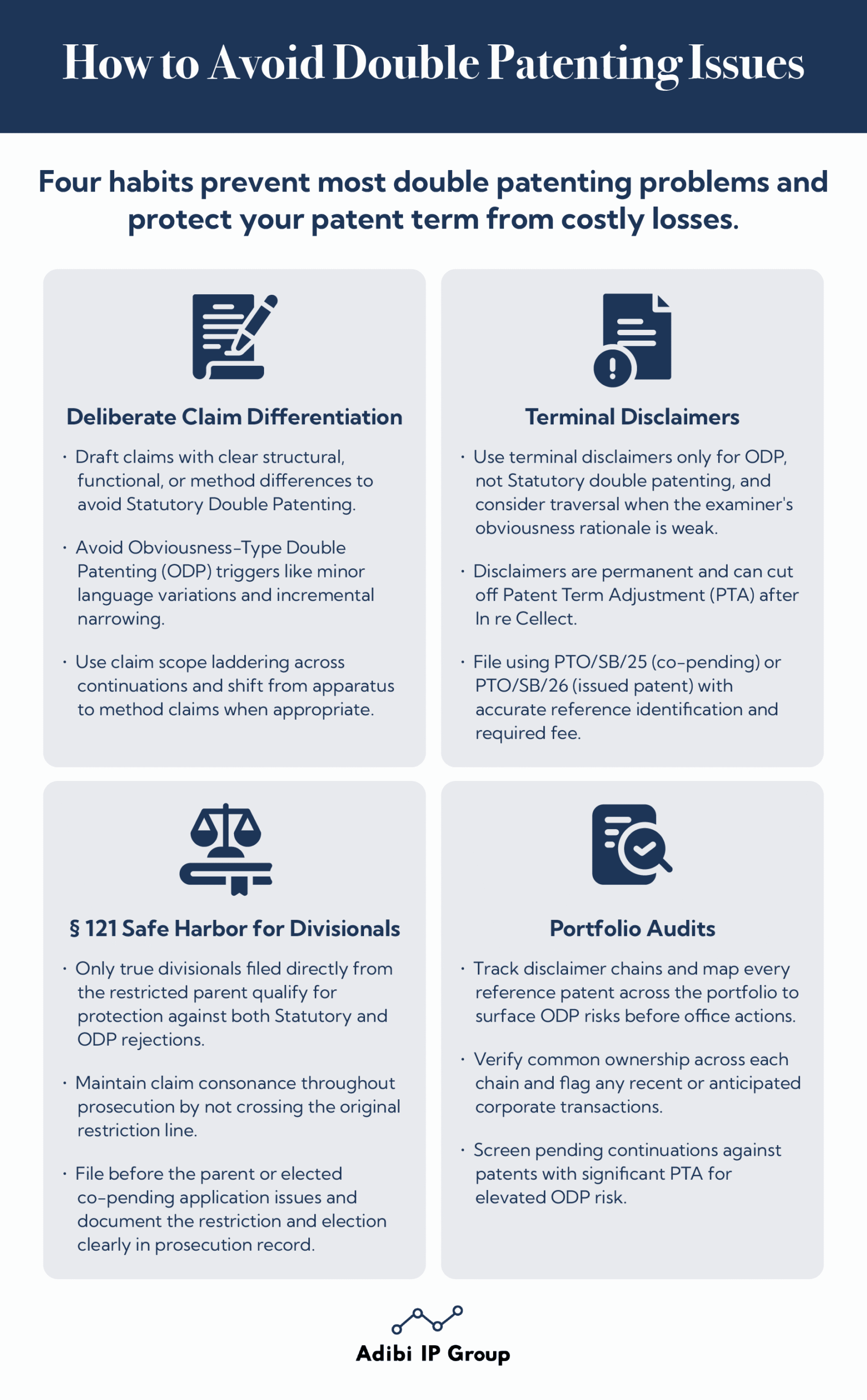
Avoiding double patenting issues comes down to four habits: deliberate claim differentiation when drafting related applications, timely and correctly executed terminal disclaimers when ODP rejections arrive, careful preservation of the § 121 safe harbor on divisionals, and ongoing portfolio audits tracking disclaimer chains and common ownership. Statutory double patenting (two patents claiming literally identical subject matter) requires claim amendment and cannot be cured by a terminal disclaimer. Obviousness-type double patenting (ODP), the far more common rejection, is typically resolved by terminal disclaimer, claim amendment, or substantive traversal. The choice among the three has grown materially harder since the Federal Circuit’s 2023 decision in In re Cellect placed PTA-derived term squarely within the ODP analysis. This guide covers the doctrine and its triggers, terminal disclaimer mechanics, claim strategy alternatives, the § 121 safe harbor, portfolio-level strategy, and the recent Federal Circuit decisions reshaping the field.
Key Takeaways
- Two doctrines, two cures. Statutory double patenting under 35 U.S.C. § 101 requires claim amendment; obviousness-type double patenting (ODP) is usually resolved by terminal disclaimer, amendment, or traversal. Confusing the two is the most common preventable prosecution error.
- Cellect changed the calculus. The Federal Circuit held that ODP analysis must use the post-PTA expiration date, and earlier-expiring family members can serve as ODP references against PTA-extended ones. The Supreme Court denied certiorari on October 7, 2024, making Cellect settled law.
- Allergan narrowed the blast radius. A first-filed, first-issued, later-expiring claim cannot be invalidated by a later-filed, later-issued, earlier-expiring reference claim sharing a common priority date. Acadia v. Aurobindo (nonprecedential) applied that holding in 2025, with an en banc petition pending.
- PTA dies, PTE survives. Under Novartis v. Ezra Ventures, Patent Term Extension survives a terminal disclaimer; Patent Term Adjustment generally does not. With most patents receiving at least some PTA, averaging roughly 411 days where granted, and exceeding a year for more than a quarter of all patents. The disclaim-versus-amend decision now carries real commercial stakes.
- Disclaimers are permanent. In re Dinsmore confirms that an improperly filed terminal disclaimer cannot be undone by reissue under 35 U.S.C. § 251. Treat each filing as a strategic decision, not a clerical task.
- The § 121 safe harbor is earned, not given. Only a true divisional filed directly from the restricted parent qualifies (G.D. Searle v. Lupin), and consonance must be maintained throughout prosecution (St. Jude Medical v. Access Closure).
- The terminal-disclaimer NPRM is dead. The USPTO withdrew its May 2024 proposal on December 4, 2024, after more than 300 comments and a joint letter from five former senior USPTO officials. 37 CFR 1.321(c) and (d) remain the governing rules.
- Portfolio discipline beats office-action firefighting. Audit disclaimer chains, verify common ownership before every corporate transaction, and screen continuations against PTA-bearing parents before filing.
Understanding Double Patenting: The Two Core Rejection Types
Double patenting is not a single doctrine but two distinct rejections with very different cures. Confusing them is the most common source of preventable prosecution missteps.
| Issue | Statutory Double Patenting | Obviousness-Type Double Patenting (ODP) |
| Legal basis | 35 U.S.C. § 101 (statutory) | Judicially created doctrine |
| What triggers it | Identical claim subject matter across two patents or applications | Claims not “patentably distinct” from claims in a reference patent or co-pending application |
| Cured by terminal disclaimer? | No | Yes, in most cases |
| Typical resolution | Claim amendment to eliminate identity | Terminal disclaimer, amendment, or substantive traversal |
Statutory Double Patenting: When the Same Invention Appears Twice
Statutory double patenting under 35 U.S.C. § 101 prohibits claiming literally identical subject matter across two patents or applications by the same inventive entity. The test is claim-by-claim coextensiveness, not mere overlap. A terminal disclaimer cannot cure it because the rejection is grounded in § 101’s prohibition on duplicate patents, not in unjust term extension. Only claim amendment — or, rarely, abandonment of one application — resolves it.
In modern prosecution, statutory rejections are uncommon. Examiners tend to issue ODP rejections preferentially because the analytical bar is lower and the cure is administratively cleaner, a pattern consistent with the doctrinal framework laid out in MPEP § 804. When a statutory rejection does appear, it usually signals that claims have drifted into literal identity during amendments, and a claim-by-claim diff against the reference at the response stage is typically enough to confirm whether the rejection has merit.
Obviousness-Type Double Patenting: The More Frequent and Nuanced Threat
ODP, sometimes written OTDP, is a judicially created doctrine that blocks claims not patentably distinct from claims in a reference patent or co-pending application. The doctrine traces to the 19th-century concern, articulated in cases such as Miller v. Eagle Manufacturing Co., 151 U.S. 186 (1894), that a single inventor should not obtain multiple patents covering obvious variants of the same invention.
The analysis runs in two steps: claim construction and comparison, then a determination of whether the differences would have been obvious to a person of ordinary skill in the art. The reference claim plays a role analogous to (though not identical to) prior art under § 103. Because ODP reaches obvious variants and not just identical claims, it dominates modern patent prosecution. Its modern justification is twofold: preventing unjustified extension of the patent monopoly and preventing harassment of accused infringers by multiple assignees holding patents on obvious variants.
The families most vulnerable are recognizable: large continuation chains sharing a common specification, parent-child relationships where child claims narrow or restate parent claims, and co-pending applications owned by the same entity claiming overlapping subject matter.
A useful mental model:
- Reference claim: A composition comprising compound X and a pharmaceutically acceptable carrier.
- Pending claim (patentably indistinct): A composition comprising compound X and a buffer.
- Pending claim (patentably distinct): A method of treating disease Y by administering compound X at a defined dosage range to patients exhibiting a specified biomarker profile.
The doctrinal shift that matters most for 2026 practice came in In re Cellect, LLC, 81 F.4th 1216 (Fed. Cir. 2023). The Federal Circuit held that when family members differ in expiration dates solely because of Patent Term Adjustment, earlier-expiring members can serve as ODP references against later-expiring ones, and that ODP analysis must use the expiration date after PTA has been added. The Supreme Court denied certiorari on October 7, 2024, making Cellect settled law. Before Cellect, many practitioners treated PTA as effectively immune from ODP attack, by analogy to Patent Term Extension under Novartis AG v. Ezra Ventures LLC. That assumption is no longer safe; portfolios with significant PTA accrual now carry materially elevated ODP risk — and given that most patents receive at least some PTA, with PTA-bearing patents averaging 411 days of added term and more than 25% receiving over a year, the exposure is broad rather than niche.
The Federal Circuit cabined Cellect in Allergan USA, Inc. v. MSN Laboratories Private Ltd., 111 F.4th 1358 (Fed. Cir. 2024), holding that a first-filed, first-issued, later-expiring claim cannot be invalidated for ODP by a later-filed, later-issued, earlier-expiring reference claim sharing a common priority date. The court applied this reasoning in a nonprecedential disposition in Acadia Pharmaceuticals Inc. v. Aurobindo Pharma Ltd., No. 2024-1401 (Fed. Cir. June 9, 2025), where both parties agreed the case was “entirely controlled by” Allergan; an en banc rehearing petition was filed August 8, 2025. Parent patents that issue first and receive PTA now enjoy a measure of insulation from intra-family attack by their own later-filed continuations. The exception is narrow, fact-specific, and the subject of ongoing en banc activity — building strategy on the assumption that Allergan will hold in every fact pattern is a mistake.
Office Actions and the Examiner’s Analysis
A USPTO office action raising an ODP rejection identifies the reference, the specific claims being compared, and the examiner’s obviousness rationale. “Patentably indistinct” means claims reciting the same invention or an obvious variant, where the differences would have been obvious at the relevant priority date. These rejections typically appear in the first office action when the reference has already issued, or in a later action when the reference issues during prosecution. Red flags before a formal rejection include examiner comments noting “related” claims in a parent or sibling, restriction requirements without clear independent-and-distinct findings, and informal examiner requests for terminal disclaimers.
A four-line framework for reading any ODP rejection on arrival: identify the reference (which patent or application is cited), the claims at issue (which subject claims map to which reference claims), the obviousness rationale (what differences, why obvious), and the strategic posture — is the reference in the same family, separately owned, or co-pending, and is the expiration-date differential large enough to make a disclaimer costly?
Recognizing the Triggers: What Causes Double Patenting Rejections
Which filings and prosecution decisions generate double patenting rejections in real portfolios?
How Continuation and Divisional Applications Create Exposure
Continuations sharing a common parent naturally generate overlapping claim scope; examiners regularly identify obvious variants between parent and child claims. Divisionals — theoretically protected by the § 121 safe harbor — can still face ODP rejections when claims drift beyond the originally restricted invention. The safe harbor is not automatic; it must be earned through prosecution discipline. The reference patent or application is the anchor for the examiner’s analysis, and its claim scope (not its disclosure) governs the comparison.
Six checkpoints are worth running before filing any continuation or divisional application:
- Compare claims against every issued and pending family member.
- Identify which family members have PTA, and assess post-Cellect exposure.
- Confirm whether a prior restriction requirement governs the filing and whether consonance can be maintained.
- Verify common ownership across the entire family — flag any IP assignments or pending corporate transactions.
- Consider whether the planned claim scope is meaningfully distinct or merely an incremental variant.
- Document the prosecution rationale contemporaneously to support any future traversal or safe harbor argument.
Patent Family Dynamics and Cross-Application Claim Overlap
Large families amplify ODP risk geometrically. Each new continuation must be analyzed against the parent and every issued or pending sibling. Claims in a parent can become reference claims blocking downstream continuations, and PTA on the parent does not insulate the family from intra-family ODP attack on its later-expiring members. Co-pending applications create mutual exposure even before any patent issues. Claim mapping belongs at the front end of prosecution, not the back; reactive mapping wastes prosecution rounds and forces tactical concessions that proactive analysis would have avoided.
Terminal Disclaimers: The Primary Tool for Resolving ODP Rejections
When an ODP rejection arrives, the terminal disclaimer is most often the path of least resistance, but only when filed correctly and with full awareness of its downstream consequences.
What a Terminal Disclaimer Does
A terminal disclaimer is a formal dedication of any patent term extending beyond the expiration of the reference patent. It ties the subject patent’s expiration to the reference’s, eliminating the unjust-extension rationale underlying ODP. Under 37 CFR 1.321(c), the enforceability condition is continuous, not one-time: patents subject to a disclaimer must remain commonly owned throughout their lifetime. Reactive disclaimers filed to overcome an ODP rejection are far more common than proactive ones, but the proactive form has its place when an applicant anticipates a rejection and wants to expedite allowance.
Filing a Terminal Disclaimer Correctly: Step-by-Step
The correct form is PTO/SB/25 for a disclaimer against a co-pending application, or PTO/SB/26 for one against an issued patent. Identifying the reference requires the full patent or serial number with no abbreviations — examiners and Patent Center reject sloppy identification.
A clean filing runs in seven steps:
- Receive the office action and identify the specific reference.
- Confirm common ownership between the subject application and the reference.
- Decide whether a disclaimer is the right response or whether amendment or traversal is strategically preferable.
- Complete the appropriate form with accurate reference identification.
- Obtain the required signature from someone authorized to bind the assignee.
- File with the required fee alongside the office action response.
- Confirm acceptance via Patent Center.
Common filing errors worth avoiding:
- Wrong patent or application number (verify against the official USPTO record, not the office action text).
- Missing or improperly delegated signature.
- Incorrect ownership statement.
- Failure to pay the fee.
- Filing against a parent’s serial number when the parent has already issued, where the issued patent number should be used instead.
Patent Term Trade-Offs: Disclaimer Cost vs. Benefit
A terminal disclaimer reduces enforceable patent term whenever the reference has a shorter remaining term. The calculus is no longer one of administrative convenience — it is one of commercial value at risk.
The change began with Cellect. Filing a disclaimer to overcome an ODP rejection now also cuts off any extended patent term granted through PTA on the subject patent. This contrasts with Patent Term Extension under Novartis AG v. Ezra Ventures LLC, 909 F.3d 1367 (Fed. Cir. 2018). PTE, unlike PTA, survives a terminal disclaimer. For patents with significant PTA accrual — averaging 411 days where granted, with more than 25% of all patents receiving over a year of extra term and some receiving as much as ten years — the disclaim-versus-amend decision now carries substantially higher stakes than it did before 2023. Calculating actual term loss before recommending a disclaimer is no longer optional.
Four questions, applied in sequence, will resolve most cases:
- Is the rejection legally sound, or can it be traversed on the merits?
- Does the subject patent carry significant PTA that would be lost?
- Is the commercial value of the patent concentrated in the final years of term?
- Can claim amendment be made without creating prosecution history estoppel that would meaningfully narrow enforceable scope?
Three “amendment-favors” answers point toward amending; three “disclaimer-favors” answers point toward disclaiming. The cases in between require judgment.
Common Ownership and Enforceability Risks
All patents subject to a terminal disclaimer must be commonly owned at the time of enforcement, not just at filing. This is where corporate transactions quietly create exposure. Mergers, acquisitions, IP carve-outs, divestitures, joint ventures, and selective assignments can all sever common ownership across a disclaimer chain. Even exclusive licenses, when they approach the practical equivalent of ownership transfer, can raise the question. Due diligence around any transaction touching the portfolio should include a complete inventory of disclaimer chains, identification of the reference patent for each, and confirmation that all chain members remain commonly owned after close.
One detail makes the up-front filing decision irreversible: in In re Dinsmore, 757 F.3d 1343 (Fed. Cir. 2014), the Federal Circuit held that an improperly filed terminal disclaimer is not the type of “error” that reissue under 35 U.S.C. § 251 can correct. A disclaimer filed without proper analysis stays on the record. Treating disclaimers as routine administrative responses, rather than as strategic decisions with permanent consequences, is the most common and most expensive mistake portfolio managers make. Those facing active rejections or wanting deeper grounding in current terminal disclaimer practice will find more detail in our terminal disclaimer guidance. Questions about enforceability defense strategy for portfolios with complex disclaimer chains belong with experienced counsel.
Claim Strategy: Drafting and Amending Claims to Avoid Double Patenting
A terminal disclaimer is not always the right tool. When patent term preservation matters or the examiner’s analysis is flawed, the claim itself becomes the lever.
Proactive Claim Drafting to Minimize ODP Exposure
Deliberate claim differentiation belongs at drafting time, not at office-action time. Meaningful structural, functional, or method distinctions establish patentable distinctness more reliably than mere narrowing of a parent claim. Useful techniques include shifting from apparatus to method claims, introducing genuinely novel limitations rather than incremental ones, claiming different combinations of elements rather than minor variations, and varying claim format across family members. Claim scope laddering — drafting claims at varying levels of specificity across continuations — preserves broad coverage while creating defensible distinctions.
The language patterns examiners reliably flag as patentably indistinct are recognizable in advance: claims reciting the same core combination with minor language variation, claims adding only “wherein” clauses describing inherent properties, and claims narrowing a parent claim’s range without adding novel structural or functional content. Avoiding these patterns at the drafting stage costs far less than fighting them later.
Amending Claims to Overcome ODP Without a Terminal Disclaimer
Claim amendment is preferable to a disclaimer when the subject patent carries significant PTA that would be lost, when long-tail patent term has substantial commercial value, when the family is in active enforcement or licensing programs, or when the examiner’s obviousness analysis can be substantively challenged.
Effective amendment requires introducing a limitation the reference claims do not teach or suggest, not merely narrowing scope around the same elements. Mere narrowing rarely cures ODP and often invites further rejection. The amendment must also be analyzed for prosecution history estoppel under Festo Corp. v. Shoketsu Kinzoku Kogyo Kabushiki Co., 535 U.S. 722 (2002), and its progeny, since arguments made during prosecution can later be used by accused infringers to narrow the doctrine of equivalents analysis. Where the examiner’s obviousness reasoning is conclusory, the response can incorporate substantive challenge: examiners frequently overstate the level of skill in the art or rely on rationales that would not survive § 103 scrutiny against true prior art.
Traversing ODP Rejections: Arguments and Their Limits
Formal traversal is appropriate when the examiner’s claim comparison is incorrect, when the obviousness rationale is conclusory, or when the asserted reference is not properly the closest reference. The legal standards mirror those governing § 103 obviousness, including secondary considerations where relevant. The limits are real: the judicial nature of the doctrine gives examiners and the courts considerable discretion, and arguments often fail when claim differences are characterized as “obvious variants” even where practitioners view them as substantive. The cleanest strategy is rarely all-or-nothing. In many cases the most efficient path to allowance combines partial amendment with a disclaimer, amending where possible to preserve independent claims of value, then disclaiming against the remainder.
Restriction Requirements and the § 121 Safe Harbor for Divisionals
For divisional applications, a separate body of doctrine offers genuine protection, but only if prosecution discipline preserves it.
How Restriction Requirements Interact With Double Patenting
A restriction requirement under 35 U.S.C. § 121 separates two or more “independent and distinct inventions” into separate applications. The applicant elects one group for continued prosecution; the non-elected groups can be pursued in divisional applications. The statutory safe harbor protects a patent issuing on an application subject to a properly maintained restriction — it cannot be used as a reference against a divisional filed before the patent on the elected application issues. The protection reaches both statutory and obviousness-type rejections.
Three conditions must hold:
- A formal restriction requirement must have been imposed by the examiner.
- The divisional must be filed before the patent on the other application issues.
- Claim consonance must be maintained throughout prosecution, meaning the line of demarcation between the inventions identified in the original restriction must not be crossed.
The consonance requirement is where most safe harbor arguments fail. In St. Jude Medical, Inc. v. Access Closure, Inc., 729 F.3d 1369 (Fed. Cir. 2013), the Federal Circuit invalidated a patent where prosecution amendments had crossed the original restriction line. Equally critical, G.D. Searle LLC v. Lupin Pharmaceuticals, Inc., 790 F.3d 1349 (Fed. Cir. 2015), confirmed that only a true divisional — filed directly from the application where the restriction arose — can claim safe harbor. A continuation or continuation-in-part filed where a divisional should have been filed forfeits the protection. The operational lessons run together: file divisionals directly from the restricted parent, not from an intervening continuation, and resist amendments that pull subject matter from a non-elected group into the divisional.
Protecting the § 121 Safe Harbor Throughout Prosecution
The safe harbor is fact-specific and evidence-driven, applied without much patience for administrative sloppiness. A clean prosecution record documenting the restriction requirement and the applicant’s election is what makes a safe harbor argument viable years later.
An eight-step prosecution checklist captures the discipline:
- File the divisional directly from the parent where the restriction was imposed, not from an intervening continuation.
- File before the parent or other elected co-pending application issues.
- Confirm the divisional’s claims correspond to a non-elected group.
- Maintain claim consonance throughout prosecution.
- Avoid voluntary claim cancellations that shift scope outside the originally identified invention group.
- Document the restriction and election clearly in the prosecution record.
- For any second-generation divisional, evaluate specifically against current Federal Circuit guidance, since the doctrine in this area is not fully settled.
- Conduct a final safe-harbor verification before allowance.
Portfolio-Level Strategy: Managing Double Patenting Across an IP Portfolio
Handling a single ODP rejection is a tactical exercise. Managing risk across a portfolio of dozens or hundreds of patents is a strategic discipline, and it starts with a patent portfolio analysis that maps every disclaimer chain, every reference relationship, and every common-ownership boundary across the family book.
Auditing the Portfolio for Vulnerabilities
A systematic audit begins with a complete inventory of family relationships, then maps every filed terminal disclaimer against its reference patent, then verifies current common ownership across each chain. From there, the work shifts to mapping references against pending continuations to surface ODP risks before they become office actions. Tooling matters — docketing systems and IP management software make tracking possible at scale — but the substantive analysis cannot be outsourced to the software. The system records relationships; the practitioner interprets them. Prioritizing remediation is its own discipline: which patents are revenue-generating or in active enforcement, which have significant remaining term, and which face material exposure from family members with shorter expiration dates.
Terminal Disclaimer Chains and Portfolio Enforceability
Terminal disclaimers create chains of interdependence with cascading consequences. Each disclaimer ties the subject patent’s term and enforceability to the reference patent’s lifecycle. Invalidation or expiration of one patent in a chain can affect related patents’ enforceability, particularly where the chain is held by the same enforcement entity. The portfolio strategy is straightforward to articulate and harder to execute: keep chains short, keep all chain members commonly owned, and avoid disclaiming against patents that themselves face significant invalidity risk. Disclaimer relationships need active monitoring during licensing negotiations, litigation holds, and any corporate transaction — moments when chain dynamics shift from theoretical to consequential.
Aligning Strategy With Business Objectives
A disclaimer that surrenders three years of patent term may be acceptable for a non-core asset but disastrous for a flagship one. Communicating the trade-off to business stakeholders means translating term loss into commercial impact: lost market exclusivity, generic entry timing, licensing revenue projections. Stakeholders rarely follow the doctrine, but they understand the dollars. Sometimes the most valuable portfolio decision is the one that lets a patent go — consolidating, abandoning, or allowing certain patents to expire to simplify disclaimer chains and reduce overall risk. For portfolios with substantial legacy disclaimer activity or active M&A exposure, a structured portfolio review is the natural next step.
Recent Developments and Federal Circuit Guidance on Double Patenting
The doctrine continues to evolve, particularly at the intersection of ODP and patent term adjustment, and prosecution strategy must keep pace.
Key Federal Circuit Decisions Shaping Modern ODP Practice
Six recent decisions anchor the operating environment for 2026 prosecution practice:
- In re Cellect, LLC, 81 F.4th 1216 (Fed. Cir. 2023) — ODP analysis for a patent that has received PTA must be based on the expiration date after PTA has been added. Earlier-expiring family members can serve as ODP references against PTA-extended members. The Supreme Court denied certiorari on October 7, 2024.
- Allergan USA, Inc. v. MSN Laboratories Private Ltd., 111 F.4th 1358 (Fed. Cir. 2024) — Cabins Cellect: a first-filed, first-issued, later-expiring claim cannot be invalidated for ODP by a later-filed, later-issued, earlier-expiring reference claim sharing a common priority date.
- Acadia Pharmaceuticals Inc. v. Aurobindo Pharma Ltd., No. 2024-1401 (Fed. Cir. June 9, 2025) (nonprecedential) — Applies Allergan in a nonprecedential disposition; en banc petition filed August 8, 2025.
- Novartis AG v. Ezra Ventures LLC, 909 F.3d 1367 (Fed. Cir. 2018) — PTE, unlike PTA, survives terminal disclaimer. The asymmetric treatment of PTA versus PTE remains a critical practice point.
- In re Dinsmore, 757 F.3d 1343 (Fed. Cir. 2014) — An improperly filed terminal disclaimer cannot be corrected through reissue.
- G.D. Searle LLC v. Lupin Pharmaceuticals, Inc., 790 F.3d 1349 (Fed. Cir. 2015) — Only a true divisional, filed directly from the application in which the restriction arose, can claim § 121 safe harbor protection.
Open questions worth monitoring include the precise scope of the Allergan exception, the pending en banc activity in the Acadia line, and whether the Federal Circuit will further limit Cellect in fact patterns it has not yet addressed.
USPTO Policy Updates and Examination Guidelines
The most consequential policy event of the past two years was the proposal and withdrawal of a new terminal disclaimer rule. On May 10, 2024, the USPTO published a Notice of Proposed Rulemaking at 89 FR 40439 that would have required disclaimers to include a statement tying the subject patent’s enforceability to the validity of all patents in the chain. After more than 300 public comments — including a May 28, 2024 joint letter from five former senior USPTO officials (former Directors Andrei Iancu and David Kappos, former Commissioner for Patents Drew Hirshfeld, and former Deputy Directors Laura Peter and Russell Slifer) urging withdrawal — the USPTO formally withdrew the proposal on December 4, 2024. The status quo under 37 CFR 1.321(c) and (d) is preserved: terminal disclaimers restrict patent term and require common ownership for enforceability, but do not impose chain-wide invalidity contingencies. The underlying policy concerns have not gone away, and anticipating where examiner practice may shift remains part of the discipline.
Avoid Double Patenting Issues That Surface in Litigation or Diligence
Managing double patenting well is less about mastering any single rule and more about building habits that hold up across hundreds of files and years of prosecution. The framework condenses to four moves applied consistently: identify the rejection type, because statutory and ODP rejections demand different cures; choose deliberately among terminal disclaimer, amendment, and traversal based on term cost, estoppel risk, and the strategic posture of the affected patent; preserve the § 121 safe harbor for divisionals through prosecution discipline — direct filings, consonance maintenance, and a clean record; and audit the portfolio regularly for disclaimer chains, common ownership, and post-Cellect PTA exposure. The most expensive ODP problems are the ones that surface during litigation or M&A diligence rather than prosecution, and they are almost always preventable upstream.
What to do this quarter:
- Audit existing terminal disclaimer chains across the portfolio and map the reference patent for each.
- Confirm common ownership across each chain — flag any recent or anticipated corporate transactions.
- Review pending continuations for ODP exposure under Cellect, identifying patents with significant PTA at elevated risk.
- Verify § 121 safe harbor status for any active divisional prosecution and document the consonance record.
Portfolios carrying legacy disclaimer chains, active M&A exposure, or post-Cellect PTA risk benefit from a structured portfolio review with counsel experienced in both prosecution and enforceability analysis. Our patent portfolio analysis and patent defense practices work with IP managers on exactly these questions. To discuss a specific portfolio matter, contact Adibi IP Group.