
A single overlooked reference can undo fifteen years of prosecution. That fear keeps careful patent practitioners awake, and it is not irrational — but it is manageable. Every patent application carries a duty of disclosure: the obligation to give the U.S. Patent and Trademark Office (USPTO) all known information material to patentability. Fall short of it, and the most severe consequence of an incomplete information disclosure statement (IDS) is a court finding of inequitable conduct — a ruling that renders your entire patent unenforceable, every claim at once, with no cure through reissue or reexamination. And through the doctrine of infectious unenforceability, the damage can reach related patents in the same family.
Key Takeaways
- Inequitable conduct requires both but-for materiality and a specific intent to deceive the USPTO, each proven by clear and convincing evidence under Therasense. Intent cannot be inferred from materiality alone.
- The contingent consequences are real too: narrowed claim scope through prosecution history estoppel, invalidity attacks under 35 U.S.C. §§ 102 and 103 (often pressed in parallel through an IPR), attorney fee-shifting in “exceptional” cases under § 285, and discounted or dead deals in licensing and M&A.
- Most incomplete filings are process failures, not deception. Missed foreign-counterpart office actions, cross-citation gaps between related cases, and communication breakdowns among inventors and counsel.
- Prevention is controllable. Inventor questionnaires, a centralized cross-citing prior-art docket, a short foreign-counterpart relay rule, periodic audits, and a materiality-decision log both prevent omissions and build the good-faith record that defeats an intent allegation.
- If a gap appears, remediate immediately. A supplemental IDS while an application is pending, or supplemental examination under 35 U.S.C. § 257 before litigation, can neutralize the risk — though neither can launder fraud.
The Duty of Disclosure and What “Incomplete” Really Means in IDS Filings
Defining the Mandatory Duty of Disclosure Under 37 C.F.R. § 1.56
The duty of disclosure is the obligation, codified at 37 C.F.R. § 1.56, for everyone substantively involved in a patent application to give the USPTO all known information material to patentability. It is not a courtesy or a best practice. It is a rule, and it binds a defined group: the named inventors, the prosecuting attorneys and agents, the assignee, and anyone else meaningfully involved in preparing or prosecuting the application. The USPTO’s guidance in MPEP § 2001 treats that obligation as running to each individual personally, not just to the firm or the company.
Two features make the duty unforgiving. First, it is continuous: it attaches when the application is filed and does not lapse at any single milestone — it runs until the patent issues, and re-attaches in post-issuance proceedings. A reference that surfaces the week before allowance carries the same obligation as one you held at filing. Second, the rule is only half the story. Section 1.56 defines the prosecution duty; the far more dangerous concept — inequitable conduct — is a judge-made litigation doctrine that uses a different, narrower test. A practitioner can satisfy the spirit of § 1.56 and still face an inequitable-conduct allegation years later, because the two regimes were deliberately decoupled. Understanding that gap is the whole game: § 1.56 is the floor you clear during prosecution, and inequitable conduct is the weapon an opponent builds from whatever you left off the record.
What Constitutes an Incomplete IDS Filing
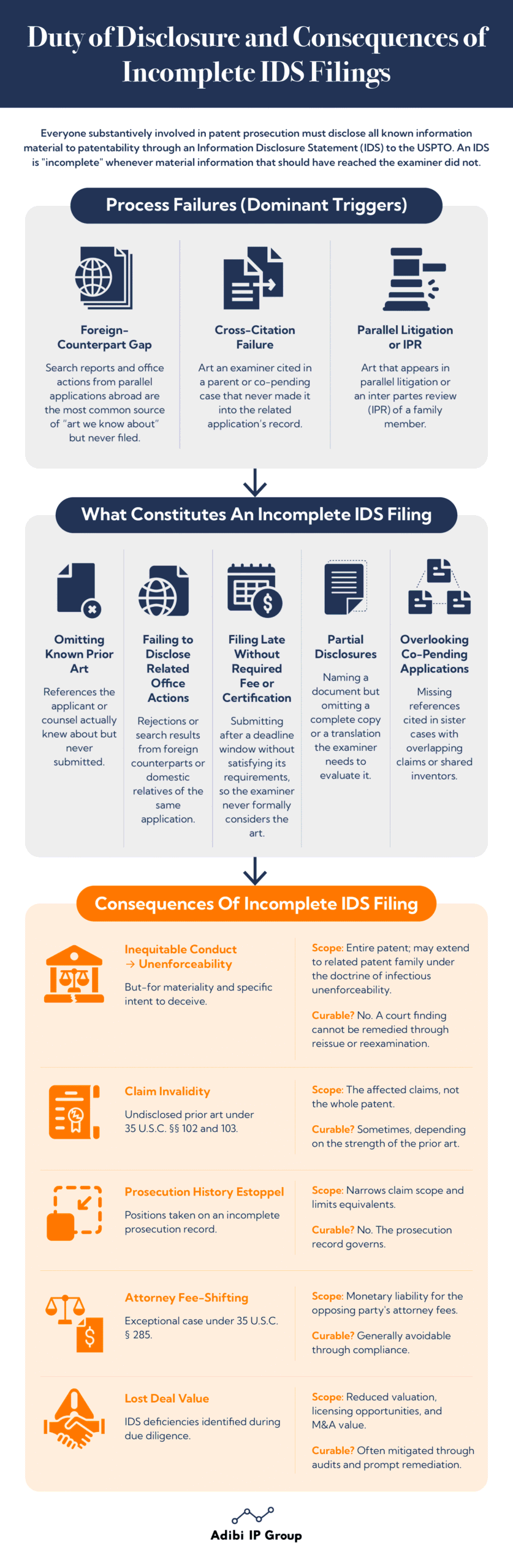
An IDS is “incomplete” whenever material information that should have reached the examiner did not. In practice, the gaps cluster into a handful of recurring failure modes:
- Omitting known prior art — references the applicant or counsel actually knew about but never submitted.
- Failing to disclose related office actions — rejections or search results from foreign counterparts or domestic relatives of the same application.
- Filing late without the required fee or certification — submitting after a deadline window without satisfying its requirements, so the examiner never formally considers the art.
- Partial disclosures — naming a document but omitting a complete copy or a translation the examiner needs to evaluate it.
- Overlooking co-pending applications — missing references cited in sister cases with overlapping claims or shared inventors.
In the field, three triggers dominate. The first is the foreign-counterpart gap: search reports and office actions from parallel applications abroad are the most common source of “art we knew about but never filed.” The second is cross-citation failure: art an examiner cited in a parent or co-pending case that never made it into the related application’s record. The third is art that appears in parallel litigation or an inter partes review (IPR) of a family member. A point worth holding onto before the stakes escalate: an incomplete IDS is exposure, not an automatic verdict. The overwhelming majority of omissions are oversights, not deceptions — and as the next sections show, oversight alone does not satisfy the legal test that destroys a patent.
The Materiality Standard: When an Omission Crosses the Legal Threshold
Not every omission matters in the eyes of a court. Since the Federal Circuit’s en banc decision in Therasense, Inc. v. Becton, Dickinson & Co., 649 F.3d 1276 (Fed. Cir. 2011), the test for materiality has been but-for: withheld information is material only if the USPTO would not have allowed the claim had it known. That standard deliberately replaced an older, looser “reasonable examiner” rule that swept in almost anything an examiner might have found interesting. Under the old rule, inequitable conduct was an “absolute plague” pleaded reflexively in patent suits. Therasense narrowed materiality precisely to stop that.
One nuance matters in practice: a reference can be but-for material for inequitable-conduct purposes even if it would not invalidate the claim at trial, because the USPTO and a federal court apply different evidentiary standards. The agency works under a preponderance standard and a broader reading of the claims; a court demands clear and convincing evidence. Information that clears the lower bar at the office can support an unenforceability finding in court regardless of how the validity fight comes out.
Courts reliably treat a few categories as material: blocking prior art that anticipates or renders obvious a claim, contradictory test or efficacy data, and adverse positions taken before a foreign patent office — the exact fact pattern in Therasense, where an applicant told the USPTO one thing and the European Patent Office another. One narrow exception sits outside the but-for test entirely: affirmative egregious misconduct, such as filing an unmistakably false affidavit, is treated as material by its nature, no but-for showing required.
What Courts Treat as Material:
| Category | Why it is material | Typical example |
| Blocking prior art | Would defeat the claim under §§ 102 or 103 | An undisclosed patent that anticipates the invention |
| Contradictory data | Undercuts the patentability arguments made to the examiner | Test results that contradict declared efficacy |
| Adverse foreign positions | Reveals inconsistent representations on the same subject matter | EPO arguments at odds with USPTO arguments (the Therasense pattern) |
| Affirmative false statements | Egregious misconduct — material per se, no but-for test | A knowingly false declaration |
Understanding what is material sets up why omitting it can detonate the whole patent, which is where inequitable conduct comes in.
Inequitable Conduct: The Nuclear Consequence of Incomplete IDS Filings
How Incomplete IDS Filings Trigger Inequitable Conduct Allegations
Inequitable conduct has two prongs, and an accused infringer must prove both by clear and convincing evidence: that the withheld information was material, and that someone acted with a specific intent to deceive the USPTO. Omissions count — you do not need an affirmative lie; a deliberate decision to withhold material art is enough to put the doctrine in play. That is why opponents treat your prosecution history as a quarry, mining every file wrapper in the family for the gap between what you knew and what you filed.
The intent prong is also where most allegations die, and it is your best reassurance. Under Therasense, the challenger must show that the individual knew of the reference, knew it was material, and made a deliberate decision to withhold it. Intent cannot be inferred from materiality alone — the fact that a reference was important does not, by itself, prove anyone hid it on purpose. Where intent rests on circumstantial evidence, deceit must be “the single most reasonable inference” the evidence will bear. Negligence does not qualify. Neither does gross negligence, nor a “should have known.” The doctrine targets deceit, not imperfection — which means a documented, good-faith judgment about a borderline reference is a formidable shield.
The Devastating Enforceability Consequences of an Inequitable Conduct Ruling
When the two prongs are met, the remedy is uniquely severe. A finding of inequitable conduct does not knock out the offending claim — it renders the entire patent unenforceable, every claim, including those that have nothing to do with the withheld reference. That is why the Federal Circuit has called the doctrine the “atomic bomb” of patent law. The patent still exists, but you can no longer assert it against anyone.
The blast radius can extend beyond the single patent. Under the doctrine of infectious unenforceability, misconduct in prosecuting one patent can render a related patent unenforceable too. But the spread is bounded, not indiscriminate. The misconduct must bear an “immediate and necessary relation” to the enforcement of the related patent — it has to connect to the targeted claims of the patent you are trying to assert. Courts have applied that principle in cases from Fox Industries through the more recent Guardant Health v. Foundation Medicine (D. Del. 2020). The flip side matters just as much: where claims are carried into a separate divisional and have no relation to the tainted art, the later patent can survive (Baxter Int’l v. McGaw, Fed. Cir. 1998). So the honest statement is not “one omission destroys everything” — it is “an omission can spread to claims closely tied to it.”
And once a court makes the finding, it is permanent. Reissue and reexamination exist to fix patentability defects; they cannot wash out a completed inequitable-conduct ruling. There is, however, an important proactive mechanism called supplemental examination under the America Invents Act (35 U.S.C. § 257) which lets a patent owner have information considered before litigation, in many cases immunizing the patent against a later charge based on that information. It is a shield you raise early, not a cure you apply after the verdict. More on it in the remediation section below.
A single incomplete filing can put an entire portfolio at risk. A patent portfolio analysis can surface and document gaps before an opponent finds them, or before they become an issue in court.
Post-Therasense Landscape: Has the Standard Changed the Risk Profile?
It is tempting to read Therasense as a safe harbor. It is not. The decision made inequitable conduct harder to prove; it did not make incomplete filings safe. Courts have continued to find inequitable conduct in the years since, and two cases make the point concrete.
In American Calcar, Inc. v. American Honda Motor Co. (Fed. Cir. 2014) — the first Federal Circuit decision to uphold inequitable conduct for nondisclosure after Therasense — three patents were held unenforceable because an inventor failed to disclose operating details of a prior-art navigation system. The striking part: the withheld art did not invalidate the claims at trial, and the intent finding rested entirely on circumstantial evidence. The heightened standard was met anyway.
In Intellect Wireless, Inc. v. HTC Corp. (Fed. Cir. 2013), the patentee submitted false declarations during prosecution and never cleanly corrected them. The court treated that as exactly the kind of affirmative egregious misconduct that is material without any but-for showing, and held the patent unenforceable.
The lesson for risk-averse practitioners is that Therasense raised the bar without removing the danger. When an omission involves a highly material reference and the surrounding facts make deceit a reasonable inference, the doctrine still bites.
Before vs. After Therasense:
| Element | Pre-Therasense | Post-Therasense |
| Materiality | “Reasonable examiner” (PTO Rule 56) — broad. | But-for — claim would not have issued. |
| Intent | Could be inferred from high materiality. | Must be proven independently; “single most reasonable inference”. |
| Sliding scale | Strong materiality offset weak intent. | Abolished — the two are separate requirements. |
| Egregious misconduct | Folded into the general test. | Distinct exception; material per se. |
| Net effect | Pleaded routinely — an “absolute plague”. | Harder to prove, not eliminated. |
Inequitable conduct is the worst outcome, but it is not the only one. An incomplete record also reshapes the scope of your claims and invites attacks on their validity.
Prosecution History Estoppel and Validity Challenges Stemming From IDS Omissions
How IDS Omissions Create Prosecution History Estoppel Vulnerabilities
The record you build during prosecution defines the scope you can later assert. Prosecution history estoppel classically arises from the narrowing amendments and arguments you make to win allowance — and an incomplete IDS feeds it indirectly, by shaping the arguments you make on a partial record. Distinguish a reference one way to overcome a rejection, and if the fuller picture later emerges, a defendant will argue your characterization was incomplete and your claims should be read narrowly.
That same incomplete record can narrow the doctrine of equivalents, shrinking the range of variations you can reach for infringement. An examiner who allowed claims on a thin record gives a defendant a ready argument that the allowance itself was built on missing information. And the effects compound: a defendant can pair a narrowed-scope argument with an unenforceability theory, attacking both how far the claim reaches and whether it can be enforced at all. None of this flows automatically from a single omission, but from the positions you take on the record. Build the record honestly and completely, and you keep control of your own claim scope.
Patent Invalidity Risks Directly Linked to Incomplete IDS Filings
Undisclosed prior art does not disappear. It waits. When it surfaces in litigation, it becomes direct ammunition for invalidity arguments under 35 U.S.C. § 102 (anticipation) and § 103 (obviousness) — the very art you might have addressed during prosecution now deployed to defeat the claim you secured without it.
It helps to be precise about the two arenas, because they are often conflated. An IPR is statutorily limited to anticipation and obviousness based on patents and printed publications; inequitable conduct and unenforceability cannot be decided in an IPR — those belong to the district court. So the real exposure is a two-front squeeze: a challenger can take your surfaced prior art to the Patent Trial and Appeal Board as a clean §§ 102/103 attack on validity, while pressing the unenforceability theory in parallel in court. Patents with known record deficiencies draw exactly this kind of coordinated fire, because the same omission supplies both fronts at once.
Litigation Exposure and the Compounding Cost of Non-Compliance
From a business perspective, the cost is best measured in dollars and deals. Under 35 U.S.C. § 285, a court may award reasonable attorney fees to the prevailing party in “exceptional” cases, and a finding of inequitable conduct is a well-worn path to exceptional-case status. Translate that plainly: you can lose your patent and be ordered to pay the infringer’s legal bills. The downside does not stop at the patent.
An inequitable-conduct finding can also seed antitrust and unfair-competition exposure, turning a failed infringement suit into affirmative liability against the patent holder. Short of that, the mere credibility of an IDS gap shifts leverage: accused infringers settle for less, licensees negotiate harder, and a portfolio’s enforcement value sags. In a transaction, the damage is immediate. When diligence uncovers a plausible disclosure gap, buyers discount the valuation, demand indemnities or holdbacks, or walk away, and a patent-backed deal can collapse on a single file wrapper.
Timing Failures, Human Errors, and Systemic IDS Compliance Breakdowns
Critical IDS Deadlines and the Consequences of Missing Them
Timing is where good intentions go to die, because the rules in 37 C.F.R. § 1.97 escalate as prosecution advances. The requirements are precise, and vagueness here is expensive:
- Early window — § 1.97(b): within about three months of filing (or national-stage entry), or before the first office action on the merits, and before the first action after a request for continued examination (RCE). Requirement: no fee, no statement. Consideration is guaranteed. This is the window you want.
- Middle window — § 1.97(c): after the early window but before a final action or notice of allowance. Requirement: a fee or the § 1.97(e) certification (that the art was first cited by a foreign office within the last three months, or only recently became known).
- Late window — § 1.97(d): after the middle window, but on or before payment of the issue fee. Requirement: both the fee and the § 1.97(e) certification. If you cannot truthfully make that certification, this route is closed to you.
A common but overstated belief is that missing the issue-fee deadline creates an uncorrectable gap. It is harder than that, not hopeless. After the issue fee is paid you cannot simply file an IDS, but two real paths remain: the Quick Path IDS (QPIDS) program — the § 1.97(e) certification plus a petition to withdraw from issue and a conditional RCE — or a full RCE to reopen prosecution. The accurate warning is that the fix becomes slower and costlier, and can be practically unavailable if you cannot make the required certification, not that the door is welded shut.
The IDS Filing Windows:
| Window / Timing | Requirement | Fee | § 1.97(e) Certification |
| § 1.97(b) — early (before first action / ~3 months) | Nothing extra | No | No |
| § 1.97(c) — after first action, before allowance | Fee or statement | One or the other | One or the other |
| § 1.97(d) — before/at issue-fee payment | Fee and statement | Yes | Yes |
| After issue-fee payment | QPIDS petition + conditional RCE, or full RCE | Yes | Yes (for QPIDS) |
Note: the “No” in the early-window row refers to the IDS consideration fee and the § 1.97(e) statement. A separate cumulative IDS size fee under § 1.17(v) can still apply in any window once the 50/100/200-item thresholds are crossed (see below).
One modern wrinkle reinforces the theme of discipline over volume: the USPTO now charges IDS size fees when the cumulative number of applicant-submitted items crosses tiered thresholds (50, 100, and 200 items). The reflexive “file everything” habit now carries a literal price.
Human Error Patterns That Produce Incomplete IDS Filings
Most incomplete filings trace to ordinary process failures, not bad faith:
- No systematic docketing of foreign counterpart office actions across an international portfolio.
- Communication breakdowns among inventors, in-house counsel, and outside prosecution counsel.
- Inadequate monitoring of related litigation, IPRs, and third-party prior-art citations.
- Over-reliance on inventors to volunteer material art without a structured protocol.
The most heavily litigated of these is the foreign-counterpart timing trap. Because a foreign associate can be an “individual” subject to the duty under § 1.56(c), the disclosure clock can start when they receive a counterpart office action — not when U.S. counsel finally sees it. The fix is a standing rule that foreign associates relay cited art within a short, fixed window. Done within thirty days, that relay also helps preserve patent term adjustment under § 1.704(d) — a rare instance where compliance and term protection pull in the same direction.
Organizational and Systemic Failures That Amplify IDS Risk
Individual mistakes scale into systemic risk when the organization lacks structure:
- No centralized prior-art tracking across a large portfolio, so art known in one matter never reaches its relatives.
- Inadequate inventor training on the personal nature of the duty of candor.
- No periodic IDS audits during long-pending continuations and continuations-in-part, where references accumulate for years.
- Cost-cutting in prosecution that quietly raises downstream liability.
Some practitioners feel an instinct to “bury” material art in a giant IDS as a form of insurance. The law here is split rather than settled: some courts have declined to treat burying — hiding a key reference in a sea of others — as inequitable conduct on its own (Bridgestone Americas Tire Operations v. Speedways Tyres, N.D. Tex. 2023; Illinois Tool Works v. Termax, N.D. Ill. 2023), while others have treated it as a cognizable basis (Molins PLC v. Textron, Fed. Cir. 1995; PACT XPP v. Intel, D. Del. 2023), and the Federal Circuit has not definitively resolved the question. Either way, volume is not protection. It strains the examiner’s ability to consider anything, weakens the “the examiner considered it” presumption you were hoping to bank, and now triggers size fees. Every failure mode above is a solvable process gap, which is exactly what the prevention playbook addresses.
Risk Management Strategies to Prevent the Consequences of Incomplete IDS Filings
Building a Proactive IDS Compliance Framework
A durable compliance framework does two things at once: it prevents omissions, and it builds the good-faith paper trail that makes a future intent allegation collapse. Contemporaneous documentation of why you made a materiality call is the single best answer to a later claim that you hid something on purpose. Build the program around five moves:
- Inventor disclosure questionnaires at filing, refreshed at each major prosecution event — so material art is captured while memories are fresh.
- A centralized, cross-citing prior-art docket linking every member of a family, so a reference cited in one case automatically populates the others.
- A foreign-counterpart relay rule — ideally thirty days or less — for search reports and office actions from abroad.
- Periodic IDS audits of long-pending continuations and CIPs, where disclosure gaps quietly accumulate.
- A materiality-decision log that records why borderline references were or were not submitted.
Read that list twice and you will notice each item is simultaneously prevention and evidence of candor. Running pre-litigation IDS audits before you assert a high-value patent turns the same discipline into a litigation asset.
Navigating Remediation When IDS Omissions Are Discovered
Sometimes the gap is already there. What you do in the first days after discovery matters enormously, because prompt, documented, voluntary disclosure directly undercuts any later claim of deceptive intent — and since intent must be the single most reasonable inference, speed is itself a defense. The viable paths depend on where the application or patent sits:
Remediation Paths Compared:
| Path | When viable | Key benefit | Risk / limitation |
| Supplemental IDS | Application still pending | Simplest fix — file the missing art. | Governed by the § 1.97 window; fee/certification may apply. |
| Supplemental examination (35 U.S.C. § 257) | Patent issued, pre-litigation | Information considered can’t later support inequitable conduct. | Converts to reexamination if it raises a substantial new question; cannot launder fraud. |
| Reissue | Certain correctable defects | Fixes some prosecution errors. | Cannot cure a completed inequitable-conduct problem; reopens claims. |
| Reexamination | New question of patentability | Puts art before the USPTO. | Slow; may narrow claims. |
Of these, supplemental examination is among the most underused and most on-point: it was created precisely to let patent owners cleanse the record before an opponent weaponizes it, with the major caveat that it cannot immunize fraud and may be referred for further scrutiny if material fraud appears. When deficiencies turn up in genuinely high-value assets, engaging specialized patent litigation counsel early — while options are still open — is the difference between a managed correction and a courtroom emergency.
Cultivating a Culture of Candor to Protect Long-Term Patent Enforceability
The duty of candor cannot live in a binder no one opens. Because inequitable conduct turns on an individual’s knowledge and deliberate choice, the organizations that are safest are the ones where surfacing and documenting material art is simply how people work — not a checkbox bolted on at allowance. Senior patent counsel set that tone, and the standard they set quietly compounds: rigorous disclosure produces cleaner prosecution histories, which produce more litigation-resilient assets.
The return on that investment is best framed as a contrast. Disciplined disclosure costs marginal time and attention. The alternative — an unenforceable patent, the other side’s attorney fees under § 285, and a discounted or dead transaction — costs the asset itself. Measured against that, candor is not overhead. It is the cheapest insurance in the portfolio.
Turn Disclosure Discipline Into Durable Enforceability
Incomplete IDS filings carry genuine, portfolio-ending risk — but that risk is controllable. Inequitable conduct is a deceit doctrine, not a perfection doctrine: it requires both but-for materiality and a specific intent to deceive, and good-faith, well-documented disclosure defeats the intent prong before it starts. Know what’s material, build prevention into your workflow, and remediate immediately if a gap appears. Meet your duty of disclosure this way and you won’t worry about discovering an expensive IDS gap across a courtroom or a deal table. Schedule a portfolio enforceability review with Adibi IP Group to surface and document disclosure gaps across your high-value assets before litigation, licensing, or M&A puts them under a microscope.