
Sometimes the prior art citation in your obviousness rejection isn’t from a competitor—it’s from a collaborating partner. A patent examiner cites a partner institution’s published research developed under a joint research agreement, and suddenly your collaborative work blocks your own patent. Under Pre-AIA 35 U.S.C. § 103(c), prior art doesn’t count against you under an obviousness analysis when the cited reference and your claimed invention were, at the time the invention was made, subject to a qualifying Joint Research Agreement. Congress built this provision through the CREATE Act of 2004 as a collaboration shield — a recognition that separate organizations innovating together under a JRA shouldn’t be penalized for their own teamwork.
Consider what this looks like in practice under a JRA. Partner Institution Y discloses invention X to Company Z under a pre-existing written JRA covering experimental work in the field. Institution Y files a patent application first (qualifying as 102(e) prior art). Company Z later files on related invention X’, resulting from JRA-scope activities. Without 103(c), the examiner could cite Y’s filing as prior art to reject Z’s claims as obvious, even though X’ emerged from the joint research. Section 103(c) disqualifies Y’s disclosure for Z’s obviousness analysis.
This article explains Joint Research Agreements (JRAs) under 103(c)(2) as a statutory mechanism and a distinct pathway from the 103(c)(1) common ownership rule for disqualifying prior art in obviousness rejections. We’ll cover what each requires, how to invoke them during prosecution, where practitioners most often stumble, and the case law and MPEP guidance that shapes current practice.
Key Takeaways
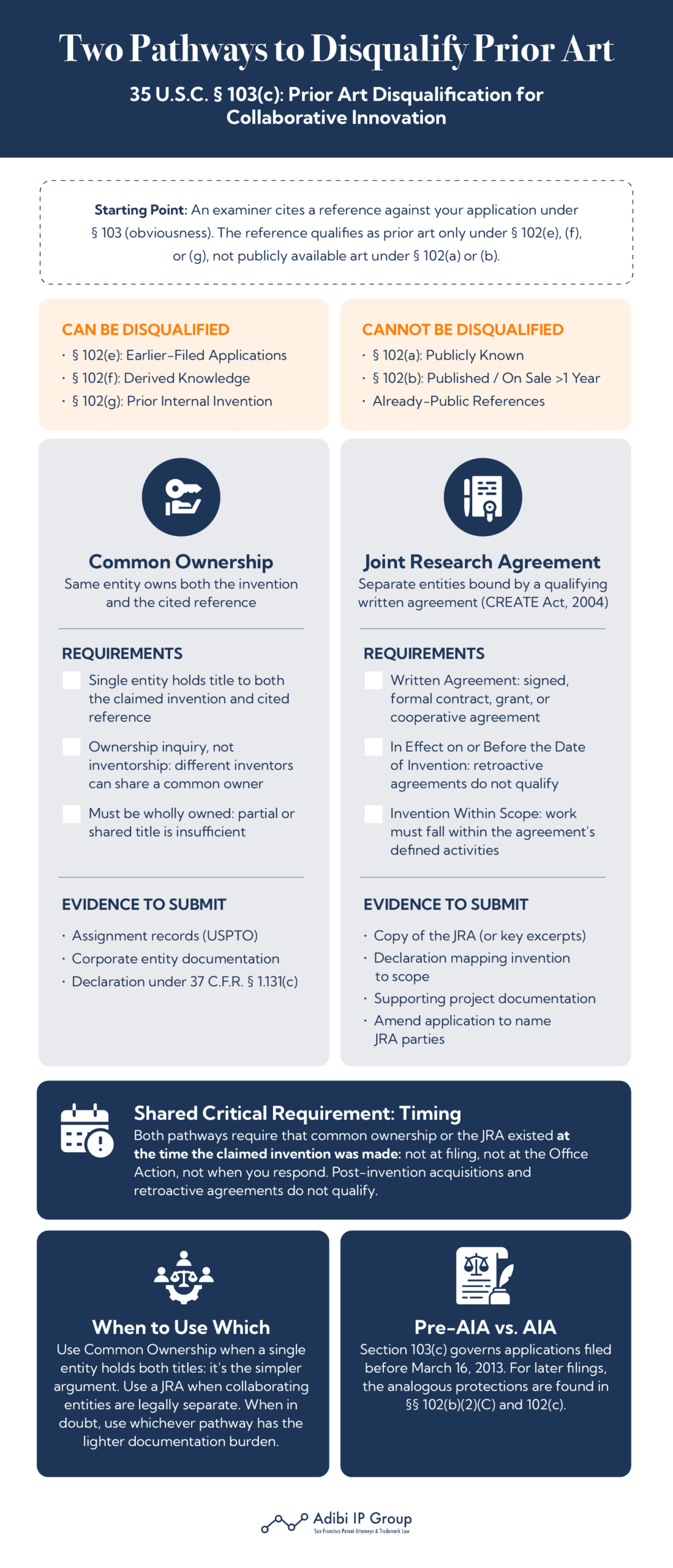
- 103(c) disqualifies “friendly fire” prior art — references that only qualify as prior art under § 102(e), (f), or (g) cannot be used in an obviousness rejection when the parties share common ownership or a qualifying Joint Research Agreement.
- Two pathways exist: common ownership and JRAs. Common ownership requires a single entity to hold title to both the claimed invention and the cited reference. JRAs extend protection to separate entities bound by a qualifying written agreement.
- Timing is the most critical requirement. Common ownership must exist — and a JRA must be in effect — at the time the claimed invention was made, not at filing or prosecution.
- The CREATE Act of 2004 closed the collaboration gap. Before Pub. L. 108-453, multi-entity collaborators without common ownership had no statutory shield against their own prior art.
- Documentation wins or loses the argument. Assignment records, corporate entity maps, executed JRAs, and scope evidence must be prosecution-ready before the rejection arrives.
- Pre-AIA vs. AIA matters. Section 103(c) governs applications with effective filing dates before March 16, 2013. For later filings, the analogous protections live in §§ 102(b)(2)(C) and 102(c).
What Is 103(c)? The Statute in Plain English
Picture two patent applications sitting on an examiner’s desk. Both involve related technology. One was filed earlier, and under normal rules, it qualifies as prior art against the other. But both came from the same research program — maybe the same company, maybe a university-industry partnership. Section 103(c) tells the examiner: if the only reason that earlier filing qualifies as prior art is because of who was involved — not because it was publicly available to the world — and if the parties can show common ownership or a qualifying JRA at the time of invention, then that reference gets set aside. It cannot be used in the obviousness analysis.
Section 103(c) targets prior art that qualifies under specific subsections of 35 U.S.C. § 102 namely § 102(e), (f), and (g). These are references that exist because of the actions of related parties: earlier-filed applications by co-workers, knowledge derived from coinventors, or inventions made by others within the same organization. Section 103(c) does not apply to prior art that is publicly available under § 102(a) or (b), such as published papers or products on the market. If the reference was already public, common ownership or JRA won’t save you.
Congress recognized something obvious about how innovation actually works: collaborative research environments — corporate R&D divisions, university-industry partnerships, multi-entity joint ventures — generate overlapping work product. Penalizing that overlap with obviousness rejections creates a perverse incentive. Organizations would be better off not collaborating, or structuring their work to avoid any paper trail connecting related efforts. Section 103(c) eliminated that penalty for entities that could demonstrate they were genuinely working together.
The Problem Congress Was Solving
Before 103(c) existed in its current form, collaborative patent filing created real hazards for organizations innovating together. A pharmaceutical company partners with a university to develop a new compound. The university publishes preliminary findings — as universities do — and files its own provisional application. Six months later, the company files an application covering a refined version of the same compound. Under pre-103(c) rules, the university’s earlier filing could be cited as § 102(e) prior art against the company’s application, even though the work was part of the same research program.
Companies hesitated to collaborate with academic institutions because every shared publication or filing became a potential weapon in prosecution. Universities faced pressure to delay disclosures — undermining their core mission — or to funnel all IP through a single entity, which often didn’t reflect the actual inventive contributions.
The original 103(c), enacted in 1984 by Pub. L. 98–622, addressed this for commonly owned inventions — though initially only for prior art under § 102(f) and (g). But it left a gap: collaborators who weren’t under common ownership — joint ventures, sponsored research partnerships, multi-company consortia — remained exposed. The Cooperative Research and Technology Enhancement Act of 2004 (CREATE Act), enacted as Pub. L. 108-453 on December 10, 2004, closed that gap by extending 103(c) protection to parties bound by a qualifying Joint Research Agreement.
Without that expansion, any multi-entity research program operating without a shared corporate parent would still face exactly the prior art trap Congress intended to eliminate.
Pre-AIA vs. AIA: Where 103(c) Fits Today
Section 103(c) applies to patent applications governed by Pre-AIA law, meaning applications with an effective filing date before March 16, 2013. For these applications, the § 103 obviousness framework includes 103(c) as an operative provision.
The America Invents Act didn’t eliminate the collaboration shield — it relocated and restructured it. Under AIA, the analogous protections live in §§ 102(b)(2)(C) and 102(c). The underlying principle is the same: collaborative work shouldn’t be weaponized as prior art. But the mechanics differ. The AIA’s “effective filing date” framework replaces the Pre-AIA “date of invention” framework, and the specific prior art categories subject to disqualification aren’t identical.
The practical rule: if your application is under Pre-AIA law, 103(c) is your statute. If it’s under AIA, look to §§ 102(b)(2)(C) and 102(c). This article covers the Pre-AIA framework — but the strategic principles around documentation, timing, and agreement structure carry forward under either regime.
Common Ownership: Requirements and Mechanics
The common ownership pathway is the more direct of the two routes under 103(c). If the claimed invention and the cited prior art reference were owned by the same person or entity at the time the invention was made, the reference is disqualified from the obviousness analysis. No agreement needed. No additional filings beyond what you’d submit in a normal Office Action response. The ownership itself is the shield.
But “direct” doesn’t mean “easy.” Who actually owns what, when did ownership attach, and what documentation proves it — that’s where this pathway earns its complexity.
What Qualifies as “Common Ownership”?
Common ownership means that both the claimed invention and the cited prior art reference are owned by the same person or organization. MPEP § 2146 defines “commonly owned” as “wholly owned by the same person(s) or organization(s) at the time the invention was made.” This is an ownership inquiry, not an inventorship inquiry — a distinction that catches practitioners off guard more often than it should.
An inventor creates. An owner holds legal title. These are frequently different parties. In most corporate settings, inventors assign their rights to their employer through employment agreements. The inventor of Record A and the inventor of Record B might be completely different people working in different buildings — but if both assigned their rights to the same corporation, common ownership exists. What matters is where the title sits, not who conceived the invention. For a deeper treatment of this distinction, see Inventorship vs. Ownership: Key Distinctions.
Common ownership is clearest in these scenarios:
- Same corporation, different teams. Two patents both assigned to Acme Corp. The inventors never met. Doesn’t matter — Acme owns both, common ownership satisfied.
- Inventor assigned both applications to the same employer. A single inventor working on related projects files two applications, both assigned to the same university. Common ownership exists through the assignment chain.
- Parent-subsidiary relationship where the parent holds all IP. If a subsidiary’s employment agreements assign all IP to the parent corporation, and the parent also owns the cited reference, common ownership is established through the parent.
Where it gets murkier: affiliates, minority-owned subsidiaries, and joint ventures without unified IP ownership. A 50/50 joint venture where each partner retains its own IP doesn’t create common ownership, even if the partners consider themselves deeply collaborative. A subsidiary where the parent holds 80% equity but IP assignments run to the subsidiary itself may or may not qualify, depending on the corporate documents. The analysis is entity-specific, and assumptions here are dangerous.
Timing — “At the Time the Invention Was Made”
A timeline tells the story better than any definition:
- January 2010: Inventor A, employed by Company X, files Application 1. Rights assigned to Company X.
- March 2010: Inventor B, employed by Company Y, conceives the invention that becomes Application 2.
- June 2010: Company X acquires Company Y. All IP rights transfer to Company X.
- September 2010: Inventor B files Application 2, now assigned to Company X.
In prosecution, the examiner cites Application 1 against Application 2. Can you invoke 103(c)? The answer hinges on March 2010 — the date Inventor B’s invention was made. At that point, Company X owned Application 1, and Company Y owned the work that would become Application 2. Different owners. The June acquisition came too late.
Common ownership must exist at the time the claimed invention was made — not at the time the application was filed, not at the time of the Office Action, and not when you respond to the rejection. The statutory language is precise, and examiners are trained to verify it. MPEP § 2146 reinforces this requirement, instructing examiners that a statement of common assignee alone is insufficient — there must be a statement that common ownership existed “at the time the invention was made.”
Mergers, acquisitions, and corporate reorganizations happen on their own timelines, and they don’t always align with invention dates. Practitioners who assume that current common ownership is sufficient — without verifying the ownership chain at the critical date — risk having the 103(c) argument rejected outright.
The inverse is also worth noting: consistent with the statute’s temporal framework, if common ownership existed at the time of invention but was later severed through a divestiture or spin-off, the statutory test is still met. The statute looks backward to a specific moment, not at the current state of affairs.
Proving Common Ownership During Prosecution
When you invoke 103(c) based on common ownership in response to a patent office action, the USPTO expects evidence, not assertions. The evidentiary package typically includes:
- Assignment records showing that both the claimed invention and the cited prior art were assigned to the same entity. Recorded assignments with the USPTO Assignment Recordation Branch carry the most weight.
- Corporate documentation establishing the ownership chain if the assignment path runs through subsidiaries, mergers, or reorganizations — merger agreements, board resolutions, or IP transfer agreements.
- A declaration or statement under applicable regulations (37 C.F.R. § 1.131(c) for Pre-AIA applications, or 37 C.F.R. § 1.130 under AIA) identifying the prior art reference, asserting common ownership at the time of invention, and providing the factual basis.
Examiners will verify that the common ownership date aligns with the invention date — not the filing date. Any ambiguity in the corporate chain triggers a requirement for additional documentation. The cleaner your ownership timeline is upfront, the less likely you’ll face a second rejection on the same ground.
One practical note: if your client’s corporate structure involves multiple entities with cross-assignments, build the ownership chart before you draft the response. Discovering a gap in the assignment chain after you’ve submitted the declaration is significantly more painful than discovering it during preparation.
Unsure whether your corporate structure qualifies as common ownership? Adibi IP Group can help you evaluate your position before responding to an Office Action.
When common ownership doesn’t apply because the collaborating parties are separate entities without shared title to the relevant IP, the second pathway becomes essential.
Joint Research Agreements: Requirements and Mechanics
The Joint Research Agreement (JRA) pathway is where 103(c) matters most for multi-entity collaborations. Added by the CREATE Act in 2004, it extends the collaboration shield to parties who don’t share a corporate parent — universities and industry sponsors, co-development partners, research consortia — provided their collaboration is formalized under a qualifying agreement.
JRAs carry a heavier documentation burden and stricter requirements than common ownership. But for organizations that can’t point to a single entity on both sides of the prior art citation, this is the only route.
What Is a Joint Research Agreement Under 103(c)?
A Joint Research Agreement under 103(c) is a written contract between two or more parties, in effect on or before the date the claimed invention was made, under which the claimed invention resulted from activities within the agreement’s scope. MPEP § 2146 defines it specifically as “a written contract, grant, or cooperative agreement entered into by two or more persons or entities for the performance of experimental, developmental, or research work in the field of the claimed invention.” Not any collaboration agreement. Not a handshake. A specific statutory concept with three non-negotiable requirements.
The distinction from informal collaboration matters. Two companies exchanging technical information over email, sharing lab space, or even co-authoring publications don’t have a JRA unless a written agreement meets the statutory test. Vendor-client agreements, consulting arrangements, and standard service contracts typically don’t qualify either — they may involve collaborative work, but they lack the structural elements the statute demands.
The Three Statutory Requirements for a Qualifying JRA
Each requirement is independent. Failing any one disqualifies the agreement.
Requirement 1: Written Agreement. The JRA must be a formal, executed written contract. Verbal agreements don’t qualify regardless of how well-documented the underlying collaboration may be. Email chains, meeting minutes recording a handshake deal, unsigned drafts — all fall short. The statute requires a signed, written instrument. There’s a certain logic to the formality: organizations that take the time to put the agreement on paper are exactly the ones Congress intended to protect.
Requirement 2: Effective on or Before the Date of Invention. The agreement must have been in effect on or before the date the claimed invention was made. An agreement executed after the invention date — even covering the same parties, same subject matter, same everything — does not qualify. Retroactive agreements are dead on arrival.
This creates a practical imperative: JRAs need to be in place before the research begins, not after the results are in. Organizations that wait until prosecution to formalize their collaboration will often find that the critical date has already passed. Execute the JRA at the outset of any collaborative research program. Treat it as foundational IP infrastructure — same priority as lab setup and funding agreements.
Requirement 3: Invention Within the Scope of the Agreement. The claimed invention must have been made as a result of activities undertaken within the scope of the JRA. Work that falls outside the agreement’s defined scope — even if performed by the same parties during the same time period — is not covered.
This is where agreement drafting intersects with patent prosecution strategy. A narrowly scoped JRA protects only the specific work it covers. A broadly scoped JRA provides wider coverage but may face scrutiny about whether the claimed invention genuinely resulted from the agreement’s defined activities. The scope language in the original agreement becomes the evidentiary battleground if the argument is challenged.
JRA Qualification Checklist:
- Is there a signed, written agreement between the relevant parties?
- Was the agreement executed on or before the date the claimed invention was made?
- Does the agreement’s scope encompass the activities that led to the claimed invention?
- Are all parties to the claimed invention and the cited reference identified in or covered by the agreement?
- Can you document the connection between the agreement’s scope and the inventive work?
Invoking a JRA During Patent Prosecution
Responding to an obviousness rejection with a JRA argument demands more than common ownership does. The USPTO needs to see not just that an agreement exists, but that it meets all three statutory criteria.
The typical submission includes:
- A copy of the JRA itself, or relevant portions establishing its effective date, parties, and scope. Confidentiality concerns may justify submitting excerpts rather than the full agreement, but the excerpts must cover the statutory elements.
- A declaration identifying the cited prior art reference, the parties involved, and the specific JRA under which the claimed invention was made. The declaration should explicitly map the invention to activities within the agreement’s scope.
- Supporting evidence linking the inventive work to the JRA’s scope — project plans, progress reports, inventor testimony, or lab notebooks showing that the claimed invention arose from the collaborative activities defined in the agreement.
- A statement that the application and the cited reference name the invention as having been made by or on behalf of parties to the JRA. Under 103(c) as amended by the CREATE Act, the application must also be amended to disclose the names of the parties to the JRA. This is a statutory requirement, not a discretionary practice.
Raise the JRA argument in your first substantive response to the rejection. No absolute statutory deadline bars a later submission, but raising it early avoids complications, prevents estoppel arguments, and signals that this is a substantive position rather than a last-resort maneuver.
Reference the MPEP Chapter 2100 for the USPTO’s detailed guidance on JRA submissions and the examiner’s verification procedures.
Common Ownership vs. Joint Research Agreements: Choosing the Right Path
Sometimes the answer is obvious — a single corporation’s internal teams fall under common ownership, and a university-industry partnership without shared IP ownership requires a JRA. But a surprising number of collaborative arrangements sit in a gray zone where either pathway might apply, or where an organization assumes one pathway works when the other is actually required.
Common Ownership vs. JRA at a Glance
| Factor | Common Ownership | Joint Research Agreement |
| Basic requirement | Same entity owns both the invention and the cited reference | Written agreement between parties covers the inventive work |
| Documentation burden | Assignment records and corporate chain | Full agreement, declaration, scope evidence |
| Timing requirement | Ownership must exist at date of invention | Agreement must be in effect on or before date of invention |
| Parties | Single entity (or unified corporate family) | Two or more separate entities |
| Disclosure obligation | None beyond standard prosecution | Must disclose JRA party names in the application |
| Typical use cases | Corporate teams, parent-subsidiary, single-assignee scenarios | University-industry partnerships, joint ventures, research consortia |
| Complexity | Lower — ownership is binary | Higher — scope, timing, and formality all scrutinized |
When common ownership is the right path: Your organization owns both pieces of IP outright — same corporate entity, clean assignment chain, no ambiguity about title at the invention date. The documentation is simpler and the argument is harder for an examiner to challenge.
When a JRA is the right path: The collaborating parties are legally separate entities. No single entity holds title to both the claimed invention and the cited reference. A qualifying written agreement is in place (or should be). This is the only route for multi-entity collaborations without unified IP ownership.
When both might apply: A parent company owns all IP from its subsidiary’s work and has a JRA with an external partner whose work is cited as prior art. If the cited reference comes from the subsidiary, common ownership may suffice. If it comes from the external partner, you’ll need the JRA. If both references appear in a rejection, you might invoke both pathways for different citations in the same response.
The decision principle: Use whichever pathway requires the least documentation burden while satisfying the statutory requirements. Common ownership, when available, is almost always the cleaner argument. But don’t force it — if the ownership chain has gaps, a well-documented JRA is a stronger position than a shaky common ownership claim.
Navigating a situation where both pathways might apply? Contact Adibi IP Group for guidance on the strongest approach for your specific case.
Case Law and MPEP Guidance Interpreting 103(c)
The statute sets the rules. Decisions and examiner guidance reveal where the lines fall — and where they blur. For patent prosecutors building an obviousness rejection response around commonly owned or JRA-covered prior art, this is the authoritative grounding.
Key Decisions Shaping 103(c) Practice
Two Federal Circuit decisions illustrate the contours of 103(c) practice and the boundaries Congress drew around its protections.
In re Bartfeld, 925 F.2d 1450 (Fed. Cir. 1991) tested the limits of 103(c) before the statute was expanded to cover § 102(e) prior art. The applicant attempted to use a terminal disclaimer and the policy rationale of 103(c) to overcome a § 102(e)/§ 103 rejection, arguing that Congress intended to shield all “secret” prior art from obviousness determinations. The Federal Circuit rejected this argument, holding that the court could not disregard the statute’s then-unambiguous exclusion of § 102(e) from 103(c)’s scope. The practitioner takeaway: 103(c)’s protections are defined by the statutory text as it existed at the relevant time, not by its policy goals. Congress later addressed this gap by adding § 102(e) to 103(c)’s coverage in 1999.
OddzOn Products, Inc. v. Just Toys, Inc., 122 F.3d 1396 (Fed. Cir. 1997) clarified that confidential designs disclosed to the inventor under § 102(f) constitute prior art for purposes of a § 103 obviousness analysis. This ruling established § 102(f) material as a basis for obviousness — the very problem the CREATE Act later addressed by extending 103(c)’s JRA protections. The case was directly cited in the CREATE Act’s legislative history (H.R. Rep. No. 108-425) as demonstrating why multi-entity collaborators needed statutory protection for shared confidential work product.
The throughline across these decisions reduces to three questions: Does your ownership or agreement predate the invention? Can you prove it with contemporaneous documentation? Is the scope clearly defined? Answer yes to all three, and the argument stands on solid ground.
MPEP Guidance — What Examiners Are Trained to Look For
The Manual of Patent Examining Procedure provides the operational instructions examiners follow when evaluating 103(c) arguments. The relevant sections — primarily MPEP § 2146 and its subsections (§ 2146.01 on prior art disqualification, § 2146.02 on establishing common ownership or JRA, and § 2146.03 on examination procedure) — outline what examiners verify and what they’re trained to scrutinize.
When a 103(c) common ownership argument is raised, examiners verify:
- That the prior art reference falls under § 102(e), (f), or (g) — not § 102(a) or (b). If the reference qualifies through public availability rather than the actions of related parties, 103(c) doesn’t apply regardless of ownership.
- That common ownership existed at the date of invention, supported by documentary evidence. Examiners look for assignment records, not just declarations.
- That the ownership chain is unambiguous. Any doubt about whether the same entity held title to both the claimed invention and the cited reference triggers a follow-up requirement.
When a JRA argument is raised, examiners additionally verify:
- That the JRA was in writing and executed before the invention date.
- That the claimed invention falls within the agreement’s defined scope.
- That the application has been amended to disclose the names of all parties to the JRA, as required by the CREATE Act.
- That the declaration provides a sufficient factual basis linking the inventive work to the JRA’s scope.
One gap practitioners should know: MPEP guidance on JRA scope determination is less detailed than on common ownership. The examiner’s assessment of whether an invention falls “within the scope” of a JRA involves judgment, not just checklist verification, and the MPEP doesn’t provide detailed criteria for that assessment. This means the quality of your scope evidence — project plans, correspondence, inventor declarations — carries outsized weight. The agreement’s language alone won’t do the work; supplement it with evidence showing the actual thread from agreement to invention.
For related guidance on how examiners build the underlying obviousness case that 103(c) responds to, see MPEP 2143: The Prima Facie Case of Obviousness.
Practical 103(c) Pitfalls and How to Avoid Them
Most 103(c) failures aren’t failures of legal knowledge. They’re failures of preparation, timing, or documentation. The statute is clear enough. The mistakes happen in the gap between knowing the rule and applying it under real-world conditions — corporate structures messier than the org chart suggests, agreements executed on the wrong side of a critical date, evidence that proves the right conclusion but doesn’t meet the examiner’s verification threshold.
These five pitfalls account for the majority of 103(c) problems.
Pitfall 1: Assuming common ownership when corporate structure is ambiguous.
A parent company with a wholly-owned subsidiary where all IP assignments flow to the parent? Clear common ownership. A 60/40 joint venture where each partner retains IP generated by its own employees? Not common ownership — even if the partners consider themselves deeply collaborative. Affiliates, partially-owned subsidiaries, and joint ventures without unified IP assignment provisions sit in a gray zone where assumptions fail.
How to avoid it: Map the actual assignment chain before invoking 103(c). Trace the cited reference and the claimed invention to their respective title holders as of the invention date. If there’s any discontinuity — any entity boundary that IP hasn’t formally crossed — common ownership may not hold. Evaluate the JRA pathway instead.
Pitfall 2: Relying on a JRA executed after the invention date.
The most absolute statutory requirement and the one with the least room for argument. The JRA must have been in effect on or before the date the claimed invention was made. An agreement signed a week late doesn’t qualify, no matter how clearly it covers the relevant work.
How to avoid it: Execute JRAs at the outset of any collaborative research program — before the first experiment, not after the first result. If you’re a tech transfer officer or IP director, build JRA execution into your collaboration onboarding process with the same priority as funding agreements and lab access.
Pitfall 3: Failing to establish that the invention falls within the JRA’s scope.
An agreement exists. It predates the invention. But the invention arose from a side project that wasn’t contemplated when the agreement was drafted — or the agreement’s scope language is so narrow that the eventual invention doesn’t clearly fall within it. Examiners will probe this connection.
How to avoid it: Draft JRA scope provisions broadly enough to cover the foreseeable range of collaborative activities, while maintaining enough specificity to be credible. When preparing the 103(c) response, include evidence — project reports, inventor declarations, correspondence — that demonstrates the connection between the JRA’s scope and the inventive work. Show the examiner the thread from agreement to invention.
Pitfall 4: Incomplete documentation submitted to the USPTO.
The legal argument is sound, but the submission package is missing a piece: the agreement lacks the execution page, the declaration doesn’t identify all parties, the assignment records don’t cover the full chain, or the application hasn’t been amended to disclose JRA party names (a CREATE Act requirement that practitioners sometimes overlook). Any gap gives the examiner grounds to reject the argument without reaching the merits.
How to avoid it: Use a checklist for every 103(c) submission. Before filing, verify: (a) the prior art reference is identified by its § 102 category; (b) the ownership or agreement documentation covers all statutory elements; (c) the timing evidence is explicit; (d) for JRAs, the application has been amended to disclose party names; and (e) the declaration provides factual basis, not just conclusory assertions.
Pitfall 5: Confusing Pre-AIA 103(c) with AIA provisions when the application straddles the transition.
Applications with effective filing dates before March 16, 2013, are governed by Pre-AIA 103(c). Those filed on or after that date fall under §§ 102(b)(2)(C) and 102(c). The mechanics differ — timing frameworks, prior art categories, and procedural requirements don’t map one-to-one. Applying the wrong framework is a substantive error that can invalidate the entire argument.
How to avoid it: Confirm the application’s effective filing date before drafting the response. For continuations and divisionals, the effective filing date may trace back to a parent application filed before March 16, 2013, even if the current filing is much later. If the application is under AIA, pivot to the §§ 102(b)(2)(C)/102(c) analysis — similar strategy, different statutory hooks.
These pitfalls share a common thread: the statute rewards preparation and punishes assumptions. The practitioners who use 103(c) most effectively treat documentation, timing, and corporate structure as prosecution-ready assets — not afterthoughts assembled when the rejection arrives.
Taking Control of Your Collaborative IP Strategy
Section 103(c) is one of the most underutilized tools in the patent prosecutor’s toolkit — not because practitioners don’t know it exists, but because the preparation it demands must happen long before the rejection that triggers it. The statute gives collaborative innovators two clear pathways to disqualify prior art that would otherwise undermine their own patent applications. The question is whether the groundwork is in place when you need it.
Document ownership chains before you need them. The time to verify that your corporate structure supports a common ownership argument is before the rejection arrives, not after. Assignment records, corporate entity maps, and IP transfer agreements should be prosecution-ready assets.
Execute JRAs at the start of the collaboration, not the end. The timing requirement is absolute. An agreement that predates the invention protects you. One that doesn’t, can’t.
Match your evidence to the examiner’s checklist. Examiners verify specific statutory elements in a specific order. The cleaner your submission maps to their verification process, the faster the argument succeeds.
Know which pathway fits and don’t force the wrong one. Common ownership is cleaner when it applies. A JRA is essential when it doesn’t. Using the wrong pathway, or a shaky version of the right one, costs time and credibility.
The collaboration shield Congress built into 103(c) — and later strengthened through the CREATE Act — protects most effectively when the collaboration itself is structured with IP protection in mind from day one. The statute isn’t a last-resort rescue; it’s a strategic asset that rewards foresight, documentation, and precision.
If you’re navigating an obviousness rejection citing your own team’s work — or structuring a research collaboration and want to protect your IP from the beginning — contact Adibi IP Group for a strategic consultation.