An applicant opens a freshly issued Office Action and finds four prior art references stitched together under a single § 103 rejection. The examiner concludes the combination would have been “obvious to one of ordinary skill in the art.” No further explanation. No specific rationale identified. This is the rejection that stalls prosecution, erodes patent value, and — if answered with a generic rebuttal — often survives all the way to final rejection.
It does not have to go that way. Patent examiners establish a prima facie case of obviousness by applying one or more of seven specific rationales codified in MPEP 2143, each derived from the Supreme Court’s landmark decision in KSR International Co. v. Teleflex Inc., 550 U.S. 398 (2007). Every rationale carries distinct evidentiary requirements. The prima facie case stands or falls on whether the examiner has articulated reasoning with rational underpinning connecting each claimed element to the prior art — and each rationale demands a different kind of reasoning. The practitioner who understands these distinctions does not respond to obviousness rejections with boilerplate. They respond with surgical precision.
What follows is the rationale-by-rationale playbook: what each of the seven KSR frameworks requires the examiner to prove, where the evidentiary gaps tend to appear, how hindsight contaminates the analysis, and the rebuttal strategies that turn a defensible rejection into one that collapses under scrutiny.
Key Takeaways
- Obviousness is a structured framework, not a judgment call. Examiners must apply one or more of seven specific KSR rationales from MPEP 2143, each with distinct evidentiary requirements — a conclusory assertion that a combination is “obvious” fails to establish a prima facie case.
- Each rationale demands a different rebuttal. A Rationale A rejection (combining known elements) requires different proof and a different response than a Rationale E rejection (“obvious to try”). Generic rebuttals waste prosecution capital.
- The PHOSITA determination shapes every outcome. The level of ordinary skill assumed by the examiner calibrates what counts as “known,” “predictable,” and “obvious to try” — and an unsupported assumption is a viable point of challenge.
- Hindsight bias is the primary analytical risk. Every rejection must include articulated reasoning with rational underpinning independent of the applicant’s disclosure. Reasoning that only makes sense because the examiner already knows the invention rests on impermissible hindsight.
- Secondary considerations can overcome even a strong prima facie case. The Federal Circuit requires that objective indicia — unexpected results, commercial success, teaching away, long-felt need — be considered in every obviousness analysis.
- The seven-rationale framework doubles as a portfolio vulnerability tool. Mapping claims against each rationale identifies specific attack vectors and informs resource allocation before an adversary acts.
What Makes a Patent Claim Obvious Under § 103
The gatekeeping question in patent prosecution is deceptively simple: would the claimed invention have been obvious to a person having ordinary skill in the art at the time of filing? Under 35 U.S.C. § 103, a patent may not be obtained if the differences between the claimed invention and the prior art are such that the subject matter as a whole would have been obvious to that hypothetical skilled artisan. The statute fits in a single paragraph. The analytical machinery it triggers does not.
The obviousness inquiry is not a single test — it is a structured, multi-factor framework that begins with the foundational analysis established in Graham v. John Deere Co., 383 U.S. 1 (1966) and expands through the operational rationales codified in MPEP 2143. The stakes are proportional to the complexity. A prima facie case that goes unrebutted destroys the claim. A rebuttal that misidentifies the examiner’s actual rationale burns prosecution capital without shifting the outcome.
The Examiner’s Burden: Establishing a Prima Facie Case
A prima facie case of obviousness is the examiner’s initial evidentiary showing — the threshold demonstration that a claimed invention would have been obvious to a person having ordinary skill in the art (PHOSITA) based on the prior art of record. Once established, the burden of production shifts to the applicant to come forward with rebuttal evidence. But the examiner’s burden is not met by mere assertion.
The Graham v. John Deere factors require the examiner to determine four things before reaching any obviousness conclusion: the scope and content of the prior art, the differences between the prior art and the claims at issue, the level of ordinary skill in the pertinent art, and any objective evidence of non-obviousness. These are not optional analytical steps — the Federal Circuit has repeatedly held they must precede, not follow, the ultimate obviousness determination.
The patent examiner burden of proof at this stage is preponderance — a reasoned explanation, not a conclusory assertion, as to why a PHOSITA would have arrived at the claimed invention. MPEP 2143 operationalizes this by requiring the examiner to identify one or more of seven exemplary rationales and support the chosen rationale with “articulated reasoning with some rational underpinning.” A rejection that merely states the combination would be obvious, without identifying which rationale applies and why the evidence supports it, fails to establish a prima facie case.
Why MPEP 2143 Matters: The KSR Framework Codified
Before 2007, obviousness analysis in patent prosecution operated primarily through the teaching-suggestion-motivation test — the TSM test. Under the rigid version of TSM that had developed in the Federal Circuit, an examiner could not combine prior art references unless the prior art itself contained an explicit teaching, suggestion, or motivation to make the combination. This framework was predictable, but it had calcified into a formalism that the Supreme Court found incompatible with the statutory text.
KSR v. Teleflex changed the landscape. The Court held that the TSM test, while a useful tool, could not serve as the exclusive gatekeeping framework for obviousness. The Court identified several additional rationales that could support an obviousness finding — rationales grounded in common sense, predictability, and the practical knowledge of skilled artisans. The Court’s key passage captures the shift: an obviousness analysis “need not seek out precise teachings directed to the specific subject matter of the challenged claim, for a court can take account of the inferences and creative steps that a person of ordinary skill in the art would employ.”
MPEP 2143 translates this holding into the operational guidance examiners follow. It codifies seven exemplary rationales — labeled (A) through (G) — each representing a distinct pathway by which an examiner may construct a prima facie case. These are not interchangeable; each carries different evidentiary demands. A Rationale A rejection (combining prior art elements) requires different proof than a Rationale E rejection (obvious to try), and the rebuttal strategy for each differs accordingly.
The strategic consequence: KSR did not merely relax the standard. It multiplied the examiner’s toolkit from one dominant rationale to seven. Effective prosecution now requires fluency in all seven — recognizing which one the examiner has invoked, evaluating whether the evidentiary showing meets that rationale’s specific requirements, and calibrating the response accordingly. For a comprehensive treatment of the non-obviousness requirements under 35 U.S.C. § 103, the foundational statutory analysis provides essential context for the rationale-specific framework that follows.
The PHOSITA Standard: Who Is the “Ordinary Skilled Artisan”?
Every element of the obviousness analysis — what counts as “known,” what qualifies as “predictable,” which solutions are “obvious to try” — is calibrated to a single hypothetical figure: the person having ordinary skill in the art (PHOSITA). This determination is not a rubber stamp. A higher level of ordinary skill means more combinations become “predictable,” more techniques become “known,” and more solutions fall within the PHOSITA’s grasp. The finding quietly shapes the outcome of every rationale the examiner invokes.
Courts determine the PHOSITA’s skill level by examining factors including the educational level of active workers in the field, the types of problems encountered in the art, the sophistication of the technology, the prior art solutions to those problems, and the rapidity with which innovations are made. (See Environmental Designs, Ltd. v. Union Oil Co., 713 F.2d 693, 696 (Fed. Cir. 1983).) In practice, examiners rarely make an explicit PHOSITA finding in an Office Action — which itself can be a point of challenge. If the examiner’s rejection implicitly assumes a skill level inconsistent with the record, the applicant has grounds to demand clarification or challenge the underlying analysis.
Understanding what each of the seven KSR rationales requires from the examiner is the first step. The next question is how those rationales operate in practice — what evidence satisfies each one, and where the evidentiary gaps tend to appear.
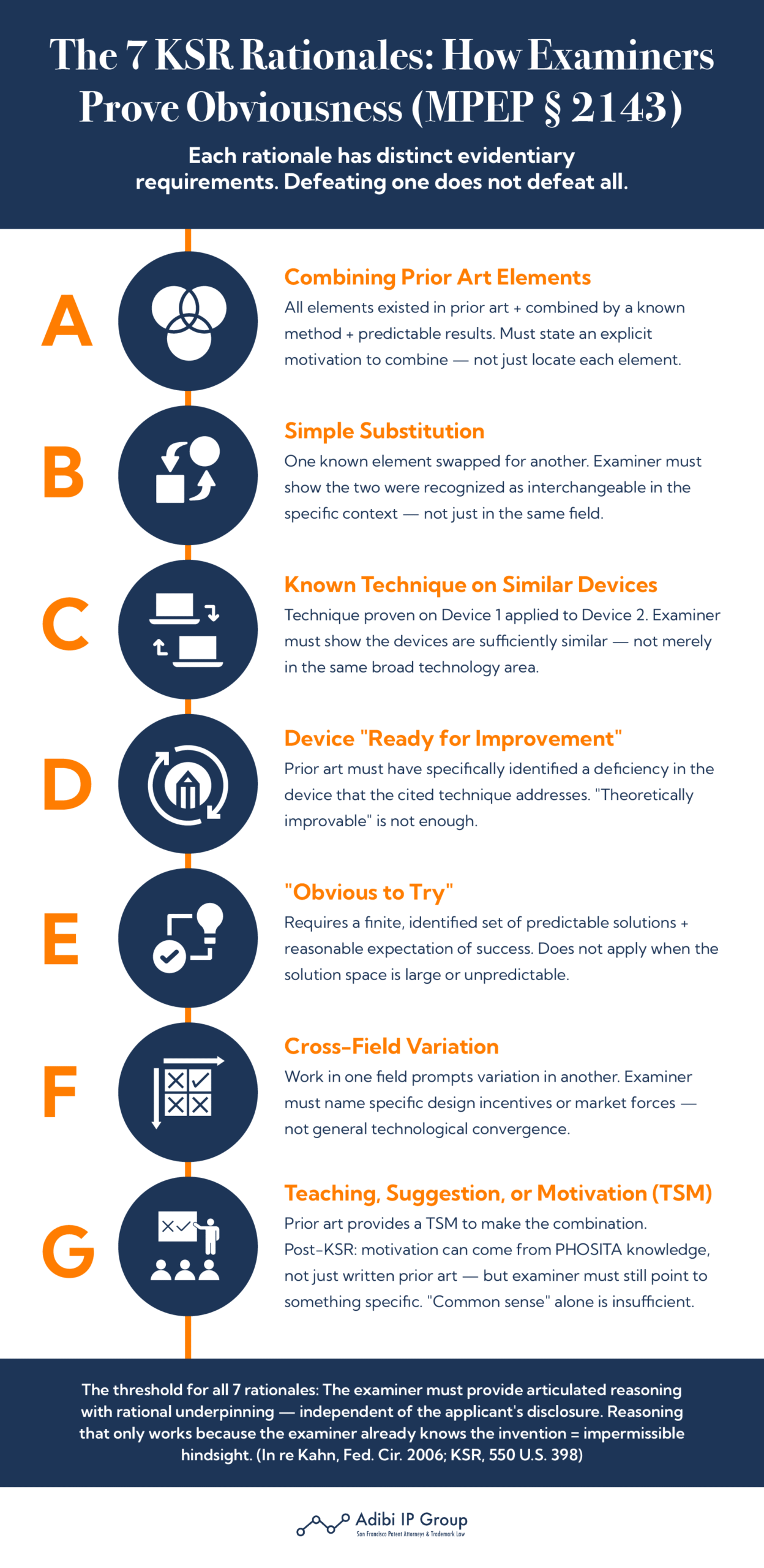
The Seven KSR Rationales: How Examiners Build Obviousness Rejections
MPEP 2143 identifies seven exemplary rationales that examiners may invoke to establish a prima facie case of obviousness. Each represents a distinct analytical framework with its own evidentiary demands, and the MPEP 2143 examples illustrating each rationale provide the operational detail practitioners need. The following reference table maps the complete landscape.
| Rationale | MPEP 2143 Label | Core Concept |
| A | Combining Prior Art Elements | Known elements combined by known methods yield predictable results |
| B | Simple Substitution | One known element substituted for another to obtain predictable results |
| C | Use of Known Technique | Known technique used to improve similar devices the same way |
| D | Applying Known Technique to Known Device | Known technique applied to a device ready for improvement with predictable results |
| E | “Obvious to Try” | Choosing from a finite number of identified, predictable solutions |
| F | Known Work Prompting Variations | Work in one field of endeavor prompts use in same or different field |
| G | Teaching, Suggestion, or Motivation (TSM) | Prior art itself suggests the modification or combination |
Rationale A: Combining Prior Art Elements According to Known Methods
This is the workhorse of obviousness rejections — the rationale examiners invoke most frequently. Under Rationale A, the examiner must demonstrate that each element of the claimed invention existed in the prior art and that a PHOSITA would have recognized that combining those elements according to known methods would yield predictable results.
- What the examiner must show: Every claimed limitation maps to an identified prior art element. The method of combination was itself known in the art. The result of the combination would have been predictable — not merely possible — to a skilled artisan. These are three distinct evidentiary showings, and the absence of any one collapses the rationale.
- Evidentiary standard: The examiner must do more than locate each element somewhere in the prior art. MPEP 2143(I)(A) requires explicit identification of where each element is found, an articulation of why the combination is predictable, and — critically — a stated motivation to combine prior art. The motivation need not come from the references themselves post-KSR; it may derive from the knowledge of a PHOSITA, the nature of the problem, or design incentives in the field. But it must be stated, not merely implied.
- Illustrative application: MPEP 2143 provides the example of combining a known base device with a known component where each performs its established function. Consider a rejection combining a reference teaching a wireless communication protocol with a second reference teaching a specific data encryption method. The examiner must explain not only that both elements existed independently but also why a skilled artisan working on secure wireless communication would have had reason to combine these specific approaches — and why the combined performance would have been predictable. If the encryption method introduces latency characteristics that alter wireless protocol behavior in unexpected ways, the predictability showing fails.
- Prosecution strategy: The most effective rebuttal typically targets the predictability requirement or the motivation to combine prior art. If the combination produces results that differ in kind — not merely in degree — from what a PHOSITA would have expected, the examiner’s prima facie case has a structural gap. Alternatively, if the prior art actively teaches away from the combination (for example, Reference A cautions against the integration approach suggested by the examiner), the motivation element is undermined. The Federal Circuit reinforced in Unigene Laboratories, Inc. v. Apotex, Inc., 655 F.3d 1352 (Fed. Cir. 2011) that a motivation to combine must be supported by a reasoned explanation, not merely the fact that all elements existed somewhere in the prior art.
Rationale B: Simple Substitution of One Known Element for Another
A claimed invention uses Component X where the prior art uses Component Y. Both are known. Both serve the same function. The examiner calls it a simple substitution and rejects the claim. The word “simple” does a lot of work in that characterization — and that is where the rebuttal opportunity lives.
- What the examiner must show: A base device or method exists in the prior art. The claimed invention substitutes one element of that base device with a different, known element. The substituted element was recognized in the art as an interchangeable alternative. The result of the substitution is predictable.
- Evidentiary standard: The critical evidentiary requirement is interchangeability. Under MPEP 2143(I)(B), the examiner must demonstrate that a PHOSITA would have recognized the two elements as functional equivalents in the relevant context — not merely that both elements existed in the same general field. A steel fastener and a titanium fastener may both be “known” in aerospace applications, but establishing interchangeability requires showing that a skilled artisan would have considered them substitutable for the specific structural role at issue.
- Illustrative application: The MPEP provides guidance through examples where one material is substituted for another known material with predictable properties. In prosecution, this rationale frequently appears in pharmaceutical and chemical arts where one excipient is replaced by another. The examiner asserts the substitution is obvious because both excipients are known in the formulation art. The applicant’s opening is to demonstrate that the substitution produces unexpected functional differences — perhaps altered bioavailability or stability — that a PHOSITA would not have predicted.
- Prosecution strategy: Challenge the interchangeability finding. If the elements serve superficially similar functions but behave differently in the claimed context — different reaction kinetics, different failure modes, different performance characteristics under the operating conditions recited in the claims — the “simple substitution” characterization fails. The Federal Circuit’s decision in In re Ruff, 256 F.2d 590 (CCPA 1958) underscores that substitution must be more than theoretical; the examiner must establish that the substitution would have been recognized in the prior art as an equivalency.
Rationale C: Use of a Known Technique to Improve Similar Devices
A technique works on Device 1. The examiner argues it would obviously work the same way on Device 2. The entire rationale rests on the word “similar” — and the evidentiary standard for establishing similarity is where most Rationale C rejections are won or lost.
- What the examiner must show: The technique was known in the art. A base device existed. A comparable device had been improved using the technique. The base device and the improved device are sufficiently similar that a PHOSITA would expect the technique to work the same way on both.
- Evidentiary standard: Similarity between the devices is the load-bearing requirement. Under MPEP 2143(I)(C), the examiner cannot simply assert that two devices occupy the same general technology space. The examiner must explain what makes them sufficiently similar that applying the technique to one would predictably produce the same improvement in the other. Where the devices differ in material ways — operating conditions, scale, underlying mechanisms — the rationale’s evidentiary foundation weakens.
- Illustrative application: An examiner might rely on Rationale C where a noise-reduction technique proven effective in automotive audio systems is applied to a hearing aid. The examiner must establish that the acoustic environments and signal processing constraints are sufficiently analogous that the technique’s effectiveness transfers predictably. If the hearing aid operates under fundamentally different frequency response constraints, the similarity showing may be insufficient.
- Prosecution strategy: The most direct challenge is to argue dissimilarity between the devices. Identify the specific technical differences that would cause the known technique to function differently — or fail to function — in the claimed context. Alternatively, demonstrate that the technique does not in fact produce the same improvement: the results in the claimed context diverge from predictable results in ways that a PHOSITA would not have foreseen.
Rationale D: Applying a Known Technique to a Known Device Ready for Improvement
Where Rationale C asks whether two devices are similar enough for a technique to transfer, Rationale D asks a different question: was the target device specifically recognized as needing improvement? The distinction is critical. “Ready for improvement” is not a synonym for “theoretically improvable” — every device is theoretically improvable.
- What the examiner must show: The device was known. The technique was known. The device was specifically recognized as amenable to improvement — meaning the art identified a problem, limitation, or deficiency in the device that the technique addresses. Applying the technique would yield predictable results.
- Evidentiary standard: The “ready for improvement” finding is the distinguishing element. Under MPEP 2143(I)(D), the examiner must point to specific evidence that the prior art recognized a deficiency in the base device and that the technique was understood to address that type of deficiency. The examiner must demonstrate that the art had identified the specific need — general theoretical improvability is insufficient.
- Illustrative application: Consider a rejection where the examiner applies a known battery management technique to a handheld medical device. Under Rationale D, the examiner must show not only that the technique and the device both existed but that the prior art recognized the device’s battery performance as deficient and that the management technique was understood to address this specific class of deficiency. If the prior art is silent on the device’s battery limitations, the “ready for improvement” predicate is missing.
- Prosecution strategy: Challenge the “ready for improvement” finding directly. Demand that the examiner identify the specific prior art evidence establishing that the device was recognized as amenable to the cited improvement. Alternatively, argue that while the technique may be known for other purposes, its application to this particular device would yield unpredictable results — the predictable results element of obviousness requires that the outcome be foreseeable, not merely hoped for.
Rationale E: “Obvious to Try” — Choosing from Finite, Predictable Solutions
No rationale underwent a more dramatic reversal in KSR than “obvious to try.” Before 2007, the Federal Circuit had generally held that “obvious to try” was not a valid basis for an obviousness rejection — the idea being that research directions are not obvious merely because a skilled artisan might consider them worth exploring. KSR flipped that holding, but with constraints that many examiners understate and many applicants fail to exploit.
- What the examiner must show: A recognized problem or need existed in the art. A finite number of identified, predictable solutions to that problem existed. A PHOSITA would have had good reason to pursue the known options within their technical grasp, with a reasonable expectation of success.
- Evidentiary standard: The operative words are “finite” and “identified.” Under MPEP 2143(I)(E), this rationale does not apply where the solution space is vast, unpredictable, or poorly characterized. The Federal Circuit in In re Kubin, 561 F.3d 1351, 1359 (Fed. Cir. 2009) upheld an “obvious to try” rejection where the prior art narrowed the field to a small number of candidate approaches with known properties. But the court has also drawn firm boundaries: in Sanofi-Aventis Deutschland GmbH v. Glenmark Pharmaceuticals Inc., 748 F.3d 1354 (Fed. Cir. 2014), the court cautioned that when the number of potential solutions is large or unpredictable, “obvious to try” cannot substitute for a specific motivation to select the claimed solution.
- Illustrative application: MPEP 2143(I)(E) draws from the KSR framework itself, where the Court considered whether using an adjustable electronic pedal sensor in a specific vehicle configuration was merely choosing from a finite set of available sensor mounting positions. The analysis turns on whether the prior art had already narrowed the options to an identifiable, manageable set — not whether the general concept was known.
- Prosecution strategy: The rebuttal typically takes one of two forms. First, argue that the solution space was not finite or identified — that a PHOSITA would have faced a large or unpredictable range of possibilities rather than a discrete set of candidates. Second, argue that even within a finite set, there was no reasonable expectation of success for the specific solution claimed. The Federal Circuit in Leo Pharmaceutical Products, Ltd. v. Rea, 726 F.3d 1346 (Fed. Cir. 2013) reversed an obviousness finding where, despite a limited number of candidate combinations, the prior art did not provide a basis to predict that the specific claimed combination would succeed.
Rationale F: Known Work in One Field Prompting Variations in Another
Technology does not develop in silos, and examiners know it. Rationale F addresses cross-pollination — situations where work in one area of technology would have prompted a skilled artisan to apply variations of that work in a related or entirely different field. The rationale sounds broad. Its evidentiary requirements are not.
- What the examiner must show: Design incentives or market forces would have prompted a PHOSITA to apply variations of known work from one field to the same or a different field of endeavor.
- Evidentiary standard: Under MPEP 2143(I)(F), the examiner must identify specific design incentives or market pressures — not merely assert that knowledge in one field would generically inform another. The rationale requires a causal chain: here is the known work, here is the specific incentive or market force, and here is why that incentive would prompt a skilled artisan to make the specific variation reflected in the claims. Vague assertions about general technological convergence do not satisfy the standard.
- Illustrative application: An examiner invokes Rationale F to argue that a data compression algorithm developed for streaming video would obviously be adapted for medical imaging transmission, citing market demand for reduced bandwidth in telemedicine. The examiner must connect the specific design incentives (bandwidth constraints in clinical settings) to the specific algorithmic adaptation (modifications needed for diagnostic-quality image fidelity). If the medical imaging context imposes lossless compression requirements that the streaming algorithm was not designed to satisfy, the rationale’s evidentiary chain breaks.
- Prosecution strategy: Challenge the specificity of the identified design incentives. If the examiner has merely cited general market trends rather than evidence that a PHOSITA in the claimed field would have been prompted to look at the cited field, the rationale lacks evidentiary support. Alternatively, argue that the fields are too dissimilar for meaningful cross-application — that the adaptation required inventive insight beyond routine variation.
Rationale G: Teaching, Suggestion, or Motivation (TSM) in the Prior Art
The teaching, suggestion, or motivation test is the legacy rationale — the framework every patent practitioner knew before KSR expanded the toolkit. Post-KSR, TSM remains a valid and frequently invoked basis for obviousness, but its application has fundamentally changed.
- What the examiner must show: The prior art — through explicit statements, implicit teachings, or the nature of the problem to be solved — provides a teaching, suggestion, or motivation to make the claimed modification or combination.
- Evidentiary standard: Under MPEP 2143(I)(G), the key post-KSR development is that TSM no longer requires an explicit, written motivation in the prior art references themselves. The Supreme Court in KSR held that motivation may be found in the knowledge of a PHOSITA, the nature of the problem, or common sense — so long as the examiner provides articulated reasoning, not conclusory assertions. The Federal Circuit has repeatedly enforced this broadened TSM standard while maintaining that the examiner must still point to something — an identified teaching, a specific suggestion, a particular motivation — rather than simply asserting that a PHOSITA would have found the combination obvious. (See Plantronics, Inc. v. Aliph, Inc., 724 F.3d 1343 (Fed. Cir. 2013).)
- Illustrative application: An examiner cites three references for a claimed semiconductor fabrication process. Reference 1 teaches the base process. Reference 2 discloses a temperature modification. Reference 3 discusses yield improvements from similar temperature modifications in related processes. Under post-KSR TSM, the examiner can argue that Reference 3’s discussion of yield improvements provides a motivation to apply Reference 2’s temperature modification to Reference 1’s process — even if no single reference explicitly suggests the specific three-way combination. The motivation comes from the PHOSITA’s understanding of how these teachings relate.
- Prosecution strategy: When TSM is invoked, the first diagnostic question is whether the examiner has identified a specific teaching, suggestion, or motivation — or merely asserted general knowledge. Post-KSR flexibility does not eliminate the requirement for articulated reasoning with rational underpinning. Examine whether the cited motivation actually leads to the claimed combination rather than a different one. Challenge overbroad characterizations of the prior art’s teachings. The Federal Circuit in In re NuVasive, Inc., 842 F.3d 1376 (Fed. Cir. 2016) reversed a PTAB obviousness finding where the Board relied on a generalized motivation that did not specifically connect to the claimed combination.
Relying solely on a TSM-based response in prosecution is now a risky strategy. If the applicant frames the entire rebuttal around the absence of explicit motivation in the references, the examiner can simply recast the rejection under Rationale A or E. The more robust approach is to address the examiner’s reasoning on its own terms — whichever rationale is actually invoked — rather than defaulting to the pre-KSR playbook.
The seven rationales define how examiners construct an obviousness rejection. But the quality of that construction depends on whether the examiner’s analysis can withstand a more fundamental challenge — one rooted not in evidentiary gaps but in cognitive bias.
When an examiner invokes multiple KSR rationales in a single rejection, the response strategy becomes proportionally more complex. Each rationale must be addressed on its own evidentiary terms; defeating one does not defeat them all. For prosecution support grounded in MPEP 2143’s evidentiary framework, contact Adibi IP Group.
How Examiners Avoid (and Sometimes Fail to Avoid) Hindsight Bias
The Hindsight Problem in Obviousness Analysis
Hindsight bias in patent examination is among the most consequential analytical risks in obviousness determinations — the tendency to use the applicant’s own disclosure as a roadmap, selecting and combining prior art references that, together, account for every claim limitation, but only because the claim itself identified which features to look for. The Supreme Court acknowledged this risk directly: “A factfinder should be aware, of course, of the distortion caused by hindsight bias and must be cautious of arguments reliant upon ex post reasoning.” (KSR Int’l Co. v. Teleflex Inc., 550 U.S. 398, 421)
The danger is structural, not incidental. An examiner reviewing a claimed combination of elements A, B, and C may locate Reference 1 (teaching A), Reference 2 (teaching B), and Reference 3 (teaching C). The combination looks “obvious” — but only because the examiner already knows what to look for. The question the obviousness analysis must answer is not whether the prior art contains the elements, but whether a PHOSITA, confronted with the problem the invention addresses, would have been led to select those specific references and combine them in that specific way — without the benefit of the applicant’s specification as a guide.
Consider a pharmaceutical formulation claim combining three excipients in specific ratios. An examiner locates each excipient in the literature and cites their known compatibility. The combination appears straightforward — in retrospect. But the prior art literature describes dozens of compatible excipients. The question is not whether these three were known, but whether a PHOSITA would have selected this specific trio at these specific ratios from the full universe of options. Hindsight makes every invention look like assembly. The law demands more.
The Examiner’s Obligation: Articulated Reasoning with Rational Underpinning
MPEP 2143 provides the primary procedural safeguard: every obviousness rejection must include “articulated reasoning with some rational underpinning to support the legal conclusion of obviousness.” This is not a formality — it is an enforceable standard. The Federal Circuit in In re Kahn, 441 F.3d 977, 988 (Fed. Cir. 2006) held that the examiner must provide an explicit analysis, not a conclusory statement, connecting the prior art to the claimed invention through reasoning that does not depend on the applicant’s disclosure for its logic.
A strong examiner rationale ties a specific design incentive or prior art teaching to a specific claim limitation. It might read: “Reference 1 teaches element A for use in reducing signal latency. Reference 2 teaches element B as a known method for addressing the same latency problem in similar systems. A PHOSITA seeking to reduce latency in the system of Reference 1 would have been motivated to incorporate the method of Reference 2 because both references address the same technical problem using compatible approaches.”
A weak rationale merely states: “It would have been obvious to combine References 1 and 2 because a person of ordinary skill would have found it obvious to do so.” This is circular reasoning dressed as analysis, and it fails the MPEP 2143 standard.
Practitioner Checkpoint: When reviewing a § 103 rejection, the first question should always be: Has the examiner provided articulated reasoning with rational underpinning for each element of the combination, independent of my client’s disclosure? If the reasoning only makes sense because the examiner already knows what the invention looks like, the rejection rests on hindsight — and that is a challenge worth making.
The Federal Circuit has repeatedly vacated obviousness findings where the reasoning amounted to post-hoc reconstruction. In the case of In re Stepan Co., 868 F.3d 1342 (Fed. Cir. 2017), the court reversed a PTAB obviousness determination where the Board’s rationale for selecting specific prior art ranges relied on knowledge available only from the applicant’s disclosure rather than from the cited references themselves.
Recognizing hindsight contamination is the diagnostic skill. The next question is what happens once a prima facie case has been established — how the burden shifts, and what evidence carries enough weight to shift it back.
Rebutting a Prima Facie Case: Evidence and Strategy
The examiner has made the prima facie showing. The burden has shifted. What happens next separates effective prosecution from expensive wheel-spinning. Rebutting an obviousness rejection requires evidence — not just disagreement — specifically calibrated to the rationale the examiner invoked. Rebuttal evidence in patent obviousness proceedings operates within a structured burden-shifting framework, and experienced practitioners treat that framework as a tactical map.
How the Burden Shifts After a Prima Facie Case Is Established
Once the examiner establishes a prima facie case, the burden of production shifts to the applicant. This is a crucial distinction: the burden that shifts is one of production, not persuasion. The applicant must come forward with evidence, but the ultimate burden of establishing obviousness remains with the USPTO at all times.
Examiner establishes prima facie case → Burden of production shifts to applicant → Applicant presents rebuttal evidence → Examiner weighs totality of evidence
A common overreaction: treating the shifted burden as though the applicant must “prove” non-obviousness — filing extensive declarations and expert reports in response to every § 103 rejection. The correct calibration matches rebuttal effort to the strength of the prima facie case. A well-supported rejection backed by specific evidentiary showings under a clearly identified rationale demands substantive rebuttal evidence. A conclusory rejection with weak articulated reasoning may be more efficiently dismantled through arguments alone, reserving evidentiary submissions for appeal if necessary.
Secondary Considerations of Non-Obviousness (Objective Indicia)
Secondary considerations of obviousness — sometimes called objective indicia of non-obviousness — are the applicant’s most powerful rebuttal tools when properly supported. The Federal Circuit has held that secondary considerations must be considered in every obviousness analysis and may overcome even a strong prima facie showing. (Transocean Offshore Deepwater Drilling, Inc. v. Maersk Drilling USA, Inc., 699 F.3d 1340, 1349 (Fed. Cir. 2012))
| Secondary Consideration | What It Requires | Common Evidentiary Pitfall |
| Unexpected Results | Results different in kind or significantly different in degree from PHOSITA expectations | Evidence not commensurate in scope with the claims |
| Teaching Away | Prior art actively criticizes, discourages, or redirects away from the claimed combination | Conflating silence with discouragement — mere absence of suggestion is not teaching away |
| Commercial Success | Market success of the claimed invention with nexus to the novel features | Showing product success without nexus to the patented feature specifically |
| Long-Felt but Unsolved Need | Recognized problem persisted over time; others attempted and failed | Failing to demonstrate that others actually attempted the solution |
| Failure of Others | Skilled artisans tried and failed to achieve the claimed result | Insufficient documentation of others’ failed attempts |
| Skepticism of Experts | Persons skilled in the art expressed doubt the approach would work | Relying on informal or undocumented expressions of skepticism |
Unexpected Results. To carry weight, unexpected results must be different in kind — not merely in degree — from what a PHOSITA would have predicted, or they must be significantly different in degree such that the magnitude itself would have been surprising. The evidence must be commensurate in scope with the claims; a demonstration that the invention works unexpectedly well under one narrow set of conditions does not rebut a rejection directed at the full claim scope. The Federal Circuit in In re Baxter Travenol Labs., 952 F.2d 388 (Fed. Cir. 1991) held that unexpected results evidence must be compared against the closest prior art, not against a straw-man reference chosen for easy contrast.
Teaching Away. Prior art teaches away when it specifically criticizes, discourages, or redirects a PHOSITA away from the claimed approach. Mere silence on the combination is not teaching away — the reference must actively discourage. The Federal Circuit in Galderma Labs., L.P. v. Tolmar, Inc., 737 F.3d 731, 738 (Fed. Cir. 2013) held that a prior art reference teaching that a particular combination was “irritating” and “not suitable” constituted teaching away from the claimed formulation. The strength of a teaching-away argument depends on how directly the prior art’s discouragement maps to the specific combination or modification at issue.
Commercial Success. Commercial success evidence requires a demonstrated nexus between the market success and the novel features of the claimed invention. Sales figures for a product that happens to embody the patent claims are insufficient if the commercial success is attributable to other factors — marketing, brand recognition, regulatory exclusivity, or unclaimed features. The Federal Circuit’s nexus requirement, reinforced in Ormco Corp. v. Align Technology, Inc., 463 F.3d 1299 (Fed. Cir. 2006), demands that the applicant connect the success to the specific inventive contribution.
Long-Felt but Unsolved Need. This consideration requires three showings: the problem was recognized, the problem persisted for a substantial period, and others had attempted but failed to solve it. The evidentiary burden is on the applicant to establish all three elements. Assertions that a problem existed are insufficient without evidence of actual failed attempts by those skilled in the art.
Failure of Others. Closely related to long-felt need, failure of others focuses specifically on documented attempts by skilled artisans that did not succeed. This evidence is most persuasive when the failed approaches used the very techniques the examiner argues would have made the claimed invention obvious.
Skepticism of Experts. Evidence that persons skilled in the art expressed doubt that the claimed approach would work — before the invention was disclosed — can undermine the examiner’s assertion that a PHOSITA would have found the approach obvious. This evidence must be contemporaneous and documented; post-hoc expressions of surprise carry less weight.
Examiner Responses to Rebuttal Evidence: What to Expect
Under MPEP 2145, examiners evaluate rebuttal evidence by weighing it against the prima facie showing as a whole. The most common examiner counterarguments fall into predictable patterns: the evidence is not commensurate in scope with the claims, the nexus between secondary considerations and the claimed features is insufficient, the results are not truly unexpected when measured against the closest prior art, or the teaching-away reference does not specifically discourage the exact combination at issue.
The strategic imperative: anticipate the counter-move before making the rebuttal. When filing a declaration of unexpected results, preemptively address scope — test across conditions that cover the full claim scope, not just the preferred embodiment. When asserting commercial success, build the nexus evidence into the initial submission: market surveys, customer testimony, or technical analysis connecting sales to the patented feature specifically. When citing teaching away, quote the exact discouraging language and map it to the claim limitation at issue.
A rebuttal’s effectiveness is determined before it is filed — in the planning, not the drafting. Practitioners who understand patent defense strategies approach every rebuttal as a two-move game.
Building a rebuttal that survives examiner scrutiny requires more than template arguments — it requires evidence precisely calibrated to the specific KSR rationale invoked. Discuss your § 103 rejection with Adibi IP Group.
Navigating Obviousness in Office Actions, Appeals, and Litigation
Responding to § 103 Rejections in Office Actions
The response strategy should be diagnostic before it is substantive. Before drafting arguments, identify which MPEP 2143 rationale the examiner has invoked, evaluate whether the evidentiary showing meets that rationale’s specific requirements, and target the weakest link in the examiner’s chain.
| Rejection Characteristic | Recommended Response Strategy |
| Rationale A (combining elements) with weak motivation articulation | Challenge the articulated reasoning; demand specific identification of motivation to combine. Cite MPEP 2143’s requirement for explicit motivation analysis. |
| Rationale B (substitution) asserting interchangeability without evidence | Argue that the elements are not recognized functional equivalents in the claimed context. Present evidence of different performance characteristics. |
| Rationale C or D with assumed device similarity | Challenge the similarity finding with specific technical distinctions. For Rationale D, demand evidence that the device was specifically identified as “ready for improvement.” |
| Rationale E (“obvious to try”) with broad solution space | Argue solution space was not finite or identified. Present evidence of unpredictable results within the solution space. Cite Sanofi-Aventis constraints. |
| Rationale F (cross-field) with vague design incentives | Demand identification of specific design incentives or market forces. Challenge the applicability of the cited field’s work to the claimed field. |
| Rationale G (TSM) relying on “common sense” without specifics | Cite KSR‘s requirement for “reasoning with some rational underpinning.” Demand the specific teaching, suggestion, or motivation. Note that post-KSR flexibility does not eliminate the articulation requirement. |
| Multiple rationales cited in a single rejection | Address each rationale independently with targeted arguments. Do not assume defeating one defeats all. Prioritize the rationale with the weakest evidentiary support. |
| Conclusory rejection without identified rationale | Challenge the prima facie case as insufficient under MPEP 2143. The examiner must identify which rationale applies — the applicant is not required to guess. |
Leveraging MPEP 2143 at the PTAB and in Federal Court
The Patent Trial and Appeal Board reviews examiner obviousness determinations de novo — the Board makes its own independent assessment rather than deferring to the examiner’s reasoning. This distinction matters tactically. Arguments that failed to persuade an examiner may succeed before the Board if the examiner’s reasoning was structurally deficient. Conversely, the Board may sustain a rejection on different grounds than the examiner articulated, provided the record supports the alternative analysis.
In inter partes review (IPR), the petitioner bears the burden of proving obviousness by a preponderance of the evidence — a different posture than prosecution, where the examiner’s prima facie case triggers burden-shifting. IPR proceedings apply the same MPEP 2143 rationales but with full adversarial briefing, deposition testimony, and expert declarations that are typically absent from prosecution. The evidentiary record in IPR is therefore richer, and the Board’s analysis tends to be more granular in its treatment of each rationale.
Federal Circuit review adds another layer. The court reviews the Board’s factual findings for substantial evidence and its legal conclusions de novo. The Federal Circuit has been particularly active in policing hindsight-driven reasoning and ensuring that the Board articulates a specific rationale rather than relying on generalized assertions of obviousness. Practitioners preparing appeal briefs should anchor their arguments in the specific MPEP 2143 rationale the Board applied and challenge whether the evidentiary record actually supports each element of that rationale’s framework.
Building a Defensible Obviousness Framework for Portfolio Management
The seven-rationale framework is not only a prosecution tool — it functions as a vulnerability assessment methodology for existing patent portfolios. Each rationale represents a specific attack vector that an adversary may use to challenge patent validity.
A portfolio-level assessment begins by mapping each patent’s key claims against the seven rationales. Which claims depend on combinations of known elements that an adversary could characterize as predictable (Rationale A)? Which claims cover substitutions that might be framed as “simple” swaps of interchangeable components (Rationale B)? Which claims operate in crowded art spaces where an “obvious to try” argument could gain traction because the solution space appears finite (Rationale E)?
This mapping exercise identifies the patents most exposed to obviousness attack and informs resource allocation decisions: which patents justify the cost of fortifying the prosecution record with declarations of unexpected results, evidence of commercial success, or documented teaching away. It also identifies patents where the most cost-effective response is strategic claim amendment rather than expensive evidentiary rebuttal.
The value of this approach is specificity. “The patent may be vulnerable to obviousness challenge” conveys nothing actionable. “Claims 1-5 are most exposed to Rationale A attack because the specification does not document unexpected results from the combination, and the prior art contains at least three references teaching the individual elements” — that is something a portfolio manager can act on before an adversary does.
Mastering the Obviousness Playbook
Obviousness under MPEP 2143 is not a judgment call. It is a structured analytical process built on seven distinct rationales, each with its own evidentiary requirements, its own vulnerabilities, and its own rebuttal playbook. The practitioner who treats all § 103 rejections as interchangeable — responding with generic arguments about the absence of motivation to combine — is playing a pre-KSR game under post-KSR rules.
The Seven-Rationale Framework in Practice
- A prima facie case of obviousness requires the examiner to apply one or more of seven specific KSR rationales with articulated reasoning — not merely assert that a combination would have been “obvious.”
- Each rationale carries distinct evidentiary requirements; a Rationale A rejection demands different proof than a Rationale E rejection, and the rebuttal strategy must be calibrated accordingly.
- The PHOSITA determination is a substantive finding that calibrates the entire analysis — challenge it when the examiner’s implicit assumptions about skill level are unsupported.
- “Obvious to try” (Rationale E) requires a finite, identified solution space with a reasonable expectation of success — it does not apply where the options are vast or unpredictable.
- Secondary considerations are not afterthoughts; they be considered in every obviousness analysis and may overcome even a strong prima facie case when properly supported with a nexus to the claimed invention.
- The first diagnostic question for any § 103 rejection is whether the examiner has provided articulated reasoning with rational underpinning independent of the applicant’s disclosure — the absence of such reasoning is the primary safeguard against hindsight-driven analysis.
- The seven-rationale framework doubles as a portfolio vulnerability assessment tool, enabling proactive identification of patents most exposed to specific types of obviousness attack.
When Obviousness Determinations Demand Expert Guidance
The seven-rationale framework reveals a consistent pattern: the margin for imprecision in post-KSR prosecution has compressed to near zero. Template arguments and generic rebuttals may have been sufficient when TSM was the only game in town. With seven distinct analytical paths available to examiners, every response must be calibrated to the specific rationale invoked and the specific evidentiary gaps in the examiner’s showing.
The playbook is the same at every level — prosecution, PTAB, Federal Circuit, portfolio management: identify the rationale, map its evidentiary requirements, find the gap, and exploit it with precision. Obviousness rejections are won on evidentiary specificity, not rhetorical force. When a patent’s validity hinges on whether the examiner has met the evidentiary standard for a specific KSR rationale — or when a portfolio assessment reveals systematic exposure to a particular class of obviousness attack — experienced prosecution counsel adds disproportionate value. If your patent portfolio faces § 103 exposure, contact Adibi IP Group to build the defensible framework.