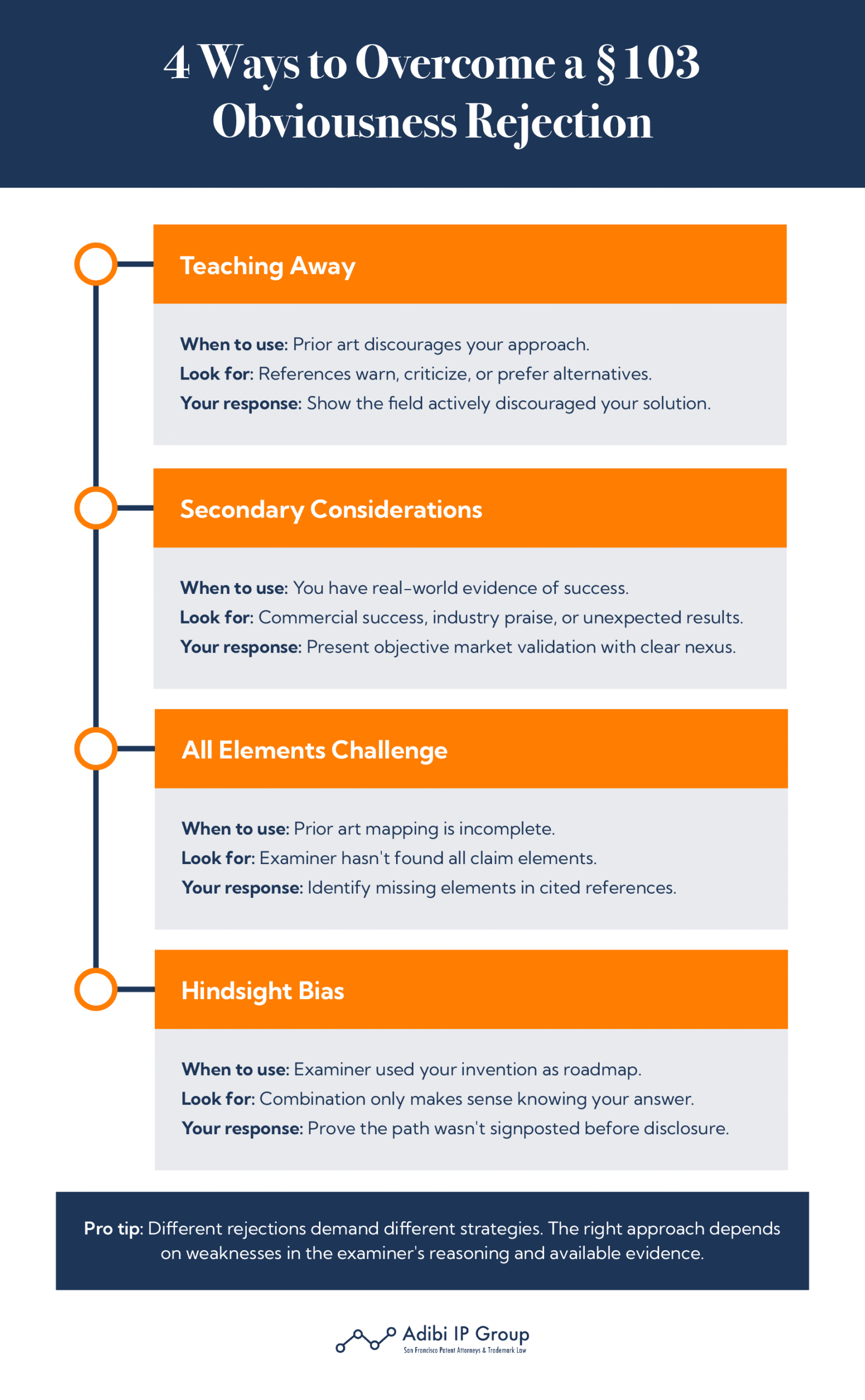
You overcome a 35 U.S.C. § 103 obviousness rejection by demonstrating that your invention, viewed as a whole, would not have been obvious to a person of ordinary skill in the art (PHOSITA) at the time of filing. The most effective strategies typically include:
- Show that prior art “teaches away” from your solution—the field actively discouraged your approach.
- Present secondary considerations like commercial success, industry praise, long-felt need, or competitor copying.
- Challenge whether the examiner found all claim elements in the cited prior art.
- Argue against hindsight reasoning—the examiner cannot use your disclosure as a roadmap.
The Graham factors, established by the Supreme Court in Graham v. John Deere Co., 383 U.S. 1 (1966), structure every §103 argument. But when the technical case is close, secondary considerations often prove decisive. These “objective indicia of non-obviousness” can shift the burden back in your favor, even when the examiner has constructed a facially reasonable combination of references.
This guide breaks down each strategy, explains when to deploy it, and provides a practical framework for building your response.
Key Takeaways
- A §103 rejection is not a verdict—it establishes a prima facie case you can overcome with proper evidence and argument.
- Four response strategies exist: teaching away, secondary considerations, all-elements challenges, and hindsight bias arguments.
- The Graham factors (scope of prior art, differences from claims, level of ordinary skill, and secondary considerations) govern every obviousness analysis.¹
- Secondary considerations carry legal weight—examiners must address evidence of commercial success, long-felt need, and unexpected results when properly presented.²
- Teaching away can defeat a rejection when prior art criticizes, discourages, or warns against your claimed approach.³
- Hindsight reasoning is prohibited—the Supreme Court in KSR warned against “ex post reasoning” that uses your invention as a roadmap.⁴
- Amendments involve tradeoffs—narrowing claims can overcome rejections but may create prosecution history estoppel limiting enforcement rights.
When to Use Each §103 Defense Strategy
The examiner has established a prima facie case—a threshold showing that your claimed invention appears obvious based on prior art. Your response either dismantles that showing or overwhelms it with evidence pointing the other way.
Different rejections demand different strategies. The right approach depends on the specific weaknesses in the examiner’s reasoning and the evidence available to you.
Teaching Away: When Prior Art Discourages Your Approach
A reference in the examiner’s rejection warns that your approach would fail. Another expresses clear preference for a different method. This is teaching away, and it directly undermines the examiner’s logic. If the prior art itself tells skilled practitioners not to do what you did, the combination cannot be obvious.
Teaching away occurs when prior art criticizes, discredits, or discourages your claimed approach. The MPEP states that “the prior art’s mere disclosure of more than one alternative does not constitute a teaching away from any of these alternatives because such disclosure does not criticize, discredit, or otherwise discourage the solution claimed.”³ The discouragement doesn’t need to be absolute—even expressions of preference for alternatives or warnings about potential problems can qualify.
Identifying a viable teaching away argument:
Look for language in the cited references that suggests your solution would cause problems, produce inferior results, or lead practitioners toward alternatives. Statements like “method X is preferred because approach Y leads to [negative outcome]” create teaching away opportunities, even if Y is what you claimed.
Constructing the argument:
“Reference X explicitly teaches that [your approach] leads to [negative outcome], stating on page [Y] that ‘[direct quote].’ A person of ordinary skill, reading this disclosure, would be led away from—not toward—the claimed invention.”
The strength depends on how explicit and unambiguous the discouragement is. A reference that merely discusses alternatives provides weaker support than one that directly warns against your path.
Anticipating the counter-argument: Examiners sometimes respond that prior art doesn’t need to “guarantee success”—only provide a reasonable expectation of success. Counter by reframing: teaching away isn’t about guarantees. It’s about what direction a skilled person would actually pursue. When literature actively discourages a path, calling that path “obvious” requires the examiner to know your answer first.
Secondary Considerations: Evidence That Tips the Scale
Your product launched and competitors took notice. Licensing inquiries arrived. An industry publication called your approach “innovative.” These aren’t just business wins—they’re legal ammunition.
Secondary considerations, also called objective indicia of non-obviousness, provide real-world evidence that your invention represents a genuine advance. Unlike technical arguments over claim scope, secondary considerations offer objective facts that can overcome even a strong prima facie case.
The Supreme Court recognized in Graham that commercial and practical factors serve as valuable indicators—they are “indicia of obviousness or nonobviousness” with legal relevance.² They reflect how the market and field actually responded to your invention—evidence harder to dismiss than legal argument alone.
Secondary considerations by persuasive weight:
| Consideration | What It Demonstrates | Typical Evidence | Strength |
| Unexpected Results | Performance exceeds predictions | Comparative testing, expert declarations | Very High |
| Long-Felt Need | Problem persisted without solution | Industry publications, failed prior attempts | High |
| Failure of Others | Skilled practitioners tried and failed | Competitor patents, abandoned projects | High |
| Commercial Success | Market validates invention’s value | Sales data, market share, licensing revenue | Moderate-High |
| Industry Praise | Experts recognize contribution | Awards, publications, conference recognition | Moderate |
| Copying by Competitors | Others copied rather than designed around | Product teardowns, internal documents | Moderate |
| Skepticism of Experts | Field doubted the approach would work | Pre-invention publications expressing doubt | Moderate |
The nexus requirement:
Secondary considerations only count if you connect them to your claimed invention. The MPEP requires “a nexus, i.e., a legally and factually sufficient connection or correspondence between the submitted evidence and the claimed invention.”⁵ Commercial success of your product alone is insufficient—you must show the success flows from features recited in your claims, not from marketing, brand recognition, or unclaimed features.
Consider: your patent claims a specific battery chemistry, but your product’s success stems from sleek industrial design. The nexus is weak. The connection must be to your claimed technical contribution.
Building the evidence package:
- Commercial success: Sales data tied to product launch, comparison to predecessor products, licensing agreements referencing the patented technology specifically
- Industry praise: Publication citations mentioning the technical innovation, award documentation, unsolicited third-party commentary
- Long-felt need: Literature documenting the problem’s history, conference proceedings, prior art’s failed attempts at the same problem
- Unexpected results: Side-by-side testing against prior art approaches, expert declarations explaining why results surprised the field
The “All Elements” Rule: Challenging Incomplete Prior Art Combinations
The examiner cites three references. Reference A allegedly teaches elements 1-3. Reference B covers elements 4-5. Reference C provides the motivation to combine. Before arguing substance, verify the examiner’s mapping is accurate.
The examiner’s burden is to identify every claim element—explicitly or inherently—somewhere in the prior art. One missing element defeats the prima facie case.
Conducting element-by-element analysis:
Create a claim chart matching each limitation in your independent claims to the specific prior art passage allegedly teaching it. Don’t rely on the examiner’s characterization—verify each mapping yourself.
Look for:
- Missing elements: The examiner asserts presence, but the cited passage doesn’t actually disclose it.
- Stretched interpretations: Unreasonably broad claim construction or prior art characterization.
- Functional versus structural gaps: The reference describes a similar function but not your specific structure.
When you find gaps, your response identifies the missing element and explains precisely why the cited art fails to teach or suggest it.
The amendment tradeoff:
If the examiner has fairly identified all elements, narrowing amendments can distinguish your claims. Adding a limitation absent from any cited reference overcomes the rejection.
But amendments create prosecution history. Under the doctrine of equivalents, narrowing amendments may limit your ability to capture equivalent infringements later. An allowed narrow claim may be less valuable than continued prosecution for a broader one. Weigh this tradeoff carefully.
Challenging Hindsight Bias: The Examiner’s Blind Spot
Read the rejection again. Does the path from prior art to your invention only make sense because someone already knows the destination? That’s hindsight bias—using knowledge of your invention to construct an “obvious” path that wasn’t apparent before your disclosure existed.
The Supreme Court in KSR v. Teleflex warned explicitly: “A factfinder should be aware, of course, of the distortion caused by hindsight bias and must be cautious of arguments reliant upon ex post reasoning.”⁴
Recognizing hindsight-driven rejections:
- The combination rationale reads like a recipe requiring knowledge of your answer.
- The motivation to combine relies heavily on the problem your invention solved.
- Reference selection feels reverse-engineered from your claim language.
Framing the argument:
“The rejection improperly relies on Applicant’s disclosure as a roadmap to selectively combine prior art elements. At the time of invention, a person of ordinary skill facing [the problem] would have had no reason to [specific combination], because [reason the combination wasn’t suggested].”
“The Office Action articulates no reason—apart from knowledge of the claimed invention—why a skilled artisan would have selected [element from Reference A] and combined it with [element from Reference B] in the claimed manner.”
Demonstrate that the path to your invention wasn’t signposted. If prior art pointed in multiple directions, or if the combination required abandoning the prior art’s preferred approaches, the “obvious” path only appears obvious after the fact.
Facing a complex §103 rejection? Adibi IP Group’s patent attorneys can help identify the strongest arguments for your specific situation. Contact us for a consultation.
With these strategies in hand, understanding the legal framework that underpins them makes your arguments more precise and harder to dismiss.
The Graham Factors: Foundation of Every §103 Argument
Every obviousness determination follows the same analytical structure—four factors the Supreme Court established in Graham v. John Deere Co. (1966). Understanding these factors shapes how you structure arguments and what evidence you gather.
The Four Graham Factors Explained
- Scope and content of the prior art. What does the existing literature disclose? What field does it occupy? You can argue that cited references are non-analogous art—from a different field and not reasonably pertinent to the problem solved—or that references don’t disclose what the examiner claims. Under the MPEP’s analogous art test, a reference qualifies only if it is from the same field of endeavor or reasonably pertinent to the problem faced by the inventor.⁶
- Differences between the prior art and the claims. What gap exists between what’s known and what’s claimed? Element-by-element analysis matters here. A single missing element can be dispositive.
- Level of ordinary skill in the art. What does the hypothetical PHOSITA know and do? This affects everything: what prior art is relevant, what combinations are obvious, what results qualify as unexpected.
- Secondary considerations. Commercial success, long-felt need, failure of others, unexpected results, industry praise. Real-world evidence that can overcome even a seemingly strong prima facie case.
The first three factors establish the prima facie case. Secondary considerations serve as a check against the inherent subjectivity of technical analysis—objective facts that shift the burden back toward non-obviousness.
How Examiners Apply Graham (And Where They Go Wrong)
The examiner must establish a prima facie case by addressing the first three Graham factors and articulating reasoning why a skilled person would combine or modify prior art to reach your claimed invention. The MPEP emphasizes that “the key to supporting any rejection under 35 U.S.C. 103 is the clear articulation of the reason(s) why the claimed invention would have been obvious.”⁷ Once that threshold is met, the burden shifts to you.
Common examiner errors:
- Conclusory reasoning: Stating a combination is “obvious” without explaining why a skilled person would make it. Post-KSR, examiners have flexibility—but they must still articulate reasoning.
- Hindsight reconstruction: Using your specification to guide reference selection and combination. If the rejection only makes sense with knowledge of your invention, challenge it.
- Ignoring secondary considerations: When you present evidence of commercial success or unexpected results, the examiner must address it. Failure to engage with properly presented evidence is error.
- Missing motivation to combine: When multiple references are combined, the examiner must explain why a skilled person would have reason to make that combination. “Common sense” cannot substitute for articulated reasoning in every case.
- Skill level errors: Setting PHOSITA’s skill too high makes everything obvious; failing to consider what ordinary practitioners would actually do distorts the analysis.
Identify which error applies and explain why the prima facie case fails on its own terms—before reaching your affirmative arguments.
KSR v. Teleflex: What Changed and What Didn’t
KSR International Co. v. Teleflex Inc. (2007) is the most significant Supreme Court obviousness decision since Graham. Understanding what KSR actually held matters more than how it’s sometimes characterized.
What changed:
Before KSR, Federal Circuit precedent required examiners to find an explicit “teaching, suggestion, or motivation” (TSM) in prior art to combine references. KSR rejected TSM as the exclusive test. Obviousness can now be established through:
- Common sense and ordinary creativity of skilled artisans
- Obvious to try (finite number of predictable solutions)
- Market demand or design incentives
- Known problem with known solutions
What didn’t change:
- Examiners must still articulate reasoning—”obvious” without explanation is insufficient.
- Graham factors remain mandatory.
- Hindsight reconstruction remains impermissible.
- Secondary considerations still carry weight.
Practical impact:
KSR expanded examiner tools for establishing prima facie obviousness. But it also expanded your tools for challenging how examiners use those tools. If an examiner invokes “common sense” without explaining what common sense dictates or why, that’s vulnerable.
The “obvious to try” rationale deserves particular attention. KSR permits it when there’s a “finite number of identified, predictable solutions” and skilled persons have “good reason to pursue the known options.”⁸ If options weren’t finite, success wasn’t predictable, or no good reason existed to select your particular path—obvious to try doesn’t apply.
Seeing how courts have applied these principles in actual cases reveals patterns you can leverage in your own arguments.
Key Patent Terminology for §103 Arguments
Precise terminology enables effective examiner engagement. These terms appear throughout Office Actions and prosecution responses—understanding them ensures you’re arguing on common ground.
PHOSITA: The Hypothetical Person Judging Your Invention
PHOSITA—Person Having Ordinary Skill in the Art—is the legal construct through which all obviousness questions filter. Not a genius. Not a novice. A hypothetical person with background and skills typical of practitioners in the relevant field at the time of invention.
Why the definition matters:
Skill level determines what’s “obvious.” A combination obvious to an expert with 20 years of experience might not be obvious to a typical practitioner with 3 years. The level also affects accessible prior art—PHOSITA is presumed to know all relevant prior art in their field.
Illustrative skill levels by technology area:
| Technology | Illustrative PHOSITA Profile |
| Software | BS in Computer Science, 2-3 years industry experience in relevant domain |
| Mechanical Engineering | BS or MS, 3-5 years experience in relevant product area |
| Biotechnology | PhD in relevant biological science, 2-3 years post-doctoral or industry research |
| Pharmaceuticals | PhD in Chemistry or Pharmacology, 3-5 years drug development experience |
| Electrical Engineering | BS or MS, 2-4 years experience in relevant circuit or system area |
Note: Actual PHOSITA determinations vary by case and depend on the specific art at issue.
Strategic consideration: You can argue for higher or lower skill levels. Higher levels mean more combinations are obvious—but also that unexpected results carry more weight, because experts have better predictive ability. Consider these tradeoffs before characterizing PHOSITA as particularly sophisticated or unsophisticated.
Prior Art: What Counts Against Your Patent
Under the America Invents Act (AIA), governing applications filed on or after March 16, 2013, prior art includes:⁹
- Patents and published applications worldwide
- Printed publications (journals, conferences, technical documents)
- Public use or sale in the United States
- Other public availability anywhere globally
These qualify if they occurred before your effective filing date. A limited one-year grace period exists for your own disclosures, though relying on it adds prosecution complexity.¹⁰
Analogous art limitation:
Not all prior art is citable. References must be “analogous”—either from the same field of endeavor as your invention, or reasonably pertinent to your particular problem. If an examiner cites a reference from a completely unrelated field with no logical connection, challenge it as non-analogous.
For a comprehensive overview of how prior art affects different rejection types, see our guide to types of patent rejections.
The TSM Test: Still Relevant After KSR
The Teaching, Suggestion, or Motivation test asks whether prior art itself provides reason to combine references in the claimed way. Before KSR, this was the primary obviousness test. Post-KSR, it’s one of several rationales, but it remains useful.
Why TSM still matters:
When examiners rely on “common sense” or “obvious to try” without strong support, demand they identify the teaching, suggestion, or motivation. If no such teaching exists and the examiner cannot articulate another valid basis, the rejection is vulnerable.
TSM proves particularly effective when cited references come from different fields or address different problems. The more attenuated the connection, the stronger your argument that nothing in the art would have led a skilled person to your specific combination.
Understanding these terms equips you for examiner engagement, but seeing principles applied in real cases provides the clearest guidance.
§103 Strategies in Action: Case Examples
Abstract frameworks become concrete in application. These cases illustrate the principles in practice and provide templates for your own arguments.
Graham v. John Deere (1966): The Framework Origin
The invention: An improved plow shank that better absorbed shock from rocks and obstructions. The innovation was placing the hinge plate below the shank rather than above, changing how the plow flexed under stress.
The holding: The Supreme Court established the four-factor test bearing the case’s name and affirmed that obviousness must be assessed at the time of invention, not with hindsight. The Court recognized secondary considerations as “indicia of obviousness or non-obviousness” with legal relevance.²
Lasting impact: Before Graham, secondary considerations were often treated as truly secondary—nice supporting arguments but not essential. Graham established them as legally relevant factors requiring consideration. Commercial success, long-felt need, and other objective evidence moved from optional to integral.
KSR International v. Teleflex (2007): Flexibility with Limits
The invention: An adjustable vehicle pedal assembly combined with an electronic throttle control sensor. Prior art showed adjustable pedals without sensors and pedals with sensors that weren’t adjustable. The question: was combining these known elements obvious?
The holding: The Supreme Court found the combination obvious, rejecting the Federal Circuit’s rigid TSM application. Common sense, market demand, and design incentives can support obviousness without explicit prior art teaching to combine.
Critical nuance: KSR did not hold that all combinations of known elements are obvious. The Court emphasized that combinations must be “obvious to try” based on a “finite number of identified, predictable solutions” with “reasonable expectation of success.”⁸ Unpredictable outcomes or non-finite options change the analysis.
Practical lesson: KSR cuts both ways. Examiners have broader rationales, but must still explain why a combination was obvious—not merely that elements existed separately. Challenge rejections invoking KSR without explaining why your specific combination was predictable or motivated.
Chemours v. Daikin (2021): Teaching Away in Practice
The invention: Chemours held patents on a polymer with a specific high melt flow rate (30±3 g/10 min) for high-speed cable insulation extrusion. The claimed polymer enabled faster coating speeds while maintaining quality.
The examiner’s case: The PTAB found the claims obvious over a single prior art reference (Kaulbach) that disclosed polymer elements with a melt flow rate of 24 g/10 min—close to but below the claimed range. The Board reasoned a skilled artisan would have been motivated to increase the melt flow rate to achieve faster coating speeds.
The winning argument: Chemours successfully argued teaching away. The prior art’s core “inventive concept” was maintaining a “very narrow molecular weight distribution.” Critically, the reference explicitly warned that techniques used to increase melt flow rate would broaden the molecular weight distribution, directly contradicting the reference’s fundamental teaching.
The Federal Circuit’s analysis: The court reversed, finding the Board “did not adequately grapple with why a skilled artisan would find it obvious to increase the melt flow rate while retaining its critical very narrow molecular-weight distribution.”¹¹ When a proposed modification would “destroy the basic objective” of the prior art, motivation to combine cannot be established.
Practical takeaway: Teaching away proves most effective when the prior art identifies a core inventive principle and the proposed modification would undermine that principle. Look for language in cited references that cautions against, discourages, or warns of problems with your claimed approach, even if the reference doesn’t explicitly say “don’t do this.”
These cases illustrate that §103 rejections can be overcome. The key is selecting the right strategy for your situation.
How to Respond to a §103 Rejection: A Step-by-Step Framework
Theory becomes practice with a systematic process. This framework applies whether you’re responding yourself or working with counsel.
Your §103 Response Framework
Step 1: Map each claim element to cited prior art. Create a claim chart pairing every limitation in your independent claims with the specific prior art passage allegedly teaching it. Don’t rely on the examiner’s characterization—verify each mapping yourself.
Step 2: Identify missing or poorly mapped elements. Find gaps where cited passages don’t actually disclose what the examiner claims, where teaching is tangential rather than direct, or where claim construction seems unreasonably broad.
Step 3: Evaluate teaching away opportunities. Review each cited reference for statements criticizing, discouraging, or expressing skepticism about your approach. Check whether prior art prefers alternatives or warns of problems with your method.
Step 4: Gather secondary consideration evidence. Assess available objective evidence: sales data for commercial success, publications demonstrating praise, documentation of others’ failed attempts, testing data showing unexpected results.
Step 5: Check for hindsight reconstruction. Determine whether the examiner’s combination rationale only makes sense knowing your invention. If the path to your claims wasn’t signposted before your disclosure, document why.
Step 6: Draft response with prioritized arguments. Lead with your strongest argument. Compelling teaching away with direct quotes? Open there. Extensive commercial success evidence with clear nexus? Lead there. Don’t bury your best argument in a list.
Common §103 Response Mistakes to Avoid
Arguing secondary considerations without nexus. Commercial success or industry praise only matters if connected to claimed features. Don’t assume the examiner makes that connection—establish nexus explicitly.
Conceding claim scope unnecessarily. “The prior art doesn’t teach X” implicitly concedes your claim requires X. Be precise about what you’re arguing and what you’re conceding.
Failing to address all cited references. Three references cited means three references addressed. A gap in any reference can undermine the rejection, but incomplete responses leave openings.
Making amendments that create estoppel. Narrowing amendments overcome rejections but create prosecution history limiting enforcement rights. Consider whether continued argument preserves broader claim scope.
Accepting the examiner’s claim construction. Unreasonably broad claim interpretation? Challenge the construction. You’re not required to accept characterizations that don’t match your specification’s plain meaning.
Need help building your §103 response? Our patent prosecution team has overcome hundreds of obviousness rejections across technology sectors. Schedule a strategy session.
Building Your Non-obviousness Case
A §103 rejection marks a starting point, not an ending. The law provides multiple pathways to demonstrate non-obviousness: teaching away arguments that undermine examiner logic, secondary considerations that deliver objective market validation, element-by-element challenges that expose prima facie gaps. The Supreme Court’s framework in Graham and KSR ensures examiners must articulate reasoning, and that you have tools to challenge it when that reasoning falls short.
The strongest responses combine legal argument with evidence. Examiners must address secondary considerations when properly presented. They cannot rely on hindsight. They must articulate reasoning for combinations. These requirements create leverage for applicants who understand the framework and deploy it systematically.
Building your case means identifying which strategy fits your facts, gathering supporting evidence, and presenting arguments with clarity. For straightforward rejections, the checklist approach works well. For complex fact patterns—multiple references, subtle claim construction issues, significant business stakes—experienced patent counsel can identify arguments you might miss and present them at full strength.
Ready to turn your §103 rejection into an allowance? Contact Adibi IP Group to discuss your patent prosecution strategy.
References
- Graham v. John Deere Co. of Kansas City, 383 U.S. 1, 17-18 (1966). Supreme Court of the United States.
- Graham v. John Deere Co., 383 U.S. at 17-18 (“Such secondary considerations as commercial success, long felt but unsolved needs, failure of others, etc., might be utilized to give light to the circumstances surrounding the origin of the subject matter sought to be patented. As indicia of obviousness or nonobviousness, these inquiries may have relevancy.”).
- Manual of Patent Examining Procedure § 2145, “Consideration of Applicant’s Rebuttal Arguments and Evidence.” United States Patent and Trademark Office, 2024.
- KSR International Co. v. Teleflex Inc., 550 U.S. 398 (2007). Supreme Court of the United States.
- Manual of Patent Examining Procedure § 716.01(b), “Nexus Requirement and Evidence of Nonobviousness.” United States Patent and Trademark Office, 2024.
- Manual of Patent Examining Procedure § 2141.01(a), “Analogous and Nonanalogous Art.” United States Patent and Trademark Office, 2024.
- Manual of Patent Examining Procedure § 2141, “Examination Guidelines for Determining Obviousness Under 35 U.S.C. 103.” United States Patent and Trademark Office, 2024.
- KSR International Co. v. Teleflex Inc., 550 U.S. at 421 (“When there is a design need or market pressure to solve a problem and there are a finite number of identified, predictable solutions, a person of ordinary skill has good reason to pursue the known options within his or her technical grasp.”).
- Manual of Patent Examining Procedure § 2151, “Overview of the Changes to 35 U.S.C. 102 and 103 in the AIA.” United States Patent and Trademark Office, 2024.
- Manual of Patent Examining Procedure § 717, “Prior Art Exceptions under AIA 35 U.S.C. 102(b)(1) and (2).” United States Patent and Trademark Office, 2024.
- Chemours Co. FC, LLC v. Daikin Industries, Ltd., 4 F.4th 1370 (Fed. Cir. 2021).