A departing engineer licenses your core patent to a competitor. A VC pulls their term sheet because you can’t prove you own your own technology. An infringer walks free because someone who helped develop the invention wasn’t named on the patent. These scenarios share a common root: confusion between inventorship and ownership—two concepts that sound similar but operate under entirely different rules.
Inventorship is legal credit. It identifies who conceived the invention, is determined by federal law, and cannot be bought, sold, or contracted away. Ownership is economic control—the right to license, enforce, and profit from the patent—and it transfers only through written agreements. The distinction between inventorship vs ownership matters because getting either one wrong can unravel everything else. Name the wrong inventors, and competitors can invalidate your patent. Fail to secure proper assignments, and you may discover you don’t actually own what you thought you built.
If you’re wondering who owns employee inventions at your company, here’s the uncomfortable truth: without a valid written assignment, the inventors do—even if they created the invention on company time, using company resources.
Key Takeaways
- Inventorship is about credit; ownership is about control. The inventor conceived the idea. The owner controls the money.
- Inventorship cannot be transferred. No contract can strip an inventor of their credit or grant inventorship to someone who didn’t contribute to conception.
- Ownership requires written assignment. Verbal agreements don’t count. Under federal law, patent rights transfer only through written instruments.¹
- Incorrect inventorship can invalidate a patent. Omitting a true inventor or including someone who didn’t contribute to conception creates grounds for challenge.
- Without written assignment, inventors own by default. Employers don’t automatically own employee inventions—they must secure written assignments.
- Joint inventors each control the entire patent independently. Any co-inventor can license to competitors without consent. Any co-inventor can refuse to participate in enforcement, blocking litigation entirely.²
- Employment agreements transfer ownership, not inventorship credit. Your contract may assign rights to your employer, but your name stays on the patent.
- State laws protect employees. Statutes like California Labor Code § 2870 limit what employers can require for inventions made entirely on personal time.
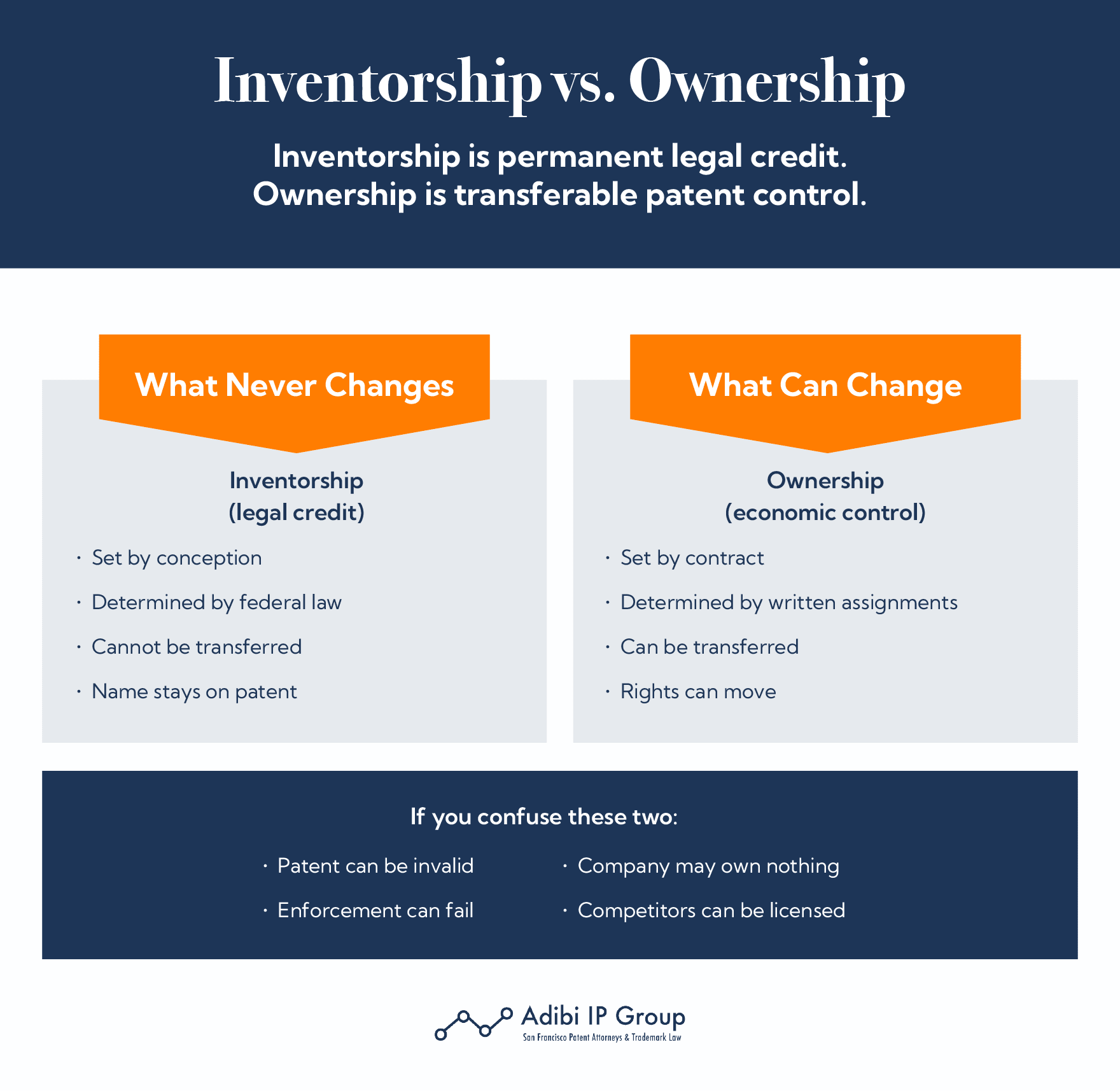
Inventorship vs. Ownership: Side-by-Side Comparison
| Aspect | Inventorship | Ownership |
| What it is | Legal credit for conception | Economic control over patent rights |
| Who determines it | Federal law (35 U.S.C. § 116) | Contracts and assignments |
| Can it be transferred? | No—permanent and inalienable | Yes—through written assignment |
| Default position | Determined by contribution to claims | Vests in inventor(s) unless assigned |
| Primary concern | Getting the names right | Getting the contracts signed |
| Consequence of error | Patent invalidity | Ownership disputes; blocked deals |
What follows examines each concept in detail: first, what the law requires for inventorship; then, how ownership actually transfers; and finally, the intersection where employment agreements, contractor relationships, and state law create the gaps that sink companies.
Patent Inventorship Requirements: Who Gets Credit and Why It Matters
The Legal Standard Under 35 U.S.C. § 116
Your lead engineer spent eighteen months building and testing the prototype. Your CEO identified the market opportunity. Your investor wrote the check. None of that matters for inventorship. Under 35 U.S.C. § 116, only one thing determines who qualifies as an inventor: conception—forming a definite and permanent idea of the complete invention as it will work in practice.³
This single standard produces counterintuitive results that founders often learn the hard way.
- Conception is the touchstone—not building, not testing. The person who had the idea is the inventor. The person who spent months implementing it may not be. The Federal Circuit has consistently held that reduction to practice—actually making the invention work—doesn’t confer inventorship.⁴ Building someone else’s idea makes you an implementer, not an inventor.
- Inventorship follows claims, not projects. You don’t need to contribute to the entire invention to be an inventor. Contributing to the conception of even one claim is enough. This also means inventorship can shift during prosecution: add a claim based on someone’s contribution, and you’ve added an inventor.
- Inventorship is inalienable. No contract can take it away. Employment agreements can—and should—transfer ownership, but they cannot alter who appears as the named inventor. If you contributed to conception, your name belongs on the patent. If you didn’t, no amount of corporate hierarchy or deal negotiation can put it there.
- Supervisors, funders, and explainers typically don’t qualify. Managing a research team doesn’t make you an inventor. Identifying a problem doesn’t make you an inventor. Explaining prior art doesn’t make you an inventor. The Federal Circuit’s three-part test from Pannu v. Iolab Corp. requires each inventor to: (1) contribute significantly to conception or reduction to practice; (2) make a contribution of meaningful quality relative to the full invention; and (3) do more than explain well-known concepts.⁵
Joint Inventorship: When Multiple Contributors Share Credit
Joint inventorship operates more flexibly than most assume. 35 U.S.C. § 116 explicitly provides that joint inventors need not work together physically, need not work at the same time, and need not contribute the same type or amount of inventive work. Each must only contribute to conception of at least one claim.
Consider two engineers at a startup. One develops a novel compression algorithm—that’s Claims 1 through 5. The other independently creates an efficient hardware implementation—Claims 6 through 10. Both are joint inventors of the patent, even though neither touched the other’s work and they may never have collaborated directly.
For startups with multiple technical founders, this matters enormously. The question isn’t whether your co-founders are joint inventors—if they’re building your core technology, they probably are. The question is whether proper assignment agreements ensure the company controls what they create.
Why Correct Inventorship Matters: The Invalidation Risk
Inventorship errors aren’t paperwork problems. They’re patent-killing problems.
- Omitting an inventor creates validity exposure. A patent that fails to name all true inventors is defective. Competitors can—and do—challenge patents on this basis. Courts have invalidated patents where material inventors were left off, intentionally or not.
- Including a non-inventor is equally dangerous. Naming someone who didn’t contribute to conception—to reward their funding, acknowledge their supervision, or satisfy internal politics—creates the same validity concerns. If the misrepresentation was knowing, the patent may become unenforceable due to inequitable conduct.
- Correction is possible, but imperfect. 35 U.S.C. § 256 allows correction of inventorship in issued patents when the error occurred without deceptive intent. Correction during prosecution is far simpler than correction after issuance. And if intentional misrepresentation occurred, correction won’t save the patent from unenforceability challenges.
The best practice is straightforward: conduct inventorship analysis during drafting—not after filing, not during litigation. Interview all potential contributors. Map contributions to specific claims. Get it right the first time. Learn more about protecting your IP rights.
Patent Ownership: Who Controls the Patent and Its Economic Value
Default Rules: Inventors Own Unless Assigned
Here’s what surprises most founders: employers don’t automatically own employee inventions.
Under 35 U.S.C. § 261, patent rights initially vest in the inventor. Unlike copyright law—where works made for hire belong to employers automatically in certain situations—patent law requires affirmative written transfer. Absent a valid assignment, the inventor owns the patent, even if they developed it at work, using company equipment, on company time.
The implications for joint ownership are even more severe. When multiple inventors own a patent without a governing agreement, each has independent rights to the entire patent. Under 35 U.S.C. § 262, any co-owner can make, use, or sell the invention without accounting to other co-owners; license the entire patent to anyone—including competitors—without consent; and refuse to participate in enforcement, potentially blocking litigation entirely.
Ethicon, Inc. v. U.S. Surgical Corp. shows what this looks like in practice. An omitted co-inventor was later added to the patent, then licensed his rights to the accused infringer. When he refused to join as plaintiff, the original patent holder couldn’t maintain the lawsuit. Case dismissed.⁶
Without proper assignment agreements, a departing co-founder could license your own patent to your biggest competitor—legally. This isn’t theoretical. It happens.
Patent Assignment Agreements: How Ownership Transfers
A patent assignment is a written contract transferring ownership from one party to another. The statute is explicit: assignments must be in writing. Oral agreements to assign patent rights are unenforceable.
“Hereby assigns” versus “agrees to assign.” This language distinction determines whether transfer happens immediately or remains a promise requiring future action. “Hereby assigns” creates automatic transfer upon execution—no separate document needed. “Agrees to assign” creates only a contractual obligation, requiring an additional assignment instrument. The Supreme Court addressed this distinction in Board of Trustees of the Leland Stanford Junior University v. Roche Molecular Systems, where an inventor’s earlier “hereby assigns” agreement to a third party defeated Stanford’s “agrees to assign” employment agreement.⁷ During due diligence, investors spot this distinction immediately.
Recording provides notice, not validity. Recording with the USPTO isn’t required for the assignment to be valid between parties, but it provides constructive notice to subsequent purchasers. Failure to record within three months can mean losing priority to later good-faith buyers.
The Hired-to-Invent Doctrine: When Employers Own Without Written Assignment
First, the critical correction: “work for hire” is a copyright doctrine. It doesn’t apply to patents. Don’t use the term; it signals misunderstanding.
Patent ownership transfers through either express written assignment or the common-law “hired-to-invent” doctrine. The Supreme Court articulated this principle in United States v. Dubilier Condenser Corp.: an employee hired specifically to invent, or to solve a particular problem, may have an implied obligation to assign resulting inventions—even without a written agreement.⁸
The doctrine is narrow, though. Courts require that the employee was hired specifically to invent or solve the particular problem that led to the invention. General employment in a research capacity typically isn’t enough. Courts are reluctant to imply assignment obligations without clear evidence of the parties’ intent.
Shop rights provide a lesser fallback. When an employee invents using employer time, materials, or facilities—but wasn’t hired to invent—the employer gets a non-exclusive, royalty-free license to practice the invention. It’s not transferable. It doesn’t exclude others. It’s not ownership.
The lesson: never rely on implied doctrines. The hired-to-invent doctrine requires litigation to establish. Shop rights provide minimal protection. Written assignment agreements eliminate uncertainty and should be executed before any inventive work begins.
State Law Considerations: California, Delaware, and Beyond
Federal law governs patent assignments. State law governs the enforceability of the contracts that create them.
California Labor Code § 2870 limits what employers can require. Under this statute, employers cannot compel assignment of inventions that an employee develops entirely on their own time, without using employer equipment, supplies, facilities, or trade secrets. The invention must also not relate to the employer’s business or anticipated R&D, and must not result from work performed for the employer. Provisions violating these limits are “against the public policy of this state and unenforceable.”⁹
Similar statutes exist in Delaware, Illinois, Minnesota, Washington, and other states. The specifics vary, but the common thread is protection against employer overreach into genuinely personal inventive activity.¹⁰ ¹¹ ¹² ¹³
The practical implication: assignment clauses must account for state law. Overly broad provisions—claiming all inventions regardless of circumstances—may be unenforceable where employees work. Well-drafted agreements track statutory language and include required notices.
Employment IP Agreements: Where Inventorship and Ownership Intersect
IP Assignment Clauses: What Founders Need to Get Right
Failing to secure proper assignments ranks among the most common—and most expensive—mistakes startups make. Chain of title issues are among the most frequent pitfalls uncovered during IP due diligence in M&A transactions.¹⁴ Investors conduct IP due diligence specifically because missing assignments can crater deals.
Key elements to consider for IP assignment provisions:
- Present assignment language: “Hereby assigns” creates immediate transfer; “agrees to assign” creates only a promise.
- Comprehensive scope: All inventions, improvements, and IP related to company business or created using company resources.
- Clear timing: Inventions conceived during employment and, where permissible, during a reasonable period thereafter.
- Cooperation clause: Assignor must sign necessary documents, assist with prosecution, provide testimony.
- Adequate consideration: Employment suffices for new hires; existing employees may require additional consideration.
- Survival provisions: Key obligations continue after termination.
Timing is critical. Get agreements signed before work begins—as part of the offer letter or onboarding. Trying to secure assignments after inventions exist introduces complications, requires additional consideration, and may face resistance from someone who now holds leverage.
Structuring IP agreements correctly from the start prevents costly disputes later. Contact Adibi IP Group for guidance on employment and contractor IP provisions.
Contractor and Advisor Agreements: The Forgotten Gap
The contractor you hired to build your prototype owns everything they created—unless you got it in writing.
Independent contractors own their inventions by default. Unlike employees (where the hired-to-invent doctrine might provide some protection), contractors retain full ownership absent express written assignment. The default strongly favors them.
Advisors can become joint inventors without trying. If an advisor contributes technical ideas that end up in patent claims, they may qualify as a joint inventor—with all the independent licensing rights that status confers. Without an assignment, that advisor could license your patent to anyone.
Solution: Execute IP assignment agreements with everyone who might contribute to inventions before any technical discussions occur:
- Independent contractors and consultants
- Advisory board members
- Academic collaborators
- Joint development partners
Once conception happens, leverage shifts to the potential inventor. The time to secure rights is before the first whiteboard session.
Contact us for patent consulting services.
What Inventive Employees Should Know About Their Rights
If you create inventions at work, several principles protect your interests.
- Your inventorship credit cannot be taken away. Even if your employer owns the patent, you remain the named inventor. Contracts can assign ownership; they cannot remove your name.
- Read what you signed. Many employees execute IP clauses without understanding them. Know the scope of your obligations: what inventions are covered, what carve-outs exist, what your state protects.
- State law may preserve your personal inventions. In California, Delaware, Illinois, Minnesota, Washington, and other states, inventions made entirely on your own time, without employer resources, unrelated to your employer’s business, may remain yours—regardless of what your employment agreement says.
- Ensure proper naming if you contributed. If your contributions rose to the level of conception for any claim, you belong on the patent. Employers cannot omit true inventors to simplify ownership.
- Inventorship doesn’t equal ownership. Being named as an inventor gives you credit, not necessarily money. Your economic rights depend entirely on your employment agreement.
Patent Ownership Disputes: What Goes Wrong and How to Prevent Them
Common Dispute Scenarios
- Omitted inventor: A contributor who conceived part of the invention isn’t named. Creates validity exposure and potential co-ownership claims.
- Included non-inventor: Someone who supervised, funded, or only helped build—but didn’t contribute to conception—is named anyway. Creates validity and enforceability risks.
- Unclear ownership: Multiple parties claim rights based on conflicting agreements, disputed employment relationships, or ambiguous language.
- Missing assignment: A departed employee or contractor claims ownership because no valid assignment was ever executed. The company assumed it owned the IP. It can’t prove it.
- Joint inventor independence: A co-inventor licenses to a competitor, or refuses to participate in enforcement, blocking the company from pursuing infringers.
Case Examples: When Inventorship and Ownership Go Wrong
Pannu v. Iolab Corp., 155 F.3d 1344 (Fed. Cir. 1998)
Dr. Pannu held a patent for an improved intraocular lens. The accused infringer, Iolab, argued the patent was invalid because Dr. Link—another contributor—should have been named as co-inventor but wasn’t.
The Federal Circuit reversed the lower court, holding that sufficient evidence existed for a jury to find Link was a co-inventor. The court articulated what’s now the standard three-part test: an alleged inventor must contribute significantly to conception, make a contribution of meaningful quality relative to the full invention, and do more than explain well-known concepts.⁵
The lesson: Inventorship requires careful, claim-by-claim analysis of who contributed to conception. Omitting a true inventor—even unintentionally—creates validity concerns that accused infringers will exploit.
Ethicon, Inc. v. U.S. Surgical Corp., 135 F.3d 1456 (Fed. Cir. 1998)
Ethicon sued U.S. Surgical for patent infringement. During litigation, U.S. Surgical discovered that Choi—an omitted contributor—had co-invented certain claims. Choi was added as co-inventor, then licensed his rights to U.S. Surgical. When Choi refused to join as plaintiff, Ethicon couldn’t maintain the suit.
The Federal Circuit affirmed dismissal. Each co-owner has independent rights—including the right to license without consent. Choi’s license was valid. Without him as plaintiff, the case couldn’t proceed.⁶
The lesson: A single co-inventor, acting alone, can license your patent to your competitor and then prevent you from enforcing it. This is why assignment agreements must be in place before inventive work begins—not after.
Preventing Disputes: A Practical Checklist
For Founders and Employers:
- Implement assignment agreements before work begins. Every employee, contractor, and advisor should execute IP assignments as a condition of engagement—not after inventions exist.
- Document contributions contemporaneously. Invention disclosure forms capture who contributed what ideas and when. This documentation proves invaluable when inventorship is later disputed.
- Conduct inventorship analysis during drafting. Work with patent counsel to identify inventors by mapping contributions to specific claims before filing.
- Perform periodic IP audits. Review your portfolio to confirm all assignments are properly executed and recorded. Find gaps before due diligence does.
For Employees:
- Document your contributions. Keep records of your ideas, sketches, and timeline. This protects your inventorship rights.
- Ensure proper naming. If you contributed to conception for any claim, your name belongs on the patent.
- Understand your agreement. Know what you’ve agreed to assign and what rights you may have retained.
Contact us for patent portfolio analysis.
Resolving Disputes: Correction and Legal Remedies
USPTO correction under 35 U.S.C. § 256 allows inventorship changes when errors occurred without deceptive intent. Omitted inventors can be added; improperly named ones removed. If intentional misrepresentation occurred, however, correction may not prevent inequitable conduct challenges.
Ownership disputes involve contract law. Resolution requires reviewing employment agreements, assignment documents, and circumstances of the inventive activity. Options include negotiation, mediation, arbitration, or litigation.
Timing pressure compounds everything. These disputes surface during funding rounds, acquisition due diligence, and enforcement actions—exactly when stakes are highest and flexibility is lowest.
Facing an inventorship or ownership question? Early guidance prevents costly disputes. Schedule a consultation with Adibi IP Group.
Strategic Considerations: Aligning IP Rights with Business Goals
Due Diligence and Funding: Why Investors Scrutinize IP Ownership
Investors and acquirers examine IP ownership because problems here can be deal-breakers. They verify:
- Proper inventor naming: Omitted inventors create validity risks.
- Executed and recorded assignments: Missing documentation means the company may not actually own its core IP.
- Clear title: Disputes, competing claims, or unresolved contractor relationships raise red flags.
- Complete coverage: Gaps in employment agreements suggest potential ownership issues.
Missing assignments or incorrect inventorship can delay closings, reduce valuations, or kill deals entirely. The time to address these issues is before they surface in diligence—not under transaction pressure.
Best practice: Maintain clean records from day one. Execute agreements before engagement. Record assignments promptly. Conduct periodic audits. Address gaps proactively.
File a patent with proper documentation.
Building Long-Term Patent Portfolio Value
A valuable portfolio requires attention to both inventorship and ownership throughout each asset’s lifecycle.
- Proper inventorship protects validity. Every patent should accurately name all true inventors—and only true inventors. Systemic inventorship errors create systemic validity risks across your portfolio.
- Clear ownership enables monetization. You cannot license, sell, or enforce patents you don’t own. Clear, documented ownership—with recorded assignments—is essential for commercial exploitation.
- Portfolio management requires ongoing attention. As inventors leave, employees join, and relationships evolve, your records must be maintained. What was clear at filing can become muddled without active management.
Reach out for patent portfolio analysis services.
Getting Inventorship and Ownership Right from the Start
The distinction between inventorship vs ownership runs deeper than terminology. Inventorship is permanent credit determined by conception—it cannot be changed by agreement. Ownership is transferable control determined by contract—it exists only because of agreement.
For founders and employers: Implement assignment agreements before work begins. Document contributions as they happen. Analyze inventorship during drafting. Audit your portfolio periodically. The disputes that derail funding rounds, complicate acquisitions, and block enforcement all trace back to these fundamentals.
For employees: Your inventorship credit is yours permanently—no contract can take it away. But your economic rights depend entirely on what you’ve signed. Read your agreement. Know your state’s protections. Ensure proper naming if you contributed to conception.
Clean IP hygiene from day one isn’t merely good practice. It’s the foundation for building a defensible, valuable patent portfolio—and the clearest path to avoiding the disputes that have sunk companies far larger than yours.
Ready to structure your IP agreements correctly? Contact Adibi IP Group to discuss your patent strategy.