Your patent portfolio might contain a hidden vulnerability you created years ago.
A terminal disclaimer filed to overcome a routine prosecution rejection can render entire patent families unenforceable if ownership ever changes—through M&A, spin-offs, licensing deals, or bankruptcy. The patent term you surrendered was visible at the time. The enforcement risk often isn’t discovered until a litigation opponent finds it.
Terminal disclaimer patent strategy matters because these filings are irrevocable. Once accepted, a TD permanently links your patent’s expiration to an earlier reference patent and creates an ownership requirement that persists for decades. File one without calculating the true cost, and you’ve traded prosecution efficiency for long-term vulnerability.
This guide gives you the strategic framework: how to recognize when terminal disclaimers become necessary, what you’re actually giving up, how to maintain enforceability through corporate changes, and how to build portfolios that minimize these constraints from the start. The goal isn’t avoiding TDs entirely—it’s filing them deliberately, with full visibility into consequences.
Key Takeaways
- Terminal disclaimers are irrevocable. Under 37 CFR 1.321, the USPTO will not withdraw an incorrect terminal disclaimer after patent grant, even if filed in error.¹
- The common ownership requirement is ongoing. TD-linked patents must remain commonly owned at the time of enforcement, not just at filing. Any gap—even brief—can defeat enforceability.¹
- PTA disappears with a TD. Filing a terminal disclaimer eliminates any Patent Term Adjustment your application accrued from USPTO delays.¹
- TDs are not admissions of obviousness. The Federal Circuit confirmed in SimpleAir, Inc. v. Google LLC (2018) that filing a terminal disclaimer doesn’t establish that claims are patentably indistinct from the parent patent.²
- Fight ODP rejections when distinction exists. Not every obviousness-type double patenting rejection requires capitulation—substantive amendments or persuasive argument can preserve full patent term.
- Map TD relationships before any transaction. Ownership divergence during M&A, spin-offs, or carve-outs is among the most common paths to unenforceable patents.
- The proposed 2024 TD rule change was withdrawn. The USPTO withdrew its controversial terminal disclaimer proposal in December 2024 after receiving over 300 public comments.³
Understanding Terminal Disclaimers: Strategic Context and Core Mechanics
The Strategic Stakes: Why Terminal Disclaimers Matter
A pharmaceutical company acquires a competitor’s patent portfolio. Eighteen months later, during litigation, opposing counsel produces a terminal disclaimer filed a decade earlier and demonstrates that common ownership lapsed for eleven days during the transaction. The patent becomes unenforceable. The acquisition’s value collapses.
This scenario plays out more often than most IP strategists realize. Terminal disclaimers create three categories of long-term consequence that surface years after filing:
- Patent Term Sacrifice: Filing a TD shortens your patent’s enforceable life to match the reference patent’s expiration. If that reference issued years earlier or carries less Patent Term Adjustment, you may surrender protection precisely when it matters most: when products are mature, competitors are circling, and every month of exclusivity counts.
- Enforcement Vulnerability: The common ownership requirement isn’t paperwork. It’s an ongoing condition. If ownership of TD-linked patents diverges at any point, enforceability can be challenged. Sophisticated litigation opponents investigate ownership chains specifically looking for gaps.⁴
- Portfolio Interdependency: Terminal disclaimers link fates. If the reference patent falls to an invalidity challenge, every patent disclaimed over it faces collateral attack. Your portfolio’s strength becomes only as durable as its most vulnerable member.
Strategic Impact Matrix:
| Factor | Without TD | With TD | What’s Actually at Stake |
| Patent Term | Full statutory term + PTA | Linked to reference patent | Years of protection, often the most valuable years |
| Ownership Flexibility | Enforce independently | Common ownership required | Every future transaction becomes an IP event |
| Litigation Exposure | Stand-alone validity | Linked vulnerability | One weak patent endangers the family |
| Portfolio Valuation | Individual assessment | Interdependent value | Due diligence complexity; deal risk |
The question isn’t whether you can file a terminal disclaimer. It’s whether prosecution convenience justifies these downstream costs.
Definition, Purpose, and Mechanics
A terminal disclaimer is a legal instrument filed under 37 CFR 1.321 that does exactly what its name suggests: disclaims the terminal portion of a patent’s statutory term. Your patent expires when the reference patent expires, regardless of its own filing or issue date.
The USPTO created this mechanism to address obviousness-type double patenting—the doctrine preventing applicants from extending patent term by obtaining multiple patents on obvious variations of the same invention. File claims that are patentably indistinct from your earlier patent, and the examiner will reject them. A terminal disclaimer resolves the rejection by eliminating the term extension that double patenting would have provided.⁵
Three commitments bind you the moment a TD is accepted:
- Term Linking: Your patent’s expiration date becomes the reference patent’s expiration date. Any additional term—from later filing, from Patent Term Adjustment—disappears.
- Common Ownership Requirement: The standard USPTO terminal disclaimer form includes language making the disclaimed patent enforceable “only for so long as” both patents remain commonly owned.⁶ This isn’t boilerplate. It’s a condition subsequent on enforceability that persists for the life of both patents.
- Irrevocability: There is no withdrawal procedure. No amendment. No do-over. The decision is permanent.¹
Understanding these mechanics matters, but the real strategic question is upstream: when does double patenting actually trigger these constraints—and when can you avoid them entirely?
Double Patenting Triggers: Recognizing When Terminal Disclaimers Become Necessary
Obviousness-Type Double Patenting (ODP): The Primary Trigger
When do you need to file a terminal disclaimer? When facing an obviousness-type double patenting rejection you cannot overcome through claim amendment or argument.
ODP rejections catch applicants off guard because they arise even when claims are technically different. You’ve drafted claims covering a specific formulation rather than a broad compound, or a particular method implementation rather than general steps. The examiner agrees your claims aren’t anticipated. Agrees they’re not obvious over the prior art. But they’re obvious variations of your own earlier patent, and that’s sufficient to trigger rejection.⁵
Recognition Patterns When Your Application Is Vulnerable:
- Filing continuations with narrowed or refined claims from the parent
- Divisional applications where restricted claims overlap with elected claims
- CIP applications building incrementally on earlier-disclosed subject matter
- Family members with overlapping effective filing dates
The Fight-or-File Decision:
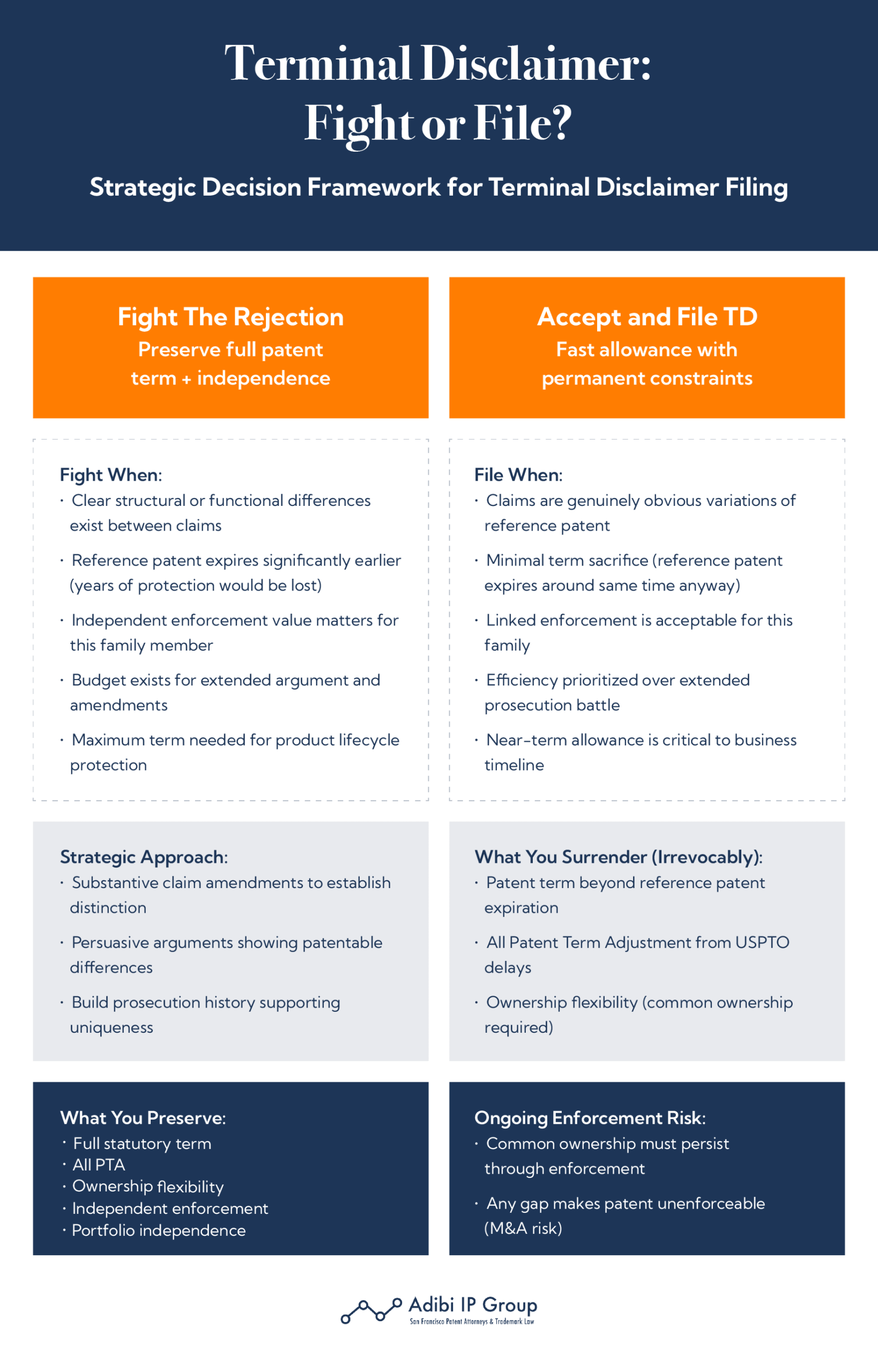
Not every ODP rejection requires capitulation. Before filing a terminal disclaimer, evaluate whether you can overcome the rejection:
| Factor | Fight the Rejection | Accept and File TD |
| Claim Distinction | Clear structural or functional differences exist | Claims are genuinely obvious variations |
| Term at Stake | Reference patent expires significantly earlier | Minimal term sacrifice |
| Portfolio Architecture | Independent enforcement value matters | Linked enforcement acceptable |
| Prosecution Economics | Budget exists for extended argument | Efficiency prioritized |
| Commercial Reality | Maximum term needed for product lifecycle | Near-term allowance critical |
If you can establish patentable distinction—through substantive amendments or persuasive traversal—you preserve full patent term and avoid ownership entanglement. This analysis should happen before reaching for the terminal disclaimer form.
For comprehensive guidance on ODP and other rejection types, see our types of patent rejections resource.
Statutory Double Patenting: When Terminal Disclaimers Won’t Help
A distinction that matters: terminal disclaimers cannot overcome statutory double patenting.
Statutory double patenting—”same invention” double patenting—occurs when claims are identical in scope. You’re claiming the same invention twice, violating 35 U.S.C. § 101‘s provision for “a patent” (singular).⁷ This is a statutory bar, not a judicial doctrine. No terminal disclaimer cures it.
The only remedies are claim amendment creating genuine distinction, or cancellation of duplicative claims.
Quick Distinction Guide:
| Issue type | ODP | Statutory Double Patenting |
| Claims are… | Obvious variations | Identical in scope |
| Legal basis | Judicial doctrine | 35 U.S.C. § 101 |
| TD fixes it? | Yes | No |
| Required response | TD or argue distinction | Amend or cancel |
Recognizing statutory double patenting early prevents wasted effort on terminal disclaimers that won’t resolve the rejection, and signals the need for more fundamental claim revision.
Proactive TD Strategy: Filing Before Rejection
Some practitioners file terminal disclaimers preemptively, before any ODP rejection issues. The approach has legitimate uses but carries significant risk.
Why Some File Preemptively:
- Streamlines prosecution in continuation-heavy portfolios
- Eliminates examiner uncertainty about family relationships
- May accelerate allowance in backlogged art units
Why Most Shouldn’t:
- Surrenders term that might never have been challenged
- Cannot be undone if business circumstances change
- Creates ownership constraints that weren’t required
- Forfeits opportunity to argue patentable distinction
The irreversibility makes preemptive filing high-stakes. Waiting for an actual ODP rejection, then evaluating whether you can overcome it without a TD, preserves strategic optionality.
The PTA Trap: If your application has accrued significant Patent Term Adjustment from USPTO delays, a terminal disclaimer eliminates that benefit entirely. A patent with two years of PTA disclaimed over an earlier reference loses those two years.¹ Calculate true term impact before filing.
Terminal Disclaimer Requirements and Common Pitfalls
USPTO Filing Requirements: Getting It Right the First Time
Terminal disclaimer requirements are straightforward but unforgiving. A defective filing wastes prosecution time and creates ambiguity about patent status.
Filing Checklist:
- Correct application/patent numbers identified (both the disclaimed patent and reference patent)
- Appropriate form selected (PTO/SB/25 for same owner; PTO/SB/26 for common ownership agreements)
- Authorized signature (registered practitioner or company representative with authority to bind)
- Filing fee included at current USPTO rates
- Electronic filing through Patent Center completed
- Confirmation of acceptance documented
Common Errors That Can Invalidate TDs:
- Wrong patent/application number (transposition errors)
- Signature by unauthorized party
- Missing or incorrect fee
- Filing after patent issuance without proper procedure
For official forms and current guidance: USPTO eTerminal Disclaimer Resources.⁸
The Common Ownership Trap
The terminal disclaimer’s enforceability provision states the disclaimed patent is enforceable “only for so long as” both patents remain commonly owned. Those seven words create more litigation vulnerability than most practitioners recognize when they sign.⁶
Common ownership isn’t a one-time requirement. It’s ongoing. Any gap—at any point during the patent term—can defeat enforceability.¹
Scenarios That Create Ownership Divergence:
The Spin-Off: A company divests a business unit, transferring some patents to the new entity. TD-linked family members end up on opposite sides of the corporate divide. Both patents may become unenforceable.
The Carve-Out: A portfolio acquisition excludes specific patents. Buyer and seller don’t realize the excluded patents are TD-linked to acquired patents. Ownership diverges.
The Bankruptcy: Patent assets sell to different buyers through auction. No one maps TD relationships before bidding. Common ownership chains shatter.
The License Structure: Certain exclusive licenses raise questions about “ownership” for TD purposes—particularly where the licensee has independent enforcement rights.
Maintaining Enforceability Through Transitions:
- Document all TD relationships in portfolio management systems before you need them.
- Flag TD-linked patents in every transaction due diligence checklist.
- Structure asset transfers to keep TD families together.
- Include TD-awareness representations in acquisition agreements.
- Conduct post-transaction audits verifying common ownership intact.
Concerned about terminal disclaimer implications for an upcoming transaction? Contact our team for strategic guidance.
Timing Decisions That Impact Portfolio Value
When you file matters as much as whether you file.
Patent Term Adjustment Disappears:
PTA compensates for USPTO examination delays. A patent that waited three years for examination might have two years of PTA extending its term. File a terminal disclaimer, and that PTA vanishes—your patent expires with the reference patent regardless of the adjustment you’d earned.¹
The Math:
- Reference Patent A: Expires January 2030 (no PTA)
- Your Patent B: Would expire January 2032 (20-year term + 2 years PTA)
- After TD over Patent A: Your Patent B expires January 2030
You just lost two years. Did the prosecution efficiency justify it?
Strategic Timing Considerations:
| When to File | Advantage | Risk |
| During prosecution | Fastest allowance path | Surrenders chance to argue distinction |
| Post-grant | Preserves prosecution options | May face validity challenges in enforcement |
| Preemptively | Streamlines family prosecution | Irrevocable; may have been unnecessary |
Strategic Portfolio Management with Terminal Disclaimers
Patent Term Optimization Strategies
The difference between routine prosecution and strategic portfolio management: calculating what a terminal disclaimer actually costs before filing it.
Term Impact Analysis (Required Before Every TD):
- Identify reference patent expiration (including its PTA).
- Calculate your patent’s expiration without TD.
- Determine the delta—your actual term sacrifice.
- Assess commercial significance of that period.
For technologies with long development cycles, those “lost” final years often carry the highest commercial value. Products are mature. Development costs are recovered. Competitors are emerging. Exclusivity matters most precisely when TDs take it away.
Avoiding TDs Through Claim Differentiation:
One of the most effective terminal disclaimer strategies is avoiding them entirely. During prosecution, evaluate whether claim amendments can overcome ODP without surrendering term:
- Narrow to specific embodiments outside reference patent scope.
- Add limitations providing genuine functional distinction.
- Focus on improvements or optimizations beyond reference claims.
- Build prosecution history supporting patentable distinction.
A few hours of claim drafting can preserve years of patent term.
Portfolio Development and Continuation Strategy
Building with TD Awareness:
Smart continuation practice anticipates ODP before it happens. When filing continuations, divisionals, or CIPs:
- Map claims against parent and sibling applications for ODP risk.
- Calculate term sacrifice if TD becomes necessary.
- Assess whether independent enforcement matters for this family member.
- Design claim scope to preserve distinction where possible.
The Defensive Publication Alternative:
For innovations you want protected from competitor patenting but don’t need to enforce yourself, defensive publication accomplishes the goal without creating TD-linked patents. You establish prior art, eliminate the continuation filing, and avoid the ownership entanglement.
For comprehensive portfolio strategy, explore our patent portfolio analysis services.
Competitive Intelligence and Market Positioning
Terminal disclaimers are public documents. Sophisticated competitors read them.
What They’re Looking For:
- TD relationships identifying which patents stand or fall together
- Ownership history gaps suggesting enforceability weaknesses
- Reference patent vulnerabilities that could destabilize linked families
- Expiration timing for market entry planning
Licensing Implications:
TD-linked portfolios carry licensing complexity. Potential licensees evaluate whether all family members are included, what happens if common ownership breaks, and whether the licensor’s value depends on vulnerable reference patents. These questions affect deal terms.
Enforcement Challenges and Litigation Considerations
Maintaining Enforceability Through Corporate Changes
Every corporate transaction becomes an IP event when your portfolio contains TD-linked patents.
Pre-Transaction Due Diligence Checklist:
- Identify all TD relationships in target portfolio.
- Map ownership chains for each TD family.
- Flag any historical ownership gaps (however brief).
- Assess validity strength of reference patents.
- Model post-transaction ownership structure.
- Verify no TD families will be split.
Structuring Deals:
- Keep TD families together in asset allocation.
- Address TD implications explicitly in acquisition agreements.
- Include representations about unbroken ownership history.
- Plan post-closing integration maintaining common ownership.
Post-Merger Verification:
After closing, confirm common ownership remains intact. Update assignment records. Ensure entity names are consistent. Document the chain for litigation readiness.
Litigation Vulnerability Assessment
Litigation opponents know exactly where to look.
Common Attack Vectors on TD-Linked Patents:
- Ownership Gap: Any historical break in common ownership—even days—may defeat enforceability.
- Reference Patent Invalidity: If the reference falls, linked patents face destabilization arguments.
- Procedural Defects: Errors in original TD filing (wrong numbers, unauthorized signatures).
- Scope Mismatch: TD doesn’t properly cover the claims at issue.
Pre-Litigation Audit:
Before asserting TD-linked patents:
- Verify unbroken common ownership from TD filing through present.
- Confirm reference patent validity and maintenance fee status.
- Review TD filing documents for procedural compliance.
- Identify likely attack vectors based on portfolio history.
- Prepare documentation supporting ownership chain.
Evolving Federal Circuit Jurisprudence
Recent Federal Circuit decisions have tightened standards for TD-linked patent enforcement, particularly around common ownership. In SimpleAir, Inc. v. Google LLC, the court confirmed that a terminal disclaimer is a “strong clue” regarding patentable distinction but doesn’t give rise to a presumption that the claims are indistinct.²
Courts increasingly examine substance over form. Factors beyond registered title—exclusive licenses, enforcement rights, economic interests—may affect whether “common ownership” is satisfied. Complex ownership structures that might have passed scrutiny a decade ago face closer examination today.
Strategic Response:
For portfolios with significant TD exposure, evaluate whether restructuring or consolidation serves long-term value better than maintaining potentially vulnerable positions. Sometimes the strategic move is simplification.
Industry-Specific Terminal Disclaimer Strategies
Pharmaceutical and Life Sciences Portfolios
Drug development timelines make terminal disclaimer decisions uniquely consequential.
Regulatory Exclusivity Interaction:
Patent term and regulatory exclusivity operate independently. A TD doesn’t affect NCE exclusivity or orphan drug protection—but for products where patent term provides longer-lasting protection, every year surrendered to a TD is a year of exclusivity lost.
Patent Term Extension Coordination:
PTE under 35 U.S.C. § 156 compensates for FDA review delays, but only one patent per product can receive it.⁹ When selecting which patent to extend, TD relationships matter—extending a reference patent effectively extends all patents disclaimed over it.
Technology and Software Innovation
Rapid obsolescence changes the TD calculus.
Technology patents may become commercially irrelevant before their statutory term expires. If the market moves on in seven years, the term sacrifice from a TD may be immaterial. The ownership constraint, however, persists—and tech portfolios change hands frequently.
Standard-Essential Patents:
SEP portfolios often involve continuation families with heavy TD exposure. FRAND commitments add complexity to TD management through ownership transitions.
University and Research Institution Considerations
Academic patents face distinct challenges.
Technology Transfer Chain:
University patents often move through multiple ownership transitions—institution to exclusive licensee, licensee to acquirer, acquirer to portfolio buyer. Each transition creates potential ownership gap risk for TD-linked families.
Joint Ownership:
Collaborative research produces jointly-owned patents. Joint ownership and TD enforceability interact in complex ways, particularly when co-owners’ commercial interests diverge. Joint research agreements have specific terminal disclaimer provisions under 37 CFR 1.321(d).
Future-Proofing Your Portfolio: Emerging Trends and Best Practices
Regulatory and Judicial Evolution
TD practice continues evolving. Examiners apply ODP analysis earlier and more broadly. Courts scrutinize common ownership more closely. What passed without incident five years ago may not today.
The USPTO’s December 2024 withdrawal of its proposed terminal disclaimer rule change—which would have tied enforceability of TD-linked patents to the validity of any claim in linked patents—signals continued stakeholder engagement on these issues.³ Future rulemaking remains possible.
Strategic Decision Framework
TD Decision Matrix—Systematic Evaluation:
| Factor | Weight |
| Term Sacrifice (years) | High |
| PTA Impact | High |
| Reference Patent Strength | Medium |
| Ownership Stability | High |
| Enforcement Importance | High |
| Prosecution Efficiency | Low |
Fight the ODP when: Clear distinction exists, significant term at stake, reference patent questionable, independent enforcement needed, ownership transitions likely.
Accept the TD when: Claims are genuinely obvious variations, minimal term sacrifice, strong reference patent, stable ownership expected, efficiency prioritized.
Implementation Roadmap
30 Days: Inventory all TD relationships. Map ownership chains. Identify vulnerabilities. Flag patents approaching enforcement decisions.
60 Days: Assess reference patent validity. Evaluate pending ODP rejections. Review continuation strategy. Update documentation.
90 Days: Implement ongoing monitoring. Train prosecution team. Integrate TD analysis into transaction protocols. Establish review standards for new filings.
Protecting Long-Term Portfolio Value
Terminal disclaimer patent strategy separates deliberate portfolio management from reactive prosecution. The IP strategists who protect long-term value understand what they’re trading when they sign a TD—and they’ve calculated whether the trade makes sense.
Four Principles:
- Calculate before you file. Know the exact term sacrifice. Include PTA. Assess commercial significance of the years you’re surrendering.
- Map your ownership chain. The common ownership requirement doesn’t expire. Document history, plan for transactions, flag TD families in every deal.
- Fight when distinction exists. Not every ODP rejection requires a terminal disclaimer. If the prosecution investment preserves significant term, make the investment.
- Build portfolios with awareness. Smart continuation practice anticipates ODP. Design claims to preserve independence where it matters.
Risk Mitigation Checklist:
- All TD relationships documented
- Common ownership verified and current
- Reference patent validity confirmed
- Term impact calculated for each TD family
- Transaction protocols include TD review
- Litigation readiness audit completed
Terminal disclaimer requirements grow more complex as portfolios expand and corporate structures evolve. Proactive management prevents the enforcement vulnerabilities and transaction complications that surface years after prosecution decisions are made.
Protect your patent portfolio’s long-term value. Schedule a strategic consultation with Adibi IP Group to assess terminal disclaimer implications and develop a customized management strategy.
References
- “MPEP 1490 – Disclaimers.” Manual of Patent Examining Procedure, United States Patent and Trademark Office.
- SimpleAir, Inc. v. Google LLC, 884 F.3d 1160 (Fed. Cir. 2018).
- “Terminal Disclaimer Practice To Obviate Nonstatutory Double Patenting; Withdrawal.” Federal Register, December 4, 2024.
- “The Crucial Role of Patent Due Diligence in Mergers & Acquisitions: Spotting Patent Litigation Risks Before Closing a Deal.” Proskauer Rose LLP.
- “MPEP 804 – Definition of Double Patenting.” Manual of Patent Examining Procedure, United States Patent and Trademark Office.
- “Terminal Disclaimer in a Patent or Proceeding in View of Patent/Application.” Form SB/25A, United States Patent and Trademark Office.
- “35 U.S. Code § 101 – Inventions Patentable.” Legal Information Institute, Cornell Law School.
- “eTerminal Disclaimer.” United States Patent and Trademark Office.
- “35 U.S. Code § 156 – Extension of Patent Term.” Legal Information Institute, Cornell Law School.