MPEP 2106 provides the USPTO’s structured framework for applying the Alice/Mayo test to determine whether patent claims cover eligible subject matter under 35 USC 101. The framework uses a two-step analysis: first confirming the claim fits a statutory category (process, machine, manufacture, or composition of matter), then evaluating whether any judicial exceptions—abstract ideas, natural phenomena, or laws of nature—are integrated into a practical application or include an inventive concept that amounts to “significantly more.”
Patent eligibility determinations under 35 USC 101 remain among the toughest calls in modern practice, directly affecting prosecution outcomes, R&D investments, and litigation exposure. Mastering MPEP 2106 means understanding how to navigate Step 2A’s judicial exception analysis and Step 2B’s “significantly more” inquiry while positioning technical advances as concrete, field-specific solutions rather than unpatentable concepts.
Key Takeaways
- MPEP 2106 sets a two-step path for assessing eligibility under 35 USC 101 by testing statutory categories and then reviewing judicial exceptions.
- Under Step 2A Prong Two, the “practical application” standard asks whether claims tie judicial exceptions to specific, technical implementations rather than high-level concepts.
- Strong responses to eligibility rejections pair doctrinal arguments with technology-focused details that show measurable improvements over conventional practice.
Understanding The Foundations Of MPEP 2106
MPEP 2106 codifies the approach for reviewing patent subject matter eligibility under 35 U.S.C. § 101, operationalizing the Alice/Mayo test through a clear two-step structure. The analysis requires identifying any judicial exception and determining whether the claims present a practical application that turns an abstract formulation into a patent-eligible implementation. This framework emerged from Supreme Court decisions in Alice Corp. v. CLS Bank International, 573 U.S. 208 (2014) and Mayo Collaborative Services v. Prometheus Laboratories, Inc., 566 U.S. 66 (2012), which together reshaped modern eligibility doctrine and created the need for consistent examination procedures.
The Alice/Mayo Framework Overview
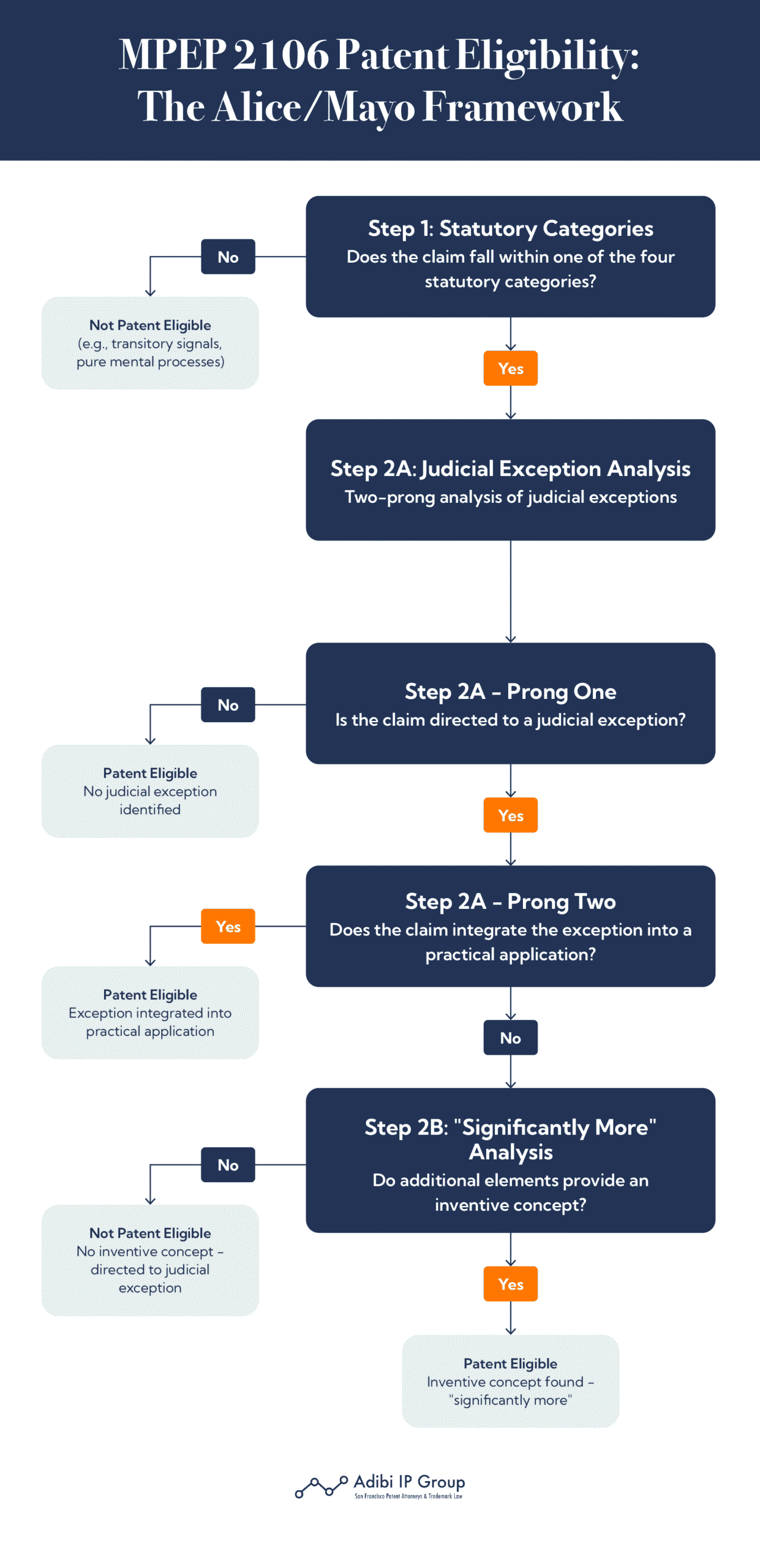
The Alice/Mayo framework anchors all eligibility decisions under MPEP 2106. Apply this two-step test to ensure the claims fit one of the four statutory categories and avoid judicial exceptions or meaningfully integrate them into real-world applications. Understanding where examiners commonly misapply these steps—particularly by overgeneralizing claim scope or overlooking practical application elements—gives you leverage in prosecution responses.
Step 1 asks whether the claim is directed to a statutory category—process, machine, manufacture, or composition of matter. Claims failing this threshold do not satisfy 35 U.S.C. § 101. Most properly drafted claims pass Step 1, so when a rejection cites this step, scrutinize whether the examiner has misread claim structure or conflated eligibility with other patentability requirements.
Step 2A uses two prongs. First, determine whether the claim is directed to a judicial exception (abstract ideas, laws of nature, natural phenomena). If so, Prong Two evaluates whether additional elements integrate that exception into a practical application. The USPTO’s 2019 Revised Patent Subject Matter Eligibility Guidance (2019 PEG) clarified that integration into a practical application is assessed by looking at whether the claim applies, relies on, or uses the judicial exception in a manner that imposes meaningful limits beyond generally linking use to a technological environment.
Step 2B applies when a claim includes a judicial exception without practical application. Assess whether the additional elements supply an inventive concept that amounts to significantly more than the exception itself. Here’s where examiners often overreach by labeling elements “conventional” without proper evidence or by ignoring how claim elements work together as an ordered combination.
This eligibility review stands apart from novelty under 35 U.S.C. § 102, non-obviousness under 35 U.S.C. § 103, and enablement under 35 U.S.C. § 112. Yet eligibility arguments often benefit from technology detail that also strengthens § 102/§ 103 positions, creating strategic opportunities to build a unified prosecution narrative.
Key Terminology And Concepts
Definitions in MPEP 2106 shape consistent eligibility assessments. Knowing these terms helps align arguments with USPTO expectations and spot when an examiner’s characterization strays from proper application.
Judicial exceptions include abstract ideas (mental processes, mathematical concepts, methods of organizing human activity), laws of nature, and natural phenomena. Identify these in Step 2A Prong One. When challenging an examiner’s characterization, focus on whether the claim as actually written recites the exception itself or instead recites a specific implementation that uses the exception as a tool.
Practical application sits at the core of Step 2A Prong Two. Claims show practical application when additional elements integrate the exception into a defined technological setting or add meaningful limits that go beyond the exception itself. The Federal Circuit’s decision in Enfish, LLC v. Microsoft Corp., 822 F.3d 1327 (Fed. Cir. 2016), illustrates how improvements to computer functionality establish practical application even when the claim involves data organization.
Additional elements are limitations beyond the identified exception. Evaluate them individually and as an ordered whole to determine practical application or an inventive concept. Don’t let examiners dismiss claim features in isolation when their combination creates a technical solution.
The broadest reasonable interpretation (BRI) governs claim reading during examination, ensuring the full scope of the claim is considered. Yet “broadest reasonable” still requires reasonableness—challenge interpretations that ignore claim language or read out specific limitations.
Inventive concept in Step 2B requires more than routine, conventional, or generic components. Look for elements that, alone or in combination, add significantly more than the exception. In BASCOM Global Internet Services v. AT&T Mobility LLC , 827 F.3d 1341 (Fed. Cir. 2016), the court found that a conventional filtering tool became inventive when installed at a specific location in a network architecture, demonstrating how arrangement matters.
Step 1: Statutory Categories Analysis
Step 1 determines whether a claim sits within one of the four statutory categories in 35 U.S.C. § 101. This is a threshold check focused on the claim’s type rather than its novelty or specific details. Step 1 rejections are relatively rare in well-drafted applications, so when you encounter one, it often signals either unusual claim structure or examiner confusion that deserves immediate attention.
Identifying Eligible Subject Matter Categories
The four categories in 35 U.S.C. § 101 set the bounds of eligible subject matter. Classify each claim as a process, machine, manufacture, or composition of matter.
Processes cover methods, procedures, and step sequences, including manufacturing steps, diagnostic workflows, and computer-implemented methods when claimed as processes. The Supreme Court’s decision in Diamond v. Diehr, 450 U.S. 175 (1981) established that processes incorporating algorithms remain eligible when the process as a whole performs a function the patent laws were designed to protect.
Machines are tangible devices or systems. Computer platforms, mechanical assemblies, and electronic apparatus are typical examples.
Manufactures are human-made articles. Non-transitory software media, printed circuit boards, and engineered artifacts qualify as manufactures.
Compositions of matter sspan chemical compounds, mixtures, and newly arranged materials. Drug formulations, alloys, and engineered biological constructs often fit here. However, Association for Molecular Pathology v. Myriad Genetics, Inc., 569 U.S. 576 (2013), clarified that naturally occurring DNA sequences are not patent-eligible compositions even when isolated, requiring claims to focus on synthetic modifications with structural distinctions.
Most applications pass Step 1 readily. The task is to read the claim’s form and placement, not to resolve deeper patentability issues.
Common Step 1 Pitfalls And Solutions
Some claims seem to fall outside statutory categories at first glance, yet many problems trace to drafting or interpretation rather than true ineligibility.
Abstract claim drafting can obscure a statutory embodiment. Claims reciting only mental steps or pure math without implementation may appear non-statutory. Review dependent claims and the specification for concrete embodiments, then consider amending to pull those details into the independent claim.
Mixed category claims can muddle classification. When a claim blends method steps and structure, determine the dominant thrust to assign a category. In practice, these rarely fail Step 1; they more often create confusion that manifests in Step 2A.
Functional claiming may mask the category. Focus on what the claim actually is—method, machine, manufacture, or composition—despite functional phrasing.
Transitory signals are a true Step 1 failure. Claims to electromagnetic waves, radio transmissions, or fleeting data streams without a physical medium fall outside the categories; anchor them to non-transitory embodiments. The USPTO’s guidance on computer-readable media clarified that transitory forms of signal transmission do not qualify, but storage on physical media does.
Step 2A: Judicial Exception Analysis
Step 2A asks whether claims are directed to judicial exceptions and, if so, whether they integrate those exceptions into practical applications. Prong One identifies the exception; Prong Two evaluates meaningful integration. This is where most § 101 battles are fought and won, so precision here pays immediate dividends in prosecution.
Prong One: Identifying Abstract Ideas
First decide whether the claim targets a known judicial exception. Abstract ideas include mathematical concepts, specified methods of organizing human activity, and mental processes performable in the human mind.
Focus on the claim’s character as a whole. Determine whether what’s recited maps to concepts courts have treated as abstract. In Alice Corp. v. CLS Bank, the Supreme Court found that intermediated settlement was an abstract idea akin to a fundamental economic practice, but the analysis turned on the full claim scope, not isolated elements.
Common abstract idea categories include:
- Mathematical formulas and computations
- Fundamental economic practices (as established in Bilski v. Kappos, 561 U.S. 593 (2010), which found hedging risk to be an unpatentable abstract idea)
- Methods of organizing human activities
- Mental processes and observations
When reviewing claims, rely on case law and USPTO guidance. The claim language itself controls whether the invention explicitly recites an abstract idea or effectively claims activities courts have recognized as abstract. Watch for examiner assertions that merely label the claim abstract without comparing it to established precedent—those characterizations are prime targets for rebuttal.
Avoid oversimplification. Even when an abstract idea appears, other elements may integrate it into a patent-eligible application.
Prong Two: Practical Application Assessment
Once an exception is identified, analyze whether the claim integrates it into a practical application. Look for more than field-of-use limitations or instructions to “apply it.” The 2019 PEG outlined specific considerations for practical application, including improvements to technology, particular machines, and transformations—offering a roadmap for both prosecution and examination.
Evaluate whether additional elements place meaningful bounds on the exception. They should contribute specific, technical context rather than a generic environment.
Elements indicating practical application include:
- Improvements to computer technology or a technical field
- Specific applications of the abstract concept
- Use of a particular machine or a transformation
- Other meaningful limits that confine scope beyond the exception
This consideration traces to cases such as Diamond v. Diehr, where a formula embedded in a defined industrial process qualified as eligible. The Court emphasized that the claims did not preempt use of the equation but instead integrated it into a specific rubber-curing application.
Do not use conclusory labels. Address each added element and explain whether it advances a practical application or merely restates the exception in different words. When examiners dismiss limitations as “insignificant extra-solution activity,” counter with specific technical functions those elements perform.
Step 2B: “Significantly More” Evaluation
Step 2B asks whether additional elements supply an inventive concept—something that, taken alone or together, amounts to significantly more than the judicial exception. You reach Step 2B only when practical application wasn’t established in 2A Prong Two, so the record already shows a judicial exception not yet integrated. The challenge here is proving that what remains still transforms the claim into something patent-eligible.
Inventive Concept Analysis
Examine whether elements beyond the exception create a concrete technical improvement or tackle a specific technical problem. Consider both individual limitations and their ordered combination—BASCOM made clear that conventional components arranged unconventionally can form an inventive concept.
Significantly more appears when added elements impose real limits on the exception. Identify a claimed improvement to computer operation or a technical field, not just automation of longstanding practice.
Consider these focal points:
- Specific technological improvements to computer functionality: Faster processing, reduced memory usage, enhanced security protocols—quantifiable gains documented in the specification.
- Unconventional steps tying the claim to particular implementations: Steps that depart from routine data-processing sequences or require non-standard configurations.
- Technical solutions aimed at concrete technical problems: In DDR Holdings, LLC v. Hotels.com, L.P., 773 F.3d 1245 (Fed. Cir. 2014), the court found claims eligible because they addressed the Internet-specific problem of retaining website visitors, a challenge that arose only in the online environment.
- Meaningful limitations that narrow scope beyond field-of-use: Technical constraints, environmental conditions, or structural requirements that confine the invention to a specific application rather than merely stating “apply this idea in domain X.”
Generic computing used in its ordinary way seldom suffices. Distinguish routine data intake or display from targeted, non-conventional processing. When an examiner asserts conventionality, demand citations or technical reasoning—”well-understood, routine, and conventional” requires evidentiary support, not just assertion.
The Bilski v. Kappos line reinforces that abstract concepts need more than generic execution to qualify. In Bilski, even adding “use a computer” to execute hedging steps did not supply significantly more, because the computer performed only routine functions.
Evidence Standards For Step 2B
Support Step 2B findings with grounded reasoning. Bare statements—on either side—do not meet examination standards. The Federal Circuit has repeatedly reversed rejections where examiners failed to provide adequate support for conventionality determinations.
Required evidence includes:
| Evidence Type | Examples |
| Technical improvements | Faster processing, reduced memory usage |
| Unconventional elements | Non-routine steps, specific implementations |
| Problem-solution nexus | Clear technological problem addressed |
Explain why elements are conventional when rejecting. Assertions about “generic computer functions” should be backed by citations to prior art, technical publications, or reasoned analysis showing conventionality at the relevant time. The MPEP itself requires examiners to support conventionality with “a factual determination” supported by evidence.
Positive indicators feature enhanced computer capabilities, specific technical fixes, and limitations that materially narrow scope. Negative indicators feature routine steps, generic hardware, and high-level ideas placed in familiar contexts without more.
Cite claim language and give a technology-aware rationale so the record shows how the determination was made. A well-documented record makes appeal easier if prosecution stalls.
Strategic Response To Eligibility Rejections
Effective replies to Section 101 rejections blend targeted claim amendments with case-supported arguments that meet the examiner where the rejection lives—MPEP 2106’s steps and prongs. Each response is an opportunity to build a prosecution record that not only overcomes the rejection but also strengthens the patent’s validity for future enforcement or licensing.
Effective Amendment Strategies
Narrowing amendments often move the needle fastest. Add concrete, technical detail that grounds the concept in a defined implementation and shows field-specific utility. But amend strategically—every narrowing trades scope for allowance, so weigh commercial value before conceding claim breadth.
Amendments can specify hardware components, data structures, timing constraints, or processing flows. Aim to show a measurable improvement in computer operation or a solution to a known technical limitation.
Consider adding limitations that specify:
- Particular data formats or transport protocols: “Transmitting compressed sensor data via MQTT protocol with QoS level 2” is concrete; “transmitting data” is not.
- Defined user interface behaviors and control logic: Interaction models that solve usability or accessibility problems, not just generic “display on screen.”
- Hardware–software interactions that change system behavior: “Configuring GPU memory allocation to prioritize real-time inference latency” shows technical integration; “using a GPU” does not.
- Technical constraints that limit scope to a concrete design: Thresholds, tolerances, timing requirements, or resource allocations that reflect real engineering decisions.
Dependent claim elevation can help. Promote focused dependent claims with stronger technical hooks when the independent version faces consistent § 101 headwinds. Review your dependency tree for claims that already recite the detail you need.
Federal Circuit outcomes consistently favor records that show specific, technical implementations rather than generic computing. In prosecution, specificity wins—both at examination and later in litigation.
Persuasive Argument Development
Address the examiner’s Step 2A Prong One characterization first when it overstates abstraction. Precision here frames the rest of the response. If you accept an overly broad characterization of the exception, you’ve already conceded half the battle.
Center practical application arguments on the claim’s specific technical improvements. Cite supportive Federal Circuit decisions—Enfish, BASCOM, DDR Holdings, McRO, Inc. v. Bandai Namco Games America Inc., 837 F.3d 1299 (Fed. Cir. 2016) (finding that rules-driven character animation was not abstract because it produced a specific technological solution)—and distinguish any cases relied on by the rejection with facts tied to your claim language.
Structure your arguments to show:
- Defined technical problems addressed by the claims: Identify the problem as rooted in technology, not business or social convenience.
- Concrete improvements to computer functionality: Performance, efficiency, security, scalability—improvements the specification documents and the claims require.
- Non-conventional use of computing resources or components: Departures from standard practice, even if using known components.
- Integration with particular machines or transformations: Physical processes, specialized hardware, or environmental interactions.
For significantly more, point to non-routine, technical features that narrow scope and deliver measurable performance or reliability benefits. Explain why the claim reflects a technical advance rather than mere computerization of known steps. Draw direct lines between claim language and specification passages that describe technical advantages.
A clear, claim-anchored narrative can turn a § 101 impasse into a notice of allowance by showing how the record fits within MPEP 2106. Remember: examiners operate under the same framework you do. When you demonstrate compliance with their own manual using case law and technical facts, you make allowance for the path of least resistance.
Technology-Specific Eligibility Considerations
Applying MPEP 2106 across fields requires sensitivity to each technology’s norms. The same framework applies, yet what counts as integration and improvement varies by domain. Tailoring your approach to the technology at issue improves both examination outcomes and claim durability.
Life Sciences And Biotechnology Applications
Life sciences claims often raise laws-of-nature issues. Review whether the claims recite a naturally occurring feature or reflect human-made modifications and defined laboratory-grade implementations. Post-Myriad, the line between natural products and patentable compositions turns on structural and functional differences that human intervention created.
Naturally occurring DNA sequences are exceptions, but engineered sequences with structural and functional differences—documented in the specification—can qualify when tied to specific uses. Similarly, in Mayo, the Court invalidated claims to correlations between drug metabolite levels and dosage optimization because they merely observed a natural law without adding inventive application.
Claims involving diagnostic methods call for careful Step 2A and Step 2B analysis. Show more than data observation; tie steps to non-routine sample handling, assay conditions, or result-driven treatment actions. The Federal Circuit’s decision in Vanda Pharmaceuticals Inc. v. West-Ward Pharmaceuticals International Ltd., 887 F.3d 1117 (Fed. Cir. 2018), upheld claims that applied a natural correlation to a specific treatment method, distinguishing Mayo by showing how the claims integrated the relationship into a practical treatment regimen.
Key considerations include:
- Concrete structural changes to natural products: Mutations, truncations, conjugations—changes that alter structure and function in ways nature does not produce.
- Non-conventional dosing regimens or treatment protocols: Schedules, formulations, or administration routes that depart from standard care.
- New purification or synthesis routes with specified parameters: Techniques that yield previously unattainable purity, yield, or selectivity.
- Integration with defined laboratory workflows or devices: Microfluidic systems, automated platforms, or particular detection instruments that constrain how the method is performed.
Biotechnology claims must also satisfy § 112. Provide operational detail that demonstrates specific utility and teaches a skilled practitioner how to reproduce the results. Eligibility and enablement often depend on the same specification detail, so robust disclosure serves both doctrines.
3D bioprinting and CRISPR applications often mix biological principles with engineered steps. Separate the natural phenomena from the technical implementation and show how the latter constrains scope. For CRISPR, claims to naturally occurring guide RNA sequences face Myriad issues, but claims to delivery systems, editing protocols, or screening methods can establish practical application through technical integration.
Computer-Implemented And Software Inventions
Software claims frequently face abstract idea challenges. Distinguish automation of longstanding practices from claims that actually change how computers operate or process data. The difference often lies in whether the specification describes a new capability or simply maps an old process onto existing hardware.
Computer-implemented methods require analysis of both the process and the technical implementation. If the core concept resembles a fundamental economic practice or mathematics, the claim needs added, concrete elements showing a technical solution. Post-Alice, software patents survive when they improve computer functionality itself, not just use computers to perform known business methods faster.
The “computer readable medium” label, standing alone, does not rescue an abstract idea. Identify architectural changes, data structure designs, or control flows that improve computing itself. In Electric Power Group, LLC v. Alstom S.A., 830 F.3d 1350 (Fed. Cir. 2016), the court found claims ineligible because they merely gathered and analyzed data without improving how computers function, illustrating the need for technical integration beyond data processing.
Practical application indicators include:
- Demonstrable improvements to computer capabilities: Reduced latency, memory efficiency, computational scalability—improvements the specification quantifies.
- Technical fixes to system-level bottlenecks: Addressing known performance, security, or reliability limitations in computing architecture.
- Data processing techniques that depart from routine pipelines: Novel algorithms, data structures, or processing sequences that enable previously unattainable results.
- Pairing with specialized hardware or configured accelerators: FPGAs, ASICs, GPUs, or neuromorphic chips used in non-conventional ways to achieve technical goals.
Artificial intelligence inventions deserve special care. Claims that recite generic model training or inference steps risk abstraction; claims that define model architectures, training regimens, or resource-aware execution constraints show technical grounding. For AI claims, focus on how the invention changes what computers can do—accuracy on edge devices, explainability in regulated domains, fairness-aware training—not just that they use AI. Recent Federal Circuit decisions in AI cases emphasize that claims must show unconventional technical implementation, not just application of AI to a new problem space. The USPTO’s 2024 AI Subject Matter Eligibility Update provides Examples 47-49 specifically addressing artificial intelligence and machine learning inventions.
Claims must still meet patentability standards for novelty and non-obviousness. The technical setting and prior art inform both eligibility positioning and downstream § 102/§ 103 analysis. A strong § 101 response often supplies evidence and argument that later supports § 103 rebuttal, so build your record with dual purpose.
Software claims benefit from specifications that teach concrete implementations, performance impacts, and design trade-offs—detail that supports Step 2A integration and Step 2B inventive concept. When drafting or prosecuting, resist the temptation to stay high-level; technical specificity is your strongest eligibility tool.
Ready to Strengthen Your Patent Strategy?
Navigating MPEP 2106 and responding to Section 101 rejections requires both deep doctrinal knowledge and technology-specific prosecution experience. Whether you’re facing a challenging eligibility rejection, drafting claims in a high-risk technology area, or building a patent portfolio that can withstand scrutiny, strategic guidance makes the difference between allowed claims and abandoned applications.
At Adibi IP Group, we help innovators and businesses develop patent strategies that anticipate eligibility challenges and position inventions for successful prosecution and enforcement. Our team combines legal precision with technical fluency across software, AI, biotechnology, and emerging technologies.
Contact us today to discuss how we can help you secure strong, enforceable patent protection and turn MPEP 2106 from a prosecution obstacle into a strategic advantage.