The patent world’s best-kept secret costs 80% less than IPR and never expires.
While your competitors burn through budgets on inter partes reviews that might be time-barred tomorrow, sophisticated patent strategists are quietly invalidating claims through the ex parte reexamination process. They achieve comparable results for $30,000-80,000, with no deadlines, no estoppel, and complete anonymity if desired.
This isn’t your grandfather’s reexamination procedure. Recent Federal Circuit decisions and USPTO reforms have transformed this “forgotten” process into a precision instrument for modern patent challenges.
Key Takeaways
- The Core Answer: Ex parte reexamination allows anyone to challenge a patent’s validity using prior art patents and publications for $12,600 in USPTO fees¹—delivering similar outcomes to IPR at 20% of the cost.
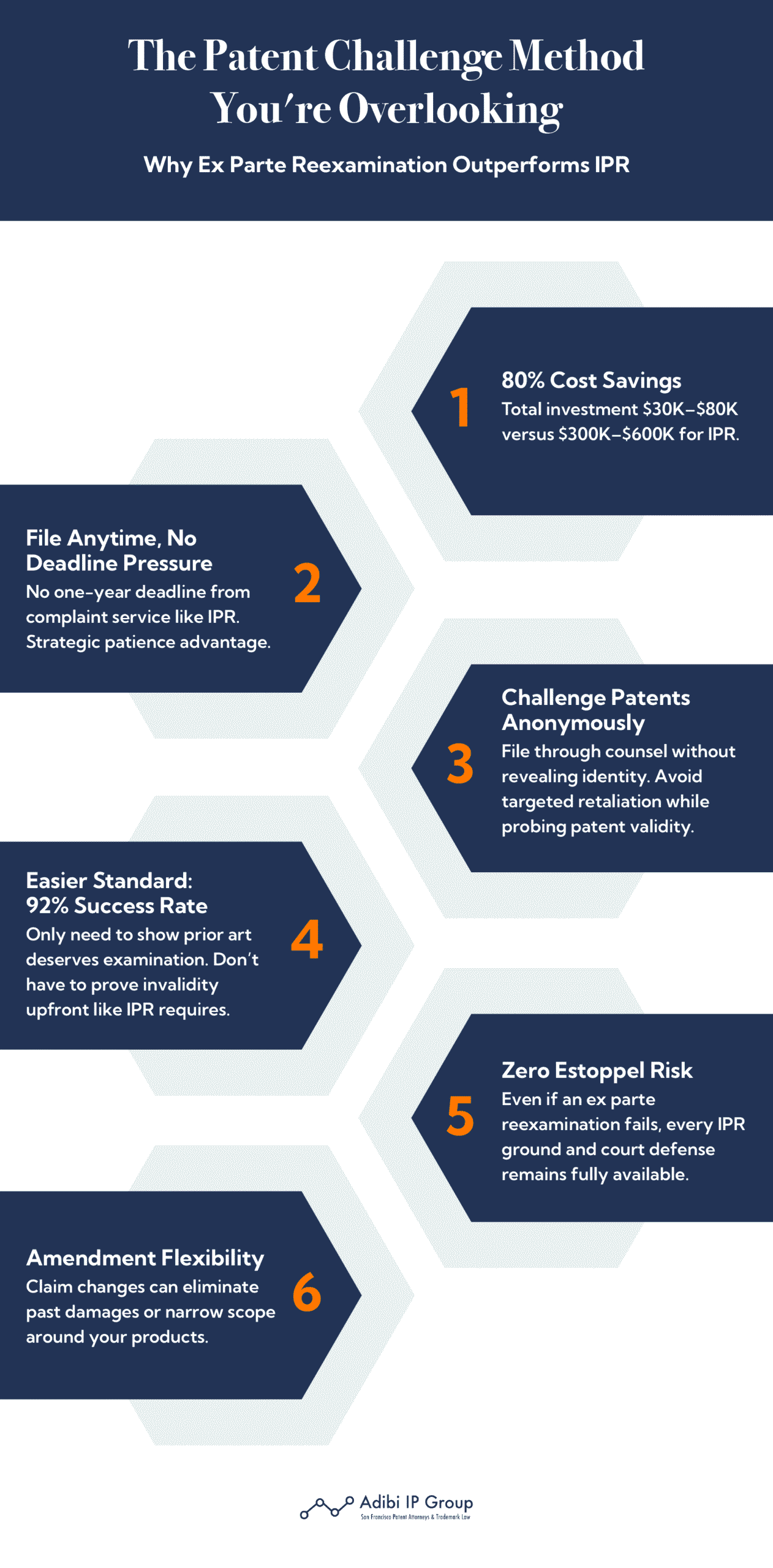
- No Time Pressure: Unlike IPR’s one-year deadline from complaint service, ex parte reexamination has no filing deadline—challenge patents even 15 years after issuance.
- Success Metrics: Over 92% of ex parte reexamination requests have been granted since 1981², with approximately 62% of patents emerging with modified or canceled claims³.
- Cost Advantage: Total investment typically runs $37,000-120,000 versus $300,000-600,000 for IPR⁴.
- Strategic Positioning: The Vivint decision⁵ and recent filing trends show sophisticated players increasingly choosing ex parte reexamination for budget-conscious, flexible patent challenges.
- Zero Estoppel Risk: Failed ex parte reexaminations don’t prevent future IPR filings or district court invalidity defenses.
The Strategic Bottom Line
The ex parte reexamination process lets anyone challenge a patent’s validity using prior art patents and publications for $12,600-40,000 in USPTO fees¹—roughly 20% of IPR costs. It operates without the one-year deadline or estoppel effects that handcuff other proceedings.
Deploy it when:
- Your IPR window has closed
- Your budget is under $100,000
- You need to preserve all litigation defenses
- Anonymous challenge offers strategic advantage
- You’re planning serial attacks on a portfolio
Key performance metrics:
- 92% grant rate with proper claim charts²
- Average 26-month resolution⁶
- Approximately 62% of patents emerge with modified claims³
- Strategic leverage in litigation settlements
The Overlooked Power Tool in Your Arsenal
Why Ex Parte Reexamination Is Having Its Renaissance
Picture this: It’s 2016. Ex parte reexamination filings have crashed to 187 annually—down 68% since the America Invents Act. Everyone’s focused on inter partes review. The old procedure seems destined for the USPTO graveyard.
Fast forward to today. Reexamination requests have seen a dramatic 100% increase, doubling from the first half of 2023 to the first half of 2024⁷. Major tech companies are deploying it strategically. Sophisticated patent owners are using it defensively.
What changed?
The IPR honeymoon ended. Time bars started biting. Estoppel effects began cascading through litigation. And those average IPR costs of $300,000-600,000⁴? They started adding up fast.
Meanwhile, the Federal Circuit quietly revolutionized ex parte reexamination. The In re Vivint decision⁵ clarified that ex parte reexamination remains unavailable only when a challenger repeatedly tries the same arguments for the same patent after a failed IPR. The USPTO has maintained robust Central Reexamination Unit operations. Success rates climbed to 92% for well-prepared requests².
The strategic calculus shifted. Smart money noticed.
The 2024 Reality Check:
- Electrical technology patents: 44% increase in reexamination filings from FY2020 to FY2021⁸
- Cost advantage: Average total cost $30,000-80,000 versus $300,000+ for IPR⁴
- No time restrictions—file it 15 years after issuance if you want
One medical device manufacturer invalidated eight of twelve asserted patents through staged reexaminations. Total cost? Less than a single IPR. Time pressure on patent owner? Continuous for three years.
That’s not overlooked. That’s strategic brilliance.
Five Strategic Advantages IPR Can’t Match
- No Expiration Date
That one-year IPR deadline from complaint service? Doesn’t exist here. Discovered killer prior art during year two of litigation? File away. Want to wait for claim construction before challenging? No problem.
Strategic patience becomes a weapon. You choose when to strike.
- Complete Anonymity Option
File through counsel without revealing your identity. No declaratory judgment jurisdiction. No targeted retaliation. No adjusted licensing demands based on who you are.
Small companies use this to probe patents without painting targets on themselves. Large companies use it to test theories without revealing strategy.
- The “Reasonable Examiner” Standard
Forget IPR’s “reasonable likelihood of prevailing.” You need only show that a reasonable examiner would consider your prior art important. This represents the difference between proving someone guilty and showing there’s a case worth investigating.
Result? 92% grant rate with proper preparation² versus IPR’s more restrictive institution standards.
- Zero Estoppel Risk
Lose an ex parte reexamination? You keep every district court argument. Every future IPR ground. Every invalidity defense intact.
IPR’s estoppel provisions can cascade through related patents, destroying entire defensive strategies. Ex parte reexamination? Try, fail, try again.
- Amendment Flexibility That Actually Helps
Patent owners can amend claims throughout the process—unlike IPR’s restrictive motion practice. Sounds like a disadvantage? Think again.
Those amendments often create intervening rights, eliminating past damages. They narrow claims around your products. They create prosecution history estoppel. Sometimes the “strengthened” patent becomes commercially worthless.
Strategic Positioning in the Modern Landscape
Ex parte reexamination isn’t the right tool for every job. But when it fits, nothing else comes close.
Common Scenarios Where Ex Parte Excels:
Budget Reality: Your invalidity budget is $75,000. IPR costs $300,000-600,000⁴. District court invalidity runs $1 million+. The math is simple—ex parte reexamination is your only administrative option.
Time Bar Trap: You’re eight months into litigation. Strong prior art emerges during expert discovery. IPR deadline passed four months ago. Ex parte reexamination remains wide open.
Portfolio Pressure: Facing twelve related patents. IPR would cost $3.6 million for all. Staged reexaminations cost $500,000 total, spread across three years, with no estoppel preventing course corrections.
The Decision Matrix:
When all paths remain open, here’s your framework:
- Need speed? IPR wins (12-18 month average from petition to decision⁹)
- Need broad prior art? District court (any evidence allowed)
- Need cost efficiency? Ex parte reexamination dominates
- Need flexibility? Ex parte reexamination alone offers unlimited do-overs
- Need anonymity? Only ex parte reexamination provides it
Your Filing Playbook
Week 1-2: The Foundation
Success starts with prior art that makes examiners pause.
Forget standard patent searches. The best references hide in dissertation databases, foreign patent offices, and technical conference proceedings. That obscure German utility model from 1995? It might be your silver bullet.
Budget $5,000-10,000 for professional searching. Focus six months before the priority date—that’s where the gold lives. One telecommunications patent fell to a South Korean thesis that three law firms missed.
Your claim charts separate winners from the 10% denied at threshold. Map every limitation to specific prior art passages: Column 3, lines 45-52; Paragraph [0047] of the publication. No hand-waving. No “would be obvious” arguments. Show exactly where each element appears.
The “reasonable examiner” test governs. Would a reasonable examiner consider this reference important in deciding patentability? If you’re explaining why it might be relevant, you’ve already lost. The evidence must be undeniable.
Week 3-4: Building the Request
The USPTO provides standardized forms for filing. Simple enough.
The execution separates professionals from amateurs.
Your request needs surgical precision. Each challenged claim gets its own substantial new question explanation—2-3 pages showing exactly how prior art destroys patentability. No kitchen sinks. No backup arguments “just in case.” Focus wins.
Include expert declarations for complex technology. Not legal arguments—technical explanations of what the prior art actually teaches. One software reexamination succeeded because a computer science professor explained how seemingly unrelated references actually described the same algorithm.
Authentication requirements are non-negotiable. Every foreign patent needs certified copies. Every non-English document needs translation. Missing paperwork kills your request regardless of merit. Order certifications immediately upon identifying references.
The Filing Mechanics
USPTO fees scale with claim count¹:
- Up to 20 claims: $12,600 (large entity)
- Additional claims incur higher fees
- Small entity receives 60% discount
- Micro entity receives 80% discount
File electronically through Patent Center for immediate confirmation. Include payment buffer—the USPTO refunds overpayments but terminates underpayments without review.
Third-party requesters must serve patent owners within one business day¹⁰. Not two. Not “promptly.” One business day. Via first-class mail and email if available. Keep proof of service—disputes happen.
The Substantial New Question Gateway
Understanding What Opens the Door
SNQ isn’t about proving invalidity. It’s about showing genuine uncertainty deserving examination.
The examiner asks: “Would a reasonable examiner consider this important?” Not “Does this invalidate the patent?” The distinction matters enormously.
Automatic Qualifiers:
- Never-before-seen prior art
- New combinations revealing non-obvious connections
- Art applying to newly amended claims
- References the examiner explicitly distinguished but didn’t apply
The Rejection Triggers:
- Prior art already considered without new arguments
- Cumulative references teaching identical elements
- Legal arguments without technical substance
- Previously adjudicated grounds
Avoiding Cumulative Art Rejections
The USPTO’s favorite rejection: “Cumulative to art already considered.” Your prior art might be better, clearer, or more explicit. Doesn’t matter if the examiner already evaluated similar teachings.
Solution: Show what makes your art substantively different. Different technical approach. Additional elements. Alternative implementation. Something the examiner couldn’t have gleaned from reviewed references.
Recent Federal Circuit Game-Changers
In re Vivint (2021): A Critical Development
The Federal Circuit found that ex parte reexamination was unavailable to a challenger who repeatedly tried and failed to raise the same arguments for the same patent in a prior IPR proceeding⁵. However, this narrow holding actually clarifies when ex parte remains available, essentially any scenario except repeated attempts with identical arguments after IPR failure.
What this means: New prior art, different combinations, or alternative theories all remain viable even after IPR proceedings. The door remains wide open for strategic challengers.
Real-world impact: Filings increased 44% in electrical technology from FY2020 to FY2021⁸. Software and electronics patents are particularly vulnerable due to complex reference interactions.
The “Overlooked Teaching” Doctrine
Recent decisions establish that an examiner’s silence on specific teachings doesn’t mean they were considered. Your job: illuminate what was missed.
Tactical approach:
- Map what the examiner explicitly discussed.
- Identify undiscussed teachings in cited art.
- Connect those teachings to claim limitations.
- Submit expert declaration confirming oversight.
Prosecution History: The Hidden Battlefield
Mining Examiner Inconsistencies
Every office action contains seeds of future reexamination.
Start with dependent claims the examiner allowed without comment. If independent claim 1 was rejected over Reference A, but dependent claim 5 adding element X was allowed, you’ve found vulnerability. Find prior art teaching element X and combine with Reference A.
Examiner interviews often reveal unrecorded agreements. The written summary says “Claims 1-5 allowable with amendments.” But what specific distinction convinced the examiner? That ambiguity creates SNQ opportunity.
Example Play: Patent prosecution involved 3 rounds of rejection. Final office action stated: “Reference A fails to teach real-time processing.” Your search finds Reference B explicitly teaching real-time processing in the same field. Combination creates SNQ despite Reference A being exhaustively considered.
Navigating Previous Challenges
Prior IPR Proceedings
Failed IPR doesn’t preclude ex parte success. Different standards (preponderance versus substantial new question), different art scope (printed publications only), different examiner perspective.
Strategic angle: Focus on references the PTAB didn’t address. IPR petitioners often submit 15+ references but the Board only analyzes 3-4. Those unaddressed references remain fertile ground.
One pharmaceutical patent survived two IPRs. Third-party then filed ex parte reexamination using references from IPR exhibits the Board never discussed. Result: Claims canceled.
Previous Reexaminations
Second reexamination requires showing why the first missed something. Options:
- New prior art discovered post-reexamination
- Federal Circuit decisions changing interpretation
- Expert testimony revealing overlooked connections
- Claim amendments creating new vulnerabilities
Advanced Tactical Deployments
Strategic Portfolio Challenge Approach
Facing 20 related patents? Traditional approach suggests 20 separate challenges. Smart approach: Staged reexaminations creating cascading vulnerability.
Sequential Challenge Strategy:
- Target the earliest patent with strongest prior art.
- Use patent owner’s amendment arguments against continuation patents.
- Create prosecution history estoppel limiting related claims.
- Watch portfolio value crater as uncertainty spreads.
Budget: $200,000-400,000 over 2-3 years
Traditional IPR cost: $6 million minimum
Value destruction: Potentially complete
Pre-Litigation Positioning
Don’t wait for lawsuit. File prophylactic reexaminations on problematic patents.
Benefits:
- No litigation stay needed (nothing to stay)
- Patent owner can’t adjust assertions based on challenge
- Settlement leverage before costs escalate
- Technical record established pre-discovery
One software company filed reexaminations on five patents of known aggressor. When lawsuit came 18 months later, three reexaminations had already confirmed. The patent owner settled for nuisance value.
The Combination Attack
Coordinate ex parte reexamination with other proceedings:
IPR + Ex Parte: File IPR on strongest grounds. Simultaneously file ex parte on different prior art. IPR provides speed and discovery. Ex parte provides backup and extended pressure.
Litigation + Ex Parte: Use litigation discovery to identify prior art. File ex parte reexamination with discovered references. Move for stay citing pending reexamination. Even if stay denied, patent owner faces two-front war.
Multiple Ex Parte: File reexaminations on different claims using different art. USPTO consolidates proceedings but must address all grounds. Patent owner must respond across multiple, distinct art-based lines of attack within the consolidated record.
Specific Technology Considerations
Software Patents: The Fertile Ground
Algorithm-based claims are particularly vulnerable post-Vivint. Why? Complex prior art interactions the original examiner likely missed.
Focus Areas:
- Functional claiming without structural limitations
- Abstract ideas with minimal technical implementation
- Method claims lacking specific hardware requirements
Winning References:
- Earlier versions of technical standards
- Academic papers describing similar algorithms
- Open-source code repositories with pre-priority dates
- Conference presentations (especially poster sessions)
Success rate: High SNQ grant rates on software method claims when properly presented
Medical Device Patents
Mechanical structure claims require precision matching.
Key Vulnerabilities:
- Combination claims where references teach individual elements
- Material composition limitations with alternative formulations
- Method of use claims with similar surgical techniques
Hidden Prior Art Sources:
- FDA 510(k) submissions (public but rarely searched)
- International regulatory filings
- Surgeon training materials
- Medical conference videos
Success rate: Approximately 62% of reexamined patents see claim modifications³
Pharmaceutical Patents
Formulation and method patents are more vulnerable than composition patents.
Target Opportunities:
- Dosing regimen claims
- Combination therapy methods
- Formulation excipient choices
- Manufacturing process claims
Overlooked References:
- Clinical trial protocols (ClinicalTrials.gov)
- Foreign regulatory submissions
- Pharmacology textbooks for known principles
- Conference abstracts predating publications
Note: Composition of matter claims rarely succeed without pre-filing prior art
Telecommunications/5G Patents
Standard-essential patents present unique opportunities.
Vulnerable Elements:
- Implementation-specific limitations beyond standard requirements
- Hardware configuration claims
- Signal processing methodology
Rich Prior Art Venues:
- Standards body submissions (3GPP, IEEE)
- Technical contributions during standard development
- Early draft specifications
- Member company presentations
Success metric: Substantial modification rates for challenged SEPs
Examiner Psychology and Presentation
Speaking Their Language
Central Reexamination Unit examiners are specialists, not generalists. They see patterns others miss.
What Gets Attention:
- Technical accuracy over legal argument
- Specific implementation details, not broad concepts
- Hardware/software interaction specifics
- Clear structural relationships in mechanical arts
What Causes Rejection:
- Attorney argument unsupported by evidence
- Conclusory statements about “obviousness”
- Kitchen-sink approaches with weak references
- Mischaracterizing prior art teachings
The Power of Expert Declarations
CRU examiners trust technical experts over attorneys.
Effective Expert Testimony:
- PhD or equivalent in the specific field
- Publications in relevant technical areas
- Industry experience with challenged technology
- Clear explanations without legal conclusions
Topics Requiring Experts:
- Software algorithm equivalence
- Chemical compound relationships
- Bioequivalence in pharmaceutical arts
- Signal processing in telecom patents
Impact: Requests with expert declarations show significantly higher grant rates
Visual Persuasion
Claim charts are necessary but not sufficient. Visual aids multiply impact.
High-Impact Visuals:
- Side-by-side structural comparisons
- Flowcharts showing method step correspondence
- Timeline graphics proving prior art dates
- Annotated figures highlighting key elements
One mechanical patent reexamination succeeded primarily because of annotated CAD drawings showing exact correspondence between prior art and claimed structure.
Strategic Response Planning
Anticipating Patent Owner Arguments
Patent owners have 60 days to respond. Predict and pre-empt their arguments.
Common Patent Owner Tactics:
“Teaches Away” Argument Counter: Show motivation to combine despite negative teaching. Include expert declaration explaining why a skilled artisan would still consider combination.
“Hindsight Reconstruction” Counter: Demonstrate contemporaneous motivation in prior art. Quote specific passages suggesting combination. Avoid using the patent’s own teaching as roadmap.
“Commercial Success” Counter: Not relevant to SNQ determination. Focus on technical prima facie case. CRU doesn’t consider secondary considerations at grant stage.
“Long-felt Need” Counter: Similar to commercial success—irrelevant to SNQ. Save for potential appeal arguments.
The Power of Supplements
Unlike IPR, you can supplement ex parte reexamination requests.
Strategic Supplements:
- New prior art discovered post-filing
- Federal Circuit decisions affecting claim interpretation
- Patent owner arguments in parallel proceedings
- Expert testimony responding to owner submissions
Timing: File within 2 months of patent owner response for maximum impact
Forcing Favorable Amendments
Sometimes narrowing claims achieves victory better than cancellation.
Guide amendments toward:
- Creating intervening rights
- Excluding your products from scope
- Adding limitations creating design-around opportunities
- Introducing prosecution history estoppel
One electronics manufacturer faced broad method claims. Ex parte reexamination forced amendments adding hardware limitations. Result: All accused products fell outside amended scope. Complete victory without cancellation.
Integration with Broader Strategy
Coordinating with Litigation Strategy
Ex parte reexamination rarely operates in isolation. Orchestrate with litigation strategy.
Early Litigation (First 6 Months):
- File ex parte immediately upon suit.
- Use initial disclosures to identify prior art.
- Move for stay pending reexamination.
- Leverage uncertainty in settlement discussions.
Mid-Litigation (Months 6-18):
- Use fact discovery to find references.
- Coordinate with expert prior art searches.
- File based on deposition revelations.
- Create pressure before expensive expert phase.
Late Litigation (Post-Claim Construction):
- Target claims based on court’s interpretation.
- Use excluded claim constructions as basis.
- File if summary judgment seems unlikely.
- Final pressure before trial.
Business Leverage Maximization
Ex parte reexamination isn’t just legal, it’s a business strategy tool.
Licensing Negotiations: Anonymous filing prevents retaliation while creating uncertainty. The patent owner can’t adjust demands based on challenger identity, and license value drops with pending reexamination.
M&A Transactions: File reexaminations on target company patents. Due diligence reveals pending challenges, causing purchase price adjustments or deal structure shifts. The seller becomes motivated to reach quick resolution.
Competitive Positioning: Challenge competitor’s blocking patents. Create freedom to operate while they’re defending. Market entry becomes possible during pendency.
Investment/IPO Impact: Patent-dependent companies face valuation pressure with pending reexaminations. Investor confidence wavers with portfolio uncertainty. Strategic timing maximizes impact.
Building Institutional Capability
Internal Infrastructure
Organizations filing multiple reexaminations need systematic approaches.
Essential Components:
Prior Art Database:
- Centralized repository of analyzed references
- Searchable by technology area
- Tagged with successful SNQ arguments
- Updated with examiner responses
Claim Chart Templates:
- Standardized formatting for consistency
- Technical expert review protocols
- Version control for iterations
- Success metrics tracking
Expert Network:
- Pre-vetted declarants by technology
- Standard engagement agreements
- Rapid response capability
- Fee structures established
Budget Planning:
- Staged filing strategies
- Cost allocation models
- ROI measurement frameworks
- Decision tree templates
Outside Counsel Selection
Not all firms excel at ex parte reexamination.
Evaluation Criteria:
- CRU experience (specific, not general USPTO)
- Technical specialists, not just prosecutors
- Prior art search capabilities
- Expert witness relationships
- Track record with specific art units
Red flags: Firms pushing IPR when ex parte makes sense. Lack of technical specialists. No dedicated prior art team. Cookie-cutter approaches.
Knowledge Management
Every reexamination teaches lessons.
Capture and Apply:
- Examiner tendencies by art unit
- Successful argument patterns
- Prior art sources by technology
- Timing optimization insights
One company’s fifth reexamination cost 40% less and succeeded 30% faster by applying accumulated knowledge.
Economic Analysis Deep Dive
True Cost Structures
Published rates don’t tell the full story.
IPR Total Investment:
- USPTO fees: $30,000-50,000
- Attorney fees: $200,000-500,000
- Expert witnesses: $50,000-150,000
- Prior art searches: $20,000-50,000
- Real total: $300,000-750,000⁴
Ex Parte Reexamination Investment:
- USPTO fees: $12,600-40,000¹
- Attorney fees: $15,000-50,000
- Expert declarations: $5,000-15,000
- Prior art searches: $5,000-15,000
- Real total: $37,000-120,000
Cost ratio: Typically 8-10x difference for comparable outcomes
Settlement Value Impact
Pending reexamination changes settlement dynamics.
Pre-Filing Demand: $2 million license
Post-Filing Reality: $400,000 settlement
Why? Uncertainty, delayed enforcement, potential invalidity, resource drain on patent owner.
Strategic leverage: Settlement values often drop significantly with pending reexamination, creating negotiation opportunities
Portfolio Effect Multipliers
Single reexamination impacts entire portfolios.
Cascade Economics:
- One successful cancellation questions related patents.
- Amendment arguments apply across continuations.
- Prosecution history created for all family members.
- Uncertainty spreads to uncommitted patents.
Real example: $12,600 reexamination on parent patent led to substantial portfolio license reduction
The Future Landscape
Emerging Trends 2025-2027
AI Integration: Artificial intelligence tools are transforming prior art searching, with natural language processing identifying non-obvious references and claim chart generation becoming partially automated.
Impact: Ex parte reexamination becomes accessible to smaller entities.
Legislative Reform Possibilities: Proposed amendments expanding prior art scope remain under consideration. Potential third-party appeal rights addition being discussed. Fee structure reviews ongoing.
Strategic implication: File now under current favorable rules.
Judicial Interpretation Evolution: Federal Circuit continuing to refine standards. District courts increasingly granting stays for ex parte. PTAB decisions creating favorable SNQ precedent.
Opportunity: Aggressive positions becoming more viable.
Technology-Specific Projections
Artificial Intelligence Patents:
- Increasing reexamination activity expected
- Algorithm claims particularly vulnerable
- Academic prior art abundance
Quantum Computing:
- Early patents facing validity challenges
- Theoretical papers predating implementations
- University research as prior art goldmine
Biotechnology/Gene Editing:
- Method claims under increased scrutiny
- International research publications as art
- Regulatory filings providing detailed disclosures
Green Technology:
- Government-funded research as prior art source
- International cooperation creating art trail
- Standard essential patents proliferating
Strategic Positioning
Organizations should prepare now for increased ex parte usage.
Recommended Actions:
For Patent Challengers:
- Build prior art search capabilities immediately.
- Establish expert networks in key technologies.
- Create reexamination response playbooks.
- Budget for increased utilization.
- Train team on current case law implications.
For Patent Owners:
- Audit portfolio for reexamination vulnerabilities.
- Prepare defensive strategies preemptively.
- Consider prophylactic continuation practice.
- Strengthen prosecution records going forward.
- Monitor competitor reexamination activity.
Your Strategic Advantage
Ex parte reexamination has evolved from forgotten relic to sophisticated strategic tool. At typically 80% less cost than IPR, with no deadlines or estoppel, it provides unique strategic advantages other proceedings cannot match.
The math is compelling: A $30,000-80,000 investment potentially eliminates patents worth millions in litigation exposure. No time pressure. No identity disclosure. No foreclosed defenses.
Key Success Factors to Consider:
- Prior art quality trumps everything – Invest in comprehensive searches.
- SNQ threshold is accessible – Reasonable examiner standard helps.
- Timing creates leverage – Deploy strategically with business objectives.
- Recent decisions opened new doors – Previously cited art gains new life.
- Anonymity provides options – Test theories without exposure.
The competitive landscape is shifting. While others remain fixated on expensive IPR proceedings or million-dollar litigation, you now possess knowledge of a powerful alternative that doubled in usage from 2023 to 2024⁷.
The ex parte reexamination process isn’t just cost-effective, it’s strategically superior in many scenarios. Master it before your competitors do.
Ready to Deploy Ex Parte Reexamination?
Don’t let IPR limitations or budget constraints leave you vulnerable. Ex parte reexamination opens strategic pathways others think are closed.
Adibi IP Group’s reexamination team brings decades of CRU experience and proven success coordinating reexamination with broader IP strategies. We’ve helped clients save millions while achieving their invalidity objectives.
Contact Us Today for a confidential consultation
Explore Our Patent Consulting Services for comprehensive IP strategy
Learn About Patent Defense Options to protect your innovations
References
- “USPTO Fee Schedule – Patent Fees Only.” United States Patent and Trademark Office, www.uspto.gov/sites/default/files/documents/Patents-fees-effective-through_1-18-25.pdf
- “Ex Parte Reexamination Filing Data.” United States Patent and Trademark Office, https://www.uspto.gov/sites/default/files/documents/ex_parte_historical_stats_.pdf
- “A Data-Based Look at Ex Parte Reexaminations.” American Bar Association Landslide, Spring 2025, www.americanbar.org/groups/intellectual_property_law/resources/landslide/2025-spring/data-based-look-ex-parte-reexaminations/
- “USPTO fee schedule.” United States Patent and Trademark Office, https://www.uspto.gov/learning-and-resources/fees-and-payment/uspto-fee-schedule
- “Vivint, Inc., Case No. 20-1992.” U.S. Court of Appeals for the Federal Circuit, Sept. 29, 2021, https://www.cafc.uscourts.gov/opinions-orders/20-1992.opinion.9-29-2021_1841724.pdf
- “Reexamination operational statistics.” United States Patent and Trademark Office, https://www.uspto.gov/sites/default/files/documents/reexamination-op-stats.pdf
- “Patent Dispute Report: 2024 Mid-Year Report.” Unified Patents, 22 Oct. 2024, www.unifiedpatents.com/insights/2024/7/22/patent-dispute-report-2024-mid-year-report
- “Central Reexamination Unit (CRU) PPAC Report.” United States Patent and Trademark Office, https://www.uspto.gov/sites/default/files/documents/20211116-PPAC-CRU-update.pdf
- “Inter Partes Review as a Means to Improve Patent Quality.” R Street Institute, 16 Nov. 2022, www.rstreet.org/research/inter-partes-review-as-a-means-to-improve-patent-quality/
- “2209-Ex Parte Reexamination.” USPTO Manual of Patent Examining Procedure, www.uspto.gov/web/offices/pac/mpep/s2209.html