In patent law, abandonment can mean losing rights you may never get back.
Sometimes it’s intentional—a strategic decision to drop an application. Other times it’s unintentional, such as missing maintenance fee deadlines due to oversight. That distinction determines whether rights are lost permanently, what remedies are available, and how quickly you must act. For instance, rights can often be reinstated if timely action is taken to assert expired due to fees patents when the abandonment was unintentional.
Key Takeaways
- Unintentional abandonment leaves room for revival, whereas intentional abandonment usually closes that door permanently.
- The applicant’s purpose dictates whether revival is possible and which process applies.
- Knowing the rules and tracking deadlines helps avoid expensive mistakes that jeopardize patent protection.
Defining Abandonment in Patent Law
Within intellectual property law, abandonment means the rights holder has given up their claim to an invention, either intentionally or by failing to act when action was required. In patents, this often involves missing official deadlines or sending a formal notice to withdraw.
The U.S. Patent and Trademark Office (USPTO) treats abandonment as a change in status.
Once labeled abandoned, the application or patent is no longer pending or enforceable unless revival procedures succeed under statutory rules.
The Patent Act and USPTO regulations set out when and how abandonment occurs. Under 35 U.S.C. § 133, if a response to an Office Action is not filed within the allotted time, the application will be abandoned.
For issued patents, abandonment can occur if maintenance fees are not paid within the statutory period and grace period provided in 35 U.S.C. § 41(b). The law differentiates between “unavoidable” and “unintentional” delays, each with different revival standards. Missing these deadlines may create circumstances where patents are deemed “expired due to fees” and must be asserted quickly to avoid permanent loss of rights.
These provisions keep the patent system running efficiently by clearing out inactive filings. They also ensure applicants remain engaged in moving their applications forward.
The Critical Distinction: Intent vs. Oversight
Abandonment can result from either a purposeful choice or a breakdown in process. Recognizing whether it happened intentionally or by mistake determines the remedies that might still be available.
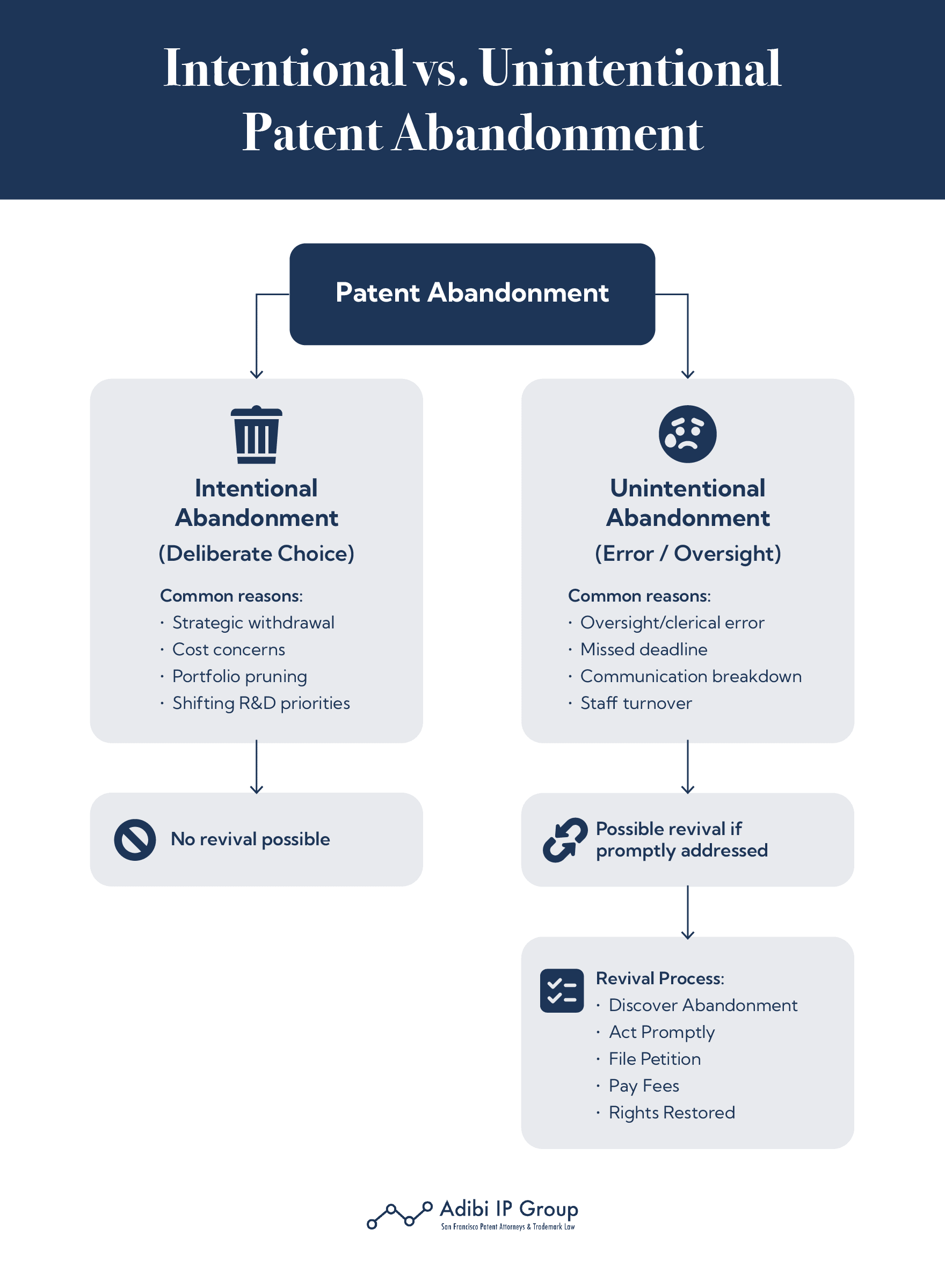
Intentional abandonment happens when there is a conscious choice to stop pursuing a patent application. This can involve a written withdrawal to the USPTO or a planned decision not to answer an Office Action.
Unintentional abandonment occurs when deadlines pass due to oversight, misunderstanding, or communication breakdown. It might result from docketing errors, turnover in staff, or missed payments that no one realized were overdue.
| Type | Key Element | Common Causes | Effect on Rights |
| Intentional | Deliberate decision | Strategic withdrawal, cost concerns | Rights permanently lost |
| Unintentional | Lack of deliberate choice | Oversight, clerical error | Possible revival if promptly addressed |
The difference turns on the responsible party’s state of mind at the time of inaction. Evidence of intent reflects a deliberate choice not to proceed, while oversight indicates no such decision was made.
Unintentional Abandonment and How to Avoid Losing Patent Rights
Unintentional abandonment happens when patent rights lapse due to a missed procedural step without any plan to let them go. It is often the result of errors that could have been avoided but, when caught quickly, may still be reversible under the proper rules.
A single oversight can stall product launches, cut off licensing revenue, or undermine investor trust. What looks like a minor deadline on paper can snowball into a business crisis if not addressed quickly.
Common Causes of Unintentional Abandonment
The most frequent cause is missing a deadline. This could mean not paying a maintenance fee, failing to respond to an Office Action, or neglecting to file a required document.
Administrative oversights contribute as well. For instance, entering the wrong due date in a docketing system or sending official mail to the wrong department can cause delays.
Switching representatives can also interrupt communication. If incoming counsel lacks complete records, critical dates may be missed.
Even rare technical failures, such as filing system outages or email delivery issues, can trigger abandonment if they stop timely action.
Examples of common triggers:
| Cause | Example Scenario |
| Missed Fee Payment | Annual maintenance fee overlooked due to staff turnover |
| Miscommunication | Office Action sent to outdated contact address |
| Technical Failure | Filing portal outage on the due date |
Legal Framework for Unintentional Abandonment
Patent offices like the USPTO allow revival of unintentionally abandoned applications under defined conditions. The applicant must show the lapse was unplanned and not part of a strategic decision.
The USPTO requires a petition, a statement explaining the delay was unintentional, and the necessary fees. In complex cases, supporting proof may be needed.
Timing is critical. Filing must happen promptly after abandonment is discovered. In the U.S., a lengthy gap between discovery and petitioning can hurt credibility.
Cases where inaction was a conscious decision for cost or competitive reasons do not qualify as unintentional. These are treated as intentional and cannot be revived on this basis.
Accurate records, deadline checks, and quick responses to official notices help avoid unintentional losses.
Intentional Abandonment as a Strategic Choice
Intentional abandonment occurs when a decision is made to stop pursuing or maintaining patent rights. While this sometimes saves money, inventors must weigh the risks carefully to avoid losing patent rights unnecessarily.
Courts and the USPTO see it as a conscious waiver that cannot be reversed once it’s on record.
A deliberate choice can save money and sharpen focus. But once made, there’s no undo button. An inventor’s strongest idea can be locked out forever if it’s abandoned at the wrong time.
Strategic Reasons for Intentional Abandonment
An application may be abandoned when an invention no longer serves business objectives. For example, a shift in the market might reduce the invention’s relevance.
At times, prosecution or maintenance costs may exceed expected benefits. This is common for organizations with limited budgets spread over several filings.
Other common factors include:
| Reason | Example Scenario |
| Portfolio pruning | Dropping weaker applications to focus on stronger claims |
| Avoiding disclosure | Preventing public release of sensitive details in published applications |
| Shifting R&D | Redirecting resources toward more promising technologies |
Making this choice on a planned timeline preserves control and lets resources be redirected to higher-priority efforts. It also avoids unintended lapses that might disrupt a wider IP strategy.
Legal Implications of Intentional Abandonment
Deliberate abandonment often occurs by ignoring an Office Action, skipping a fee payment, or filing a formal express abandonment with the USPTO. Once processed, this ends the application or patent’s pending rights.
In the U.S., dropping a patent application may affect claim scope in related cases. The support for certain claims could be lost if the disclosure is no longer accessible.
Public disclosure adds another layer of consequence. If the invention was published before abandonment, re-filing later may be blocked by statutory limits.
Because intentional abandonment is treated as final, revival options are rare. Documentation of the decision process helps confirm it aligns with long-term objectives.
Before choosing intentional abandonment:
- Review whether related applications rely on the same disclosure.
- Document the business rationale for the decision.
- Inform stakeholders (R&D teams, investors, licensing partners) so they aren’t blindsided.
- Confirm that timing won’t create statutory bars to re-filing.
Revival Pathways and Procedures
Whether revival is possible depends entirely on why the abandonment occurred. U.S. law provides options for unintentional abandonment, but intentional abandonment generally ends those options. Knowing the exact rules and evidence requirements helps preserve rights.
Revival Options for Unintentionally Abandoned Applications
When abandonment is caused by oversight, clerical mistakes, or other non-deliberate reasons, 37 C.F.R. § 1.137(b) permits revival. The delay must have been entirely unintentional.
The petition should be filed promptly with the required fee and the missing action or document. While no fixed cutoff exists, a long delay often prompts further questions.
Tip: A strong petition ties the lapse to a clear, factual mistake. Supporting documentation (emails, docketing logs, signed statements) improves credibility.
Proving Unintentional Abandonment
In revival cases, the applicant bears the burden of proving the abandonment was unintentional. The USPTO usually accepts a statement that the delay was unintentional, but it must be accurate. Longer delays can trigger requests for evidence.
Evidence may include:
- Internal emails showing no plan to abandon.
- Docketing logs documenting missed reminders.
- Signed statements from responsible team members explaining the error.
Avoid vague accounts. Detailed, factual explanations carry more weight and reduce the chance of extra scrutiny. Misrepresentation can create severe legal problems, including enforceability challenges.
Unavailable Revival Pathways For Intentional Abandonment
If abandonment was deliberate, such as ignoring an Office Action on purpose, revival is not allowed under 37 C.F.R. § 1.137.
The USPTO treats such cases as final, even if circumstances later change. This rule prevents using abandonment as a tactical tool to revive at will.
Once abandonment is final, the only possible action might be filing a new application within statutory timeframes, which may not preserve the original filing date.
The Duty of Candor in Abandonment Proceedings
Anyone seeking revival must meet the duty of candor and good faith in 37 C.F.R. § 1.56. This applies to inventors, attorneys, and agents.
All material facts about the abandonment must be disclosed, including anything suggesting it was intentional. Withholding relevant information risks denial and weakens future enforceability.
Careful recordkeeping of decisions, communications, and due dates supports credible petitions. If inconsistencies emerge between internal records and a petition, credibility can suffer.
Strategic Considerations for Inventors and Startups
Maintaining patent rights requires both procedural discipline and deliberate planning. Deadlines, disclosure rules, and filing requirements must be managed, while also making conscious choices about when an application no longer supports broader goals.
Preventative Measures Against Unintentional Abandonment
Unintentional lapses usually stem from missed deadlines, incomplete submissions, or unpaid fees. A robust docketing process that captures all USPTO communications and deadlines is the best prevention.
Staying in regular contact with patent counsel ensures prompt responses to Office Actions and keeps contact information current with the USPTO. Even small oversights can erase rights.
Teams should also be trained on public disclosure risks. Publishing invention details before filing can create prior art under the first-to-file system, making early filing a priority.
Reviewing the portfolio periodically helps confirm that pending applications still match business needs. This avoids letting valuable cases lapse because of shifting priorities or miscommunication.
Key safeguards:
- Maintain redundant deadline tracking.
- Keep all inventor and attorney details current.
- File before any public disclosure.
- Review the portfolio on a set schedule (e.g., quarterly).
Decision Framework for Intentional Abandonment
Intentional abandonment can conserve resources when an application no longer supports market or licensing objectives. Decisions should follow a structured review rather than be made casually.
First, assess the invention’s relevance to current and future markets. Next, determine whether the claims could block competitors or support related filings. Finally, review budget allocations to see if resources are better directed to stronger assets.
| Factor | High Value → Keep | Low Value → Consider Abandonment |
| Market Potential | ✔ | |
| Blocking Competitors | ✔ | |
| Licensing Opportunities | ✔ | |
| Prosecution Cost | ✔ |
Using evidence-based criteria ensures resources are used effectively while retaining control over the IP portfolio.
International Dimensions of Abandonment
Abandonment rules differ worldwide, and these variations influence whether rights are preserved in different regions. Strategic decisions should weigh both legal requirements and market importance.
Jurisdictional Variations in Abandonment Rules
Each country’s patent authority sets its own abandonment standards.
In the United States, missed deadlines or unpaid fees trigger abandonment, with limited revival options depending on whether the lapse was unintentional or unavoidable. Similarly in Europe, the EPO allows “further processing” when deadlines are missed, if action is taken promptly.
Some countries, such as Japan and China, have strict statutory periods with fewer options for reinstatement. Others, like Canada, offer reinstatement within grace periods if the lapse was unintentional.
| Jurisdiction | Grace Period | Revival Standard | Notes |
| US | Varies | Unintentional / Unavoidable | Higher bar for “unavoidable” |
| EPO | 2 months | Further Processing | Fees apply |
| China | 2 months | Limited grounds | Strict formalities |
Understanding these distinctions prevents false assumptions that a remedy in one jurisdiction will apply in another.
Global Portfolio Management Amid Abandonment Concerns
For multi-country portfolios, abandonment in one jurisdiction can affect perceptions and strategies in others.
Dropping rights in a smaller market might save money but could signal reduced commitment to investors or partners. Unplanned abandonment in a key market can undermine licensing or enforcement.
Centralized tracking and coordination with local agents ensure consistent compliance. Missing a renewal in one country can often be avoided with early alerts from a shared system.
In global disputes, competitors may use abandoned rights to challenge market position. This risk grows if patterns suggest neglect rather than intent.
Keeping a clear record of why abandonment occurred, planned or accidental, supports stronger positioning in negotiations and enforcement.
Turn Patent Abandonment Into Strategy, Not a Setback
Abandonment isn’t just about paperwork. It’s about control, resources, and reputation. Whether it happens by mistake or design, it reshapes your rights, your options, and in many cases, your business trajectory. By building strong systems to prevent unintentional abandonment and making deliberate choices about intentional abandonment, you can both avoid losing patent rights and protect patent rights for the long term.
If you’re weighing whether to keep or abandon a patent, or if you want airtight systems to prevent costly mistakes, reach out to us today. We’ll help you build processes that prevent unintentional loss, and frameworks that make intentional abandonment a strategic advantage, not a setback.